
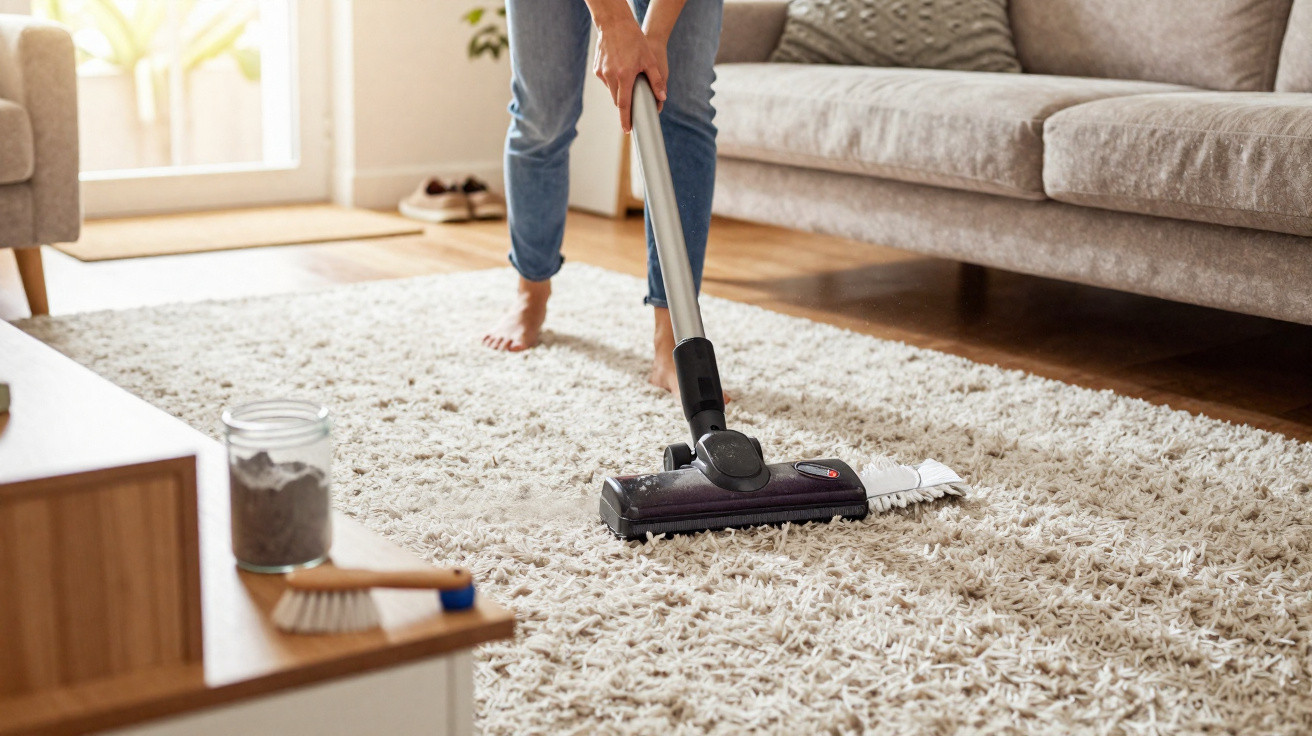
Sunlight streamed over the living-room floor, highlighting the faint, pleasing tracks left by the vacuum. It was the sort of image you might happily share in a “weekend reset” story. But a microscope view of those carpet fibres would reveal another reality: dust, pet dander, skin flakes and pollen embedded within them, quietly building up over time.
We tend to assume that a fast pass with the vacuum means the floor is “clean”. The sound of the machine, its movement and the visible stripes all create a comforting sense that the job is under control. You have done what was needed. It can be crossed off the list.
Carpets, however, are deceptive. They conceal the things we would rather not notice, and most of us vacuum in a way that only touches the surface.
The dirt that matters most is rarely the dirt you can spot.
Why most people “fake clean” their carpets without realising
I once watched a friend vacuum her flat ahead of visitors arriving. She pushed the machine over the carpet in rapid, straight passes, with the cable pulled taut and her attention already fixed on the next chore. She had “cleaned” the entire room in under five minutes.
As soon as she turned the vacuum off, the room seemed much improved. Crumbs had disappeared, the pile looked smooth and orderly, and the noise had gone. It gave every impression of a completed task. In reality, she had chiefly cleaned the upper 10–20% of the carpet fibres. Everything beneath remained undisturbed, retaining dust that had never come close to the machine’s suction.
This is how vacuuming happens in many homes on an ordinary weekday: brief passes, quick strokes and no opportunity to slow down. Since the carpet appears acceptable, we get on with something else. Yet the vacuum has had scarcely enough time to agitate the fibres, never mind extract compacted dirt from the deeper layers.
Research from flooring and allergy foundations repeatedly delivers the same uncomfortable message: before a carpet looks dirty, it can contain several times its own weight in dust and debris. Put another way, once you think, “I really need to vacuum,” the carpet may already have been collecting particles for weeks.
Survey findings from UK cleaning companies indicate that many people vacuum their main carpets no more than once weekly, and some wait until they “look bad”. That can sound sensible, until pets, children, outdoor pollution entering through open windows, cooking fumes and pollen blowing in from the balcony are factored in.
With every step, small particles are forced farther down. Feet and furniture continually press dust into the pile. A light, hurried vacuum mostly removes the loose material at the top: visible crumbs, hair and fluff. Heavier, older dust remains buried, where it can aggravate allergies, fade colours and gradually damage fibres from within.
There is a question of trust, too. Many people reason, “My vacuum is expensive, so it must be doing a good job.” But even a premium vacuum loses a remarkable amount of effectiveness when it is used too quickly, set incorrectly or fitted with a partly blocked filter. The result is a carpet that looks clean, a machine full of dirty internal workings, and only the appearance of freshness.
The right way to vacuum carpets so dust has nowhere to hide
The first change is to rethink speed. Effective carpet vacuuming takes longer than most people would like. Rather than racing around the room, approach it as you would brushing long hair: make steady, intentional passes and work in several directions.
Professionals advise moving the vacuum head at approximately a slow walking pace - around 3–5 seconds for each one-metre strip. Initially, it can feel almost unbearably slow. Those few seconds allow the beater bar or brush roll to raise the fibres, loosen trapped grit and give the suction time to remove it.
Direction is important as well. Make one set of passes north to south, then another east to west. Altering the angle helps release dust compacted along one side of each fibre. It is similar to raking a lawn: changing direction reveals what was actually there.
Machine settings also carry more weight than most people realise. Selecting “hard floor” mode for a thick carpet stops the brush from doing its intended work. Setting the head too low may form a seal, limiting airflow and reducing cleaning performance. For many vacuums, the correct height is reached when there is a gentle pull, rather than the machine attempting to attach itself to the floor.
Let’s be honest: no one really does this every day.
That is why modest, achievable changes can be so valuable. Rather than trying to vacuum perfectly every time, choose one room each week for a slower and more thorough session. Busy areas such as hallways and living rooms gain the greatest benefit, while bedrooms - where you spend hours breathing - should come next.
Two common errors quietly undermine most vacuuming routines. The first is neglecting the perimeter. Dust gathers around skirting boards, in corners and in the 10–15 cm strip beneath radiators or furniture. Leave these areas alone, and they become a lasting dust store that is gradually redistributed as people walk past.
The second mistake is viewing the vacuum as a black box. A fine grey coating of fluff on filters can substantially reduce suction. Plenty of people empty the bin but seldom wash or replace the filters. The machine becomes noisier while delivering less. It is like driving with the handbrake partly engaged: you are making the effort without receiving the benefit.
There is an element of guilt, too. People feel they “should” vacuum more frequently, then hurry through the task while only half engaged in order to quieten that persistent feeling. The rush affects the way they use the machine: faster movements, lighter passes and less attention to the spots that genuinely require deeper cleaning.
Dividing the work can help in practical terms. On one day, use the crevice tool around edges and corners. On another, make a slow, systematic pass over the main walking routes. Instead of attempting everything, everywhere, within ten minutes, you are working around real life rather than fighting it.
“Most people think their carpets are dirty when they look dirty. By that point, you’re already late. The real work is removing the dust you never see.” – UK-based carpet cleaner, 15 years’ experience
You can often sense when a vacuum is genuinely extracting more dust. The handle may feel a little heavier, the sound can change slightly, and the air may even seem subtly fresher after a thorough session. There is nothing magical about it; it is simply physics combined with persistence.
- Move slowly over high-traffic routes – the paths through the living room, in front of the sofa and beside the bed.
- Vacuum in two directions – north–south followed by east–west for deeper fibre cleaning.
- Clean or replace filters regularly – an efficient, quieter vacuum is generally a clean one.
- Use attachments on edges and stairs – dust settles into corners that the main head cannot reach.
- Aim for “better than last time”, rather than perfection – small routines build up over months.
The quiet satisfaction of a truly clean carpet
The first time you vacuum a room slowly, in two directions and with a freshly cleaned machine, there is a particular sense of satisfaction. Afterwards, you empty the bin and look at the additional dust, slightly appalled by where it has been sitting all along. That small collection makes one thing clear: your usual vacuuming method was not truly reaching it.
Once you have noticed it, it is difficult to ignore. The task starts to feel less like a chore to rush through and more like a modest but rewarding ritual. You begin to recognise which parts of the home feel “stuffy” and which seem lighter after a deep vacuum. You may cough less in the morning. Your child’s hay fever may be slightly less severe after you make the bedroom carpet a priority. These may be subtle changes, but they are genuine.
We often judge “clean” by what is visible: gleaming surfaces, arranged cushions and tidy tracks across a freshly vacuumed floor. Carpets quietly challenge that assumption. Some of the home’s most irritating or potentially harmful particles never appear in a photograph: microscopic fragments, allergens, soot and synthetic-textile fibres that fall with every movement.
Viewing vacuuming differently is not only about neatness. It concerns the air you breathe, how the floor feels beneath your feet, and the soft impact of a child landing on the carpet without sending old dust into the air. At a deeper level, it means recognising that some daily routines are designed more to look clean than to be clean.
We have all reluctantly pulled out the vacuum while wishing there were a quicker option. Still, there is something unexpectedly grounding in knowing that, from time to time, you are giving the carpet a proper reset rather than a merely cosmetic pass. The next time you create those satisfying vacuum lines on the floor, you may start to wonder what is happening underneath the surface, beyond what the eye can see.
| Key point | Detail | Benefit for the reader |
|---|---|---|
| Pass speed | Move the vacuum handle slowly, 3–5 seconds per metre | Maximises suction and loosens deeply embedded dust |
| Crossed passes | Vacuum in two perpendicular directions | Reaches dust trapped along different sides of the fibres |
| Machine maintenance | Clean filters, clear the brush and empty the bin regularly | Maintains the vacuum’s real power and prevents false “cleaning” |
FAQ:
- How often should I vacuum carpets in a busy home? For high-traffic areas, aim for two to three times a week, with at least one slower, more thorough session.
- Is a cordless vacuum enough for deep carpet cleaning? Some high-end cordless models do well, but many struggle with thick carpets; you may need an occasional deep clean with a corded machine.
- Do I really need to vacuum in two directions? Yes, if you want to reach deeper dust; it helps lift fibres and dislodge grit trapped on different sides.
- How often should I clean or replace vacuum filters? Typically every 1–3 months for washing, and 6–12 months for replacement, depending on use and manufacturer guidance.
- Can vacuuming too often damage my carpet? With the right height setting and a well-maintained brush, regular vacuuming is more likely to extend your carpet’s life than harm it.
Comments
No comments yet. Be the first to comment!
Leave a Comment