
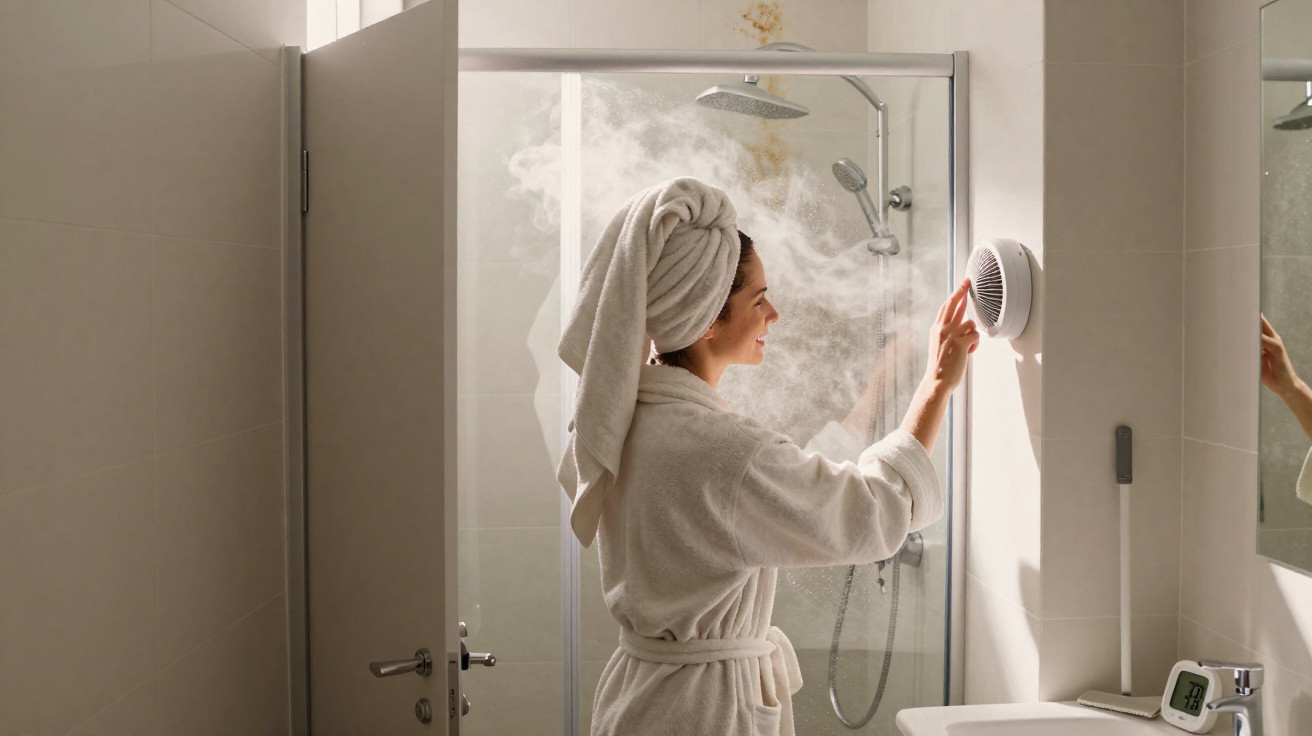
The mirror is still misted over.
Steam drifts lazily along the ceiling, winding into the corners as though searching for somewhere to rest. A moment ago, beneath the shower head, you were enjoying perhaps the only peaceful part of your day. Now you are half dressed, running late, and opening the bathroom door a little for “some air” before hurrying away.
It feels as though you have handled it properly. The window is slightly open, the door is ajar, and perhaps the extractor fan runs while you make a coffee. The room seems less damp, so that must mean the job is finished… surely?
A few hours later, however, the paint above the tiles is still faintly moist. The silicone around the bath looks a little darker than it did last month. It is easy to miss and hardly seems serious. But this is precisely how mould starts.
And, yes, most of us encourage it without knowing.
Why your bathroom is an ideal place for mould
The first error is often about timing. Many of us regard bathroom ventilation as a brief task: five minutes while brushing our teeth, then finished. The steam rises, the air feels fresher, and we move on. Yet the walls and ceiling are still holding moisture that is completely invisible.
Mould does not require standing water. It only needs a surface that stays damp and somewhere out of sight. Think of corners, the space behind the mirror, or beneath that attractive shelf you have just fitted. When ventilation ends too soon, the room gradually releases its humidity back into the air. It remains there, nourishing microscopic spores already found in dust and ageing grout.
By the point small black marks become visible, the real process has usually been under way for weeks.
Picture a compact, windowless bathroom in a busy flat. There are two consecutive morning showers, followed by a quick wash in the evening. The extractor fan hums reliably while the room is occupied, but is turned off as soon as the light goes out. The door remains shut because children are running about and washing is mounting up in the hallway.
Every day, steam fills the space, settles on the coldest surfaces, and then dries slowly in darkness. After a month, a slight musty odour develops near the ceiling. After three months, the silicone around the shower tray becomes speckled. Out come the bleach spray, the scrubbing brush and a little guilt.
It can seem like poor luck. Actually, it is a ventilation routine that practically asks mould to move in and remain.
Humidity follows straightforward physics. Warm air from a shower can contain plenty of water vapour. When it meets cooler tiles, mirrors and painted surfaces, that vapour turns into a fine layer of condensation. Some of it is visible as mist or droplets, but much of it is a microscopic damp film that the walls absorb quietly.
After the shower ends, the air cools and loses its capacity to hold as much moisture. The bathroom therefore continues to release dampness for at least 20–30 minutes afterwards. Stop ventilating at this stage and that moisture becomes trapped in the materials. This is when mould gains the advantage: not while the bathroom appears steamy, but when it appears “almost dry”.
That is why a bathroom can seem perfectly fine while still providing the ideal slow-building conditions for mould growth.
How to ventilate after a shower to prevent mould
The most useful step begins after you have left the shower. Switch on the fan at the end of your shower, rather than only while using it, and leave it running for at least 20–30 minutes once you are finished. This is when the walls and ceiling are giving their hidden moisture back to the air.
If your bathroom has a window, open it fully for a short period instead of leaving it barely open. Five to ten minutes of proper air exchange is more effective than half an hour with the window only partly open. Keep the bathroom door closed during this time too, rather than allowing humidity to spread directly into the hall or bedroom.
Approach it as you would airing a sweaty gym: quick, concentrated and then complete.
Most people do exactly the reverse. They leave the door wide open “to let the steam out” and avoid using the fan because its noise is irritating. Or, during winter, they open the window only a fraction to avoid a blast of cold air, then shut it too soon because the room becomes chilly. That is understandable: nobody wants to feel frozen after a hot shower.
On a busy morning, wiping the mirror with a towel and considering the task done can feel simpler. It seems harmless, but it merely transfers moisture to the fabric, which often ends up in the washing pile or on a radiator. The humidity remains indoors; it has simply been redistributed. Let’s be honest: nobody really does this every day with an engineer’s discipline.
This is why mould often develops in homes where people are convinced that they “ventilate well”. The routine exists, but the method does not.
One ventilation expert put it simply:
“Mold isn’t caused by one wet shower. It’s caused by the same moisture not leaving the room properly, day after day, for months.”
To interrupt that pattern, a handful of small habits can have an outsized effect.
- Let the fan run for 20–30 minutes after showering, rather than only while showering.
- Keep the bathroom door mostly shut as the room dries.
- Open the window fully for brief, purposeful periods of fresh air.
- Pull shower curtains back and use a squeegee on tiles to remove surface water.
- Check corners, ceiling edges and silicone lines for early signs of mould.
Realistically, that list may feel like quite a lot. Even so, choosing just two or three of these actions and doing them consistently can make a genuine, physical difference to the lifespan of your bathroom walls.
Rethinking what a truly dry bathroom means
We usually assess a bathroom by its appearance five minutes after leaving it. Once the mirror has cleared and the room no longer resembles a sauna, we mentally label it “dry”. In truth, a dry bathroom is one in which moisture cannot remain in the same places day after day. That takes longer.
Small routines can help. Leave the shower curtain fully drawn back so it dries, rather than scrunched up while wet. Spend ten seconds using a squeegee on the tiles before stepping out. Allow the fan to continue running while you get dressed elsewhere instead of standing beside it and shivering. On a cold morning, this may feel mildly inconvenient. Across a winter, it could mean the difference between spotless grout and a blackened corner eventually concealed behind a plant.
At a broader level, it comes down to how we treat our homes. We understand that dishwashers need a full programme, washing machines require a complete spin cycle, and phones need time charging. Bathrooms are no different. They need a drying cycle, rather than a brief rush of fresh air and an optimistic look at the mirror.
| Key point | Detail | Benefit for the reader |
|---|---|---|
| Ventilate afterwards, not only during | Leave the fan running for 20–30 minutes after showering | Reduces hidden moisture in walls and limits the appearance of mould |
| Fast, targeted fresh air | Open the window fully for a few minutes, with the door shut | Dries the bathroom without cooling the whole home or moving humidity elsewhere |
| Everyday small actions | Use a squeegee, leave the curtain open, and monitor corners and seals | Prevents expensive damage and keeps the bathroom healthier over the years |
FAQ:
- How long should I really run my bathroom fan after a shower? Ideally 20–30 minutes. That’s the window when your walls and ceiling are still releasing trapped moisture, long after the visible steam has gone.
- Is opening the door enough to ventilate the bathroom? Not on its own. An open door mostly spreads humidity into the rest of the home. You need extraction (fan) or real air exchange (window wide open) to get the moisture outside.
- Can a dehumidifier replace a bathroom fan? It can help, especially in windowless bathrooms, but it doesn’t replace proper extraction. Think of it as a useful extra tool, not the main solution.
- Why does mold keep coming back even after I clean it? Because the conditions that let it grow haven’t changed. Cleaning removes what you see; changing how you ventilate and dry the room removes what it feeds on.
- Is it bad to shower with the window open in winter? Not at all, as long as you’re comfortable. Colder air actually holds less moisture, so it helps dry the room faster. Just step away from the draft once you’re out of the shower.


Comments
No comments yet. Be the first to comment!
Leave a Comment