
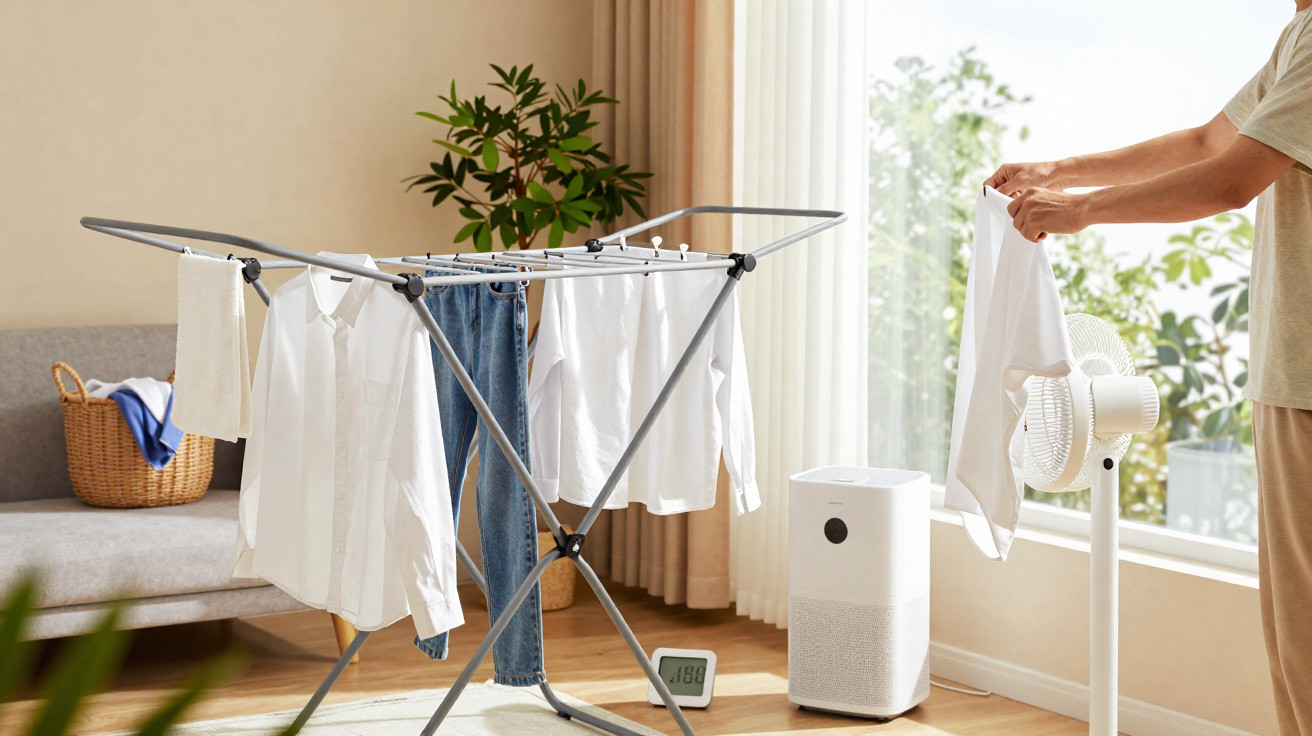
The radiator is only just warm, condensation is gathering on the windows, and your clothes airer resembles a jungle of fabric that simply will not dry.
You poke at a T-shirt that has been hanging there for two days, only to find the seams are still clammy. Outdoors, the sky looks like washing-up water and the forecast predicts rain all week. There is no tumble dryer, no spare room and no money to turn the heating up.
So begins a game of laundry Tetris: socks get moved closer to the window, jeans are draped over chair backs and shirts end up hanging from door frames. The flat carries a slight scent of wet cotton and detergent, while you wonder how your grandparents coped without smart dehumidifiers or worries about energy prices.
The answer is not necessarily more heat. To solve this problem, you need to shift a few invisible things that rarely get much thought.
Why clothes take forever to dry indoors
Look at a full clothes airer and the lack of movement is almost tangible. The clothes are wet, the room is chilly and the air seems laden. That weight in the air is moisture with no route out. Every sock and pillowcase gradually releases water into the room until the air reaches capacity and can no longer help with drying.
Fast indoor drying depends on more than temperature: airflow, humidity and surface area all matter. Get any of these wrong and you are left with that disheartening feeling of clothes being “still damp after two days”. Turning down the thermostat will not ruin your laundry; stale air will.
Picture a compact city flat in January. The heating is set to a reasonable 18°C and the windows stay largely closed to limit bills. Only one person lives there, yet the washing pile could belong to a family of four. The airer occupies the sole available corner, with shirts overlapping and towels folded over themselves. It may look practical, but it is really a bottleneck for drying.
Research by the Mackintosh Environmental Architecture Research Unit in Glasgow found that drying clothes indoors can release up to 2 litres of moisture into the air each day in a typical home. It is rather like pouring a large bottle of water into the room, then being surprised when nothing dries and mould thrives in the corners. The less effectively that moisture is removed, the longer the washing lingers on the rack.
Air has a limit to the amount of water it can contain. Once humidity is high, evaporation slows dramatically. That is when fabrics feel cold and develop a musty odour. Your T-shirt is not merely damp: it is caught in a miniature weather system created around the airer.
Overlapping piles of laundry reduce the exposed surface from which moisture can evaporate. Jeans and towels are particularly troublesome, as they hold pools of water deep within their fibres. Energy firms may focus on the thermostat and advise increasing the heating, yet the underlying physics is straightforward: a cool, dry draught will always outperform a hot, humid room.
Smart moves that dry clothes faster without extra heat
Begin by making space. Give every garment its own small pocket of air on the clothes airer, ensuring that nothing is bunched up or folded over. If you think it is good enough, separate it one more time. A towel laid flat can dry hours sooner than one doubled over a rail.
Part-way through drying, reposition heavier garments. Turn jeans so the waistband faces the most open area of the room, and rotate T-shirts so the underarms also catch the moving air. It may seem overly particular, but these small adjustments can reduce drying time far more effectively than simply raising the radiator setting.
Use household items to create airflow. A small desk fan on a low setting, aimed across the room rather than at your face, can make a substantial difference. The aim is not to forcefully blow-dry the clothes, but to prevent moisture-laden air from sitting around them.
If your bathroom has an extractor fan, use it as an inexpensive drying room. Put the airer there, leave the door slightly open and switch on the extractor. It is not especially stylish, but it steadily removes moisture rather than allowing it to spread throughout the home.
When the day is dry, open the top section of a window near the drying area for as little as 20 minutes. The room may become a little cooler, but humid indoor air can escape and drier outdoor air can replace it. That fresh air keeps evaporation going, even when temperatures are modest.
Many people transfer washing directly from the machine to the airer, already expecting a two-day wait. A simple change can have a major effect: remove as much water as possible before hanging anything up. If your washing machine permits it, run an additional spin cycle at a higher RPM. The electricity used for extra spinning is minimal compared with heating a room for hours or operating a tumble dryer.
For thicker pieces, use a towel to remove water before hanging them. Spread a bath towel flat, place a damp jumper on top, roll both up like a Swiss roll, then press down or stand gently on the roll. The towel absorbs the excess, leaving the jumper half-dry before the process even starts. This works especially well for knitwear that you would rather not put through a hotter cycle.
Placement is important too. Position the dampest and heaviest pieces around the outside of the airer, where they receive greater air movement, and keep smaller items such as socks and underwear in the centre. Put the airer where air naturally circulates or where people regularly pass by: close to a door, opposite a window or beside a fan.
Let’s be honest: nobody truly does all this every day. Everyone has evenings when the priority is simply to throw everything on the rack because they are tired. That is perfectly fine. Consider these methods as tools for the difficult days, when the washing pile is enormous, the weather is miserable or another morning of damp school uniform feels unbearable.
The biggest obstacle is usually overcrowding. Packing a full machine load onto one airer may appear efficient, but it can double drying time and turn the room into a greenhouse. Two lighter, well-spaced loads will generally dry more quickly than one dense, tangled mass.
“After I finally bought a £20 dehumidifier and aimed a cheap fan at the clothes, my living room stopped smelling like a wet dog,” says Emma, a renter in Manchester. “I don’t touch the thermostat any more. Things are just dry by morning instead of Wednesday.”
Small habits make a cumulative difference. Put shirts on hangers and suspend them from a curtain pole or doorway. Give each item a firm shake before hanging it to loosen the fibres. Try not to dry everything in the bedroom: damp air and sleep are a poor combination, and pillows will gradually take on that moisture.
- Leave space between garments: do not overlap clothes or double-fold towels.
- Create movement: use a fan on low, a slightly open window or a bathroom extractor.
- Assist heavy fabrics: add an extra spin, use the towel-roll method and rotate items halfway through.
- Monitor the room: steamed-up windows mean more ventilation is needed.
- Plan the timing: begin drying in the morning rather than late at night.
Rethinking your whole laundry routine
Drying washing indoors is not simply a household task; it is an ongoing compromise between your home, your budget and your peace of mind. Once you understand how humidity behaves, each room starts to look different. Cold corners become potential mould traps, radiators seem like valuable territory and open doorways become free ventilation routes.
On a wet Tuesday, putting a wash on the airer can feel like yet another thing going wrong. Clothes are everywhere, the heating is low and the children need football kits dry by 7 a.m. In a better week, you have prepared: you used an extra spin, selected the driest room and opened a window at lunchtime. The home and weather are unchanged, but the result is entirely different.
There is a quiet pleasure in beating difficult drying days without spending more money. You may begin washing a little earlier, separating loads by fabric weight so lighter pieces are not delayed by heavy towels. In time, you might buy a compact dehumidifier, not through panic but because you understand precisely how it helps with that persistent load of washing.
The key change is psychological rather than technical. Rather than battling the thermostat, you begin to work with airflow, timing and fabric. That is where fast-drying laundry happens.
| Key point | Detail | Benefit for the reader |
|---|---|---|
| Airflow beats raw heat | Fans, open doors and brief window opening move humid air away from clothes. | Reduces drying time while saving on heating costs. |
| Prepare clothes before hanging | An extra spin, towel-rolling and shaking garments lower their starting moisture. | Shorter time on the airer, with fewer musty smells and damp seams. |
| Space and placement matter | Avoid overlaps, place heavy items at the edges and use the driest, best-ventilated room. | Makes better use of the rooms you already have without buying new gadgets. |
FAQ:
- How can I dry clothes indoors fast without a tumble dryer? Run an extra spin cycle, spread garments across an airer, use a nearby small fan on low and open a window slightly or switch on an extractor fan to remove humid air. Combining less water, stronger airflow and lower humidity makes everything dry faster.
- Is it bad to dry clothes in the bedroom? It is not the best option. Moisture from drying laundry can increase humidity in the place where you sleep, which can encourage mould and dust mites. If there is no alternative, ventilate the room, keep the airer away from walls and dry clothes during the day rather than overnight.
- Do dehumidifiers really help with indoor drying? Yes. When placed in the same room as the airer, a dehumidifier extracts moisture from the air, allowing more water to evaporate from clothing. Many people find that it cuts laundry drying time by a third or more, even with relatively low heating settings.
- Is drying clothes on radiators a good idea? It dries them quickly, but there are compromises: humidity rises sharply in the immediate area, cold walls may develop condensation and the radiator heats the room less effectively. A better middle ground is a heated airer, or positioning a standard airer near rather than on a radiator, with good airflow.
- Why do my clothes smell musty after drying indoors? The odour generally indicates slow drying in a humid room with poor ventilation. Wash full but not overloaded loads, spin them thoroughly, separate each garment, circulate air with a fan and let moisture leave through a window or extractor so fabrics dry within a sensible timeframe.


Comments
No comments yet. Be the first to comment!
Leave a Comment