
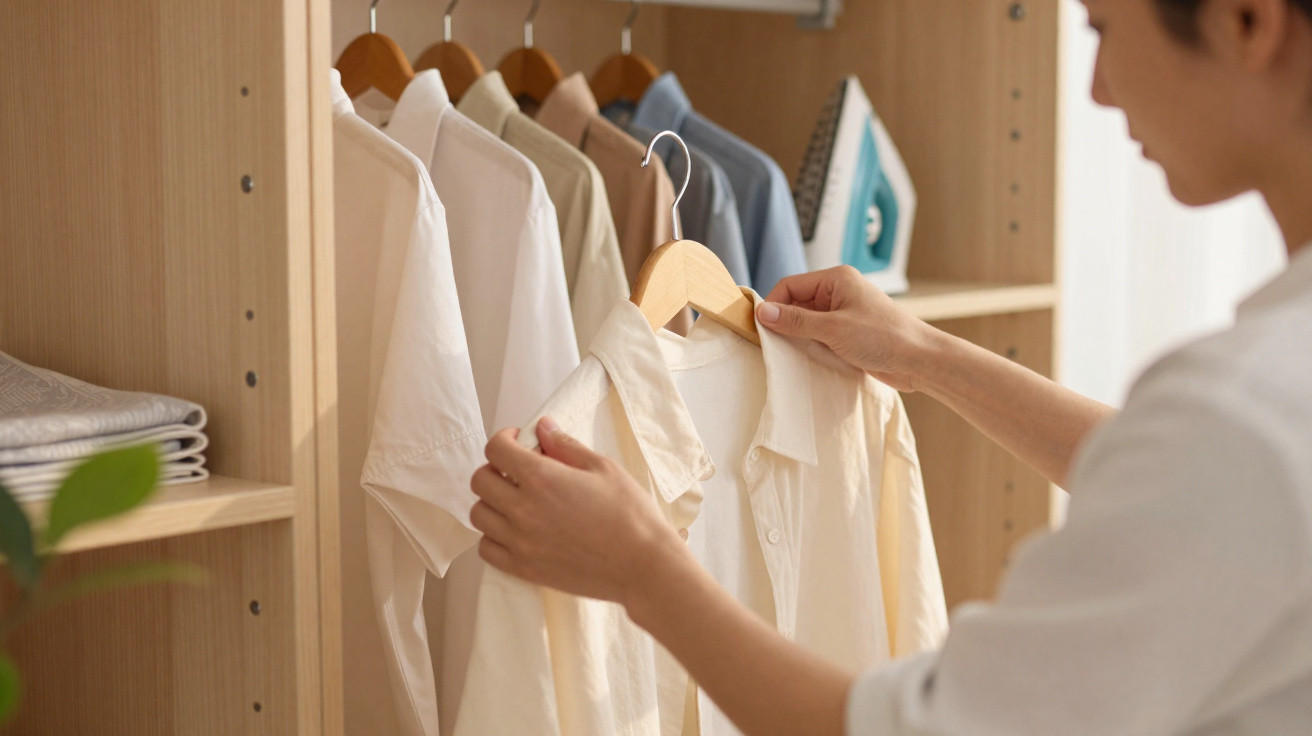
The shirt is ideal. Or at least it was when you put it away with the best intentions and time to spare. Now you are standing in the hall, half dressed and running late, looking at a collar that seems to have spent the night inside a gym bag. The iron is buried somewhere in the cupboard, the ironing board is in that alternate dimension known as “behind the vacuum cleaner”, and your taxi app is vibrating like a guilty conscience.
You look around the bathroom and notice something else: the hair straightener you used ten minutes earlier. Heated plates. A precise grip. Already plugged in.
Your mind makes that small, satisfying click when an unexpected shortcut presents itself.
When your collar ruins an otherwise perfect outfit
Few things are more irritating than one creased detail spoiling everything. Your shirt is clean, your jeans look good, your hair is behaving for once, then the collar chooses to resemble a sheet of scrunched-up paper. You do not have ten minutes to spare; you have one.
At this point, people either surrender and claim that “casual crumpled” is a look, or grab the closest drastic solution. This is precisely where the hair straightener steps in, waiting discreetly on the bathroom shelf like a hidden weapon.
Imagine a Monday morning at 8:37 a.m., with first-day-in-a-new-job nerves already building. A young woman I spoke to had changed her shirt twice, only to discover that both collars had been creased in the wardrobe. She lives in a very small flat, with no room at all for an ironing board. Her iron is somewhere from the last house move, still wrapped in bubble wrap.
In a panic, she notices her straightener open beside the sink. Acting on instinct, she closes it over the tip of the collar, draws it through slowly and sees the crease vanish in a single smooth pass. After two passes, both sides are sharp. She still gets there late. Her collar, however, is flawless.
On reflection, it is perfectly logical. A hair straightener is essentially a compact clamp-style iron: two heated plates, an adjustable temperature and pressure placed exactly where it is needed. Rather than moving a heavy soleplate across half a shirt, you can work like a detail painter, concentrating on edges, plackets and hems.
That accuracy is invaluable on small areas. Usually, nobody notices if your entire shirt has not been pressed to perfection. They notice the collar, the first few buttons and the visible hem. This is where the trick works best: it is targeted, quick and remarkably effective.
How to “iron” a collar or hem with a straightener without wrecking your clothes
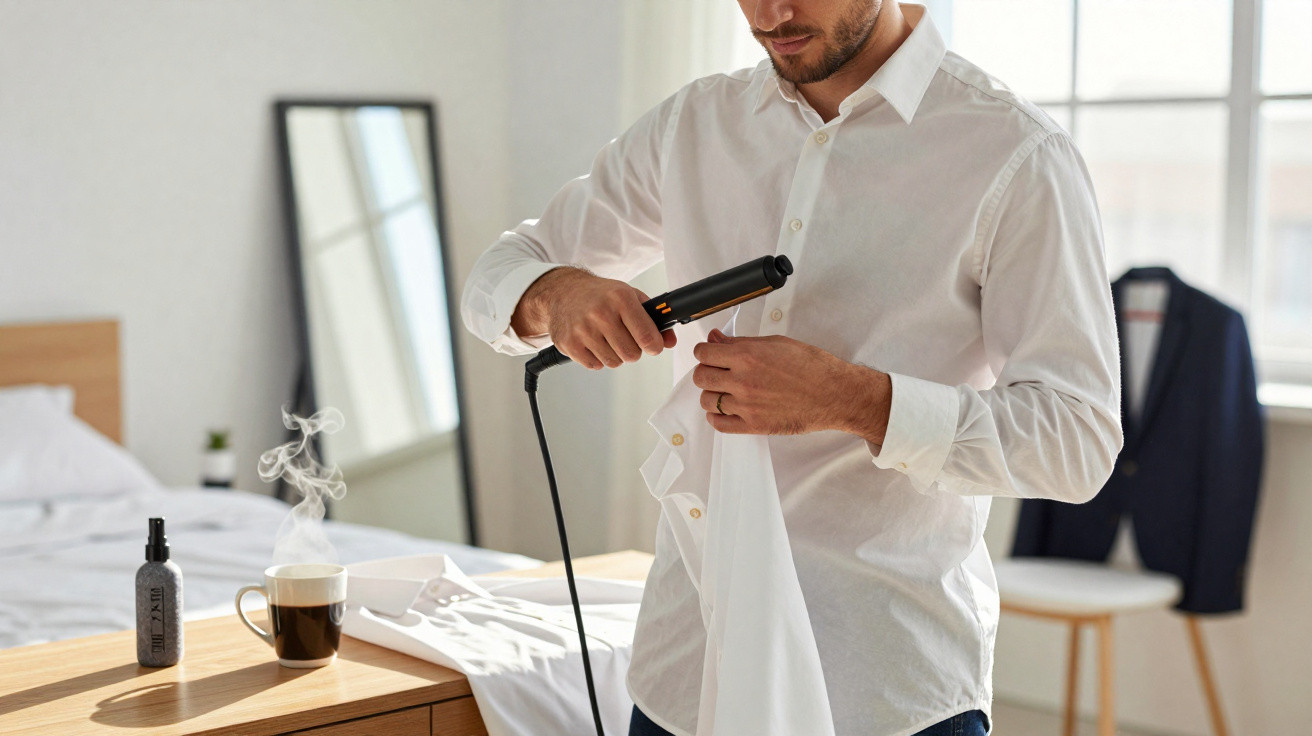
The motion itself is straightforward. Switch on your straightener and choose a medium setting, rather than the maximum heat you might use for resistant curls. Leave it to warm up while you flatten the shirt on a level surface: a bed, table or even the back of a chair if that is your only option.
Begin with the collar. Lay it open and flat, hold the straightener as you would a pair of tongs, then clamp the tip of one side between the plates. Apply a gentle close and move it slowly and steadily towards the centre. One or two passes will generally do the job. Do the same on the other side. The approach is identical for a hem or button placket: tackle it in short sections, keep moving and never leave the straightener resting on the material.
Small errors can easily undermine the whole method. The most common is excessive heat: synthetic fabrics and high temperatures are a bad combination. Lower settings are safest, particularly for polyester, viscose and blended materials. If you are unsure, try it on an inside seam first.
Another frequent mistake is working too quickly and squeezing the plates together too firmly. A straightener is not a nutcracker. Gentle pressure is sufficient; otherwise, darker fabrics can develop shiny patches or seams may be flattened in an odd way. And, realistically, this is not something anyone does every day. It is an emergency solution, not a replacement for your usual laundry routine.
There is a psychological element to this shortcut too. Using a hair tool on clothing can feel as though you are stepping over an invisible boundary between “organized adult” and “creative survivor”. But once people have tried it, they rarely reach for the ironing board again for minor touch-ups.
“I stopped dragging out the ironing board for one shirt,” laughs Camille, 29. “If I only need the collar and the front to look sharp on video calls, the straightener does the job in two minutes. Nobody knows what’s going on below the webcam frame.”
- Make sure the straightener plates are clean, with no styling-product residue that could stain fabric.
- Use medium heat or lower on delicate and synthetic materials.
- Only work on dry garments, never damp ones, to prevent stretching or distortion.
- Concentrate on the visible sections: collar, cuffs, first buttons and hemline.
- Keep the plates in motion to avoid scorch marks or unwanted shine.
Turning a “hair” tool into a quiet ally for last-minute polish
Once you know this tip, the straightener in your bathroom takes on a different role. It is no longer solely a beauty tool; it quietly becomes part of a modern-life survival kit for Zoom interviews, hurried dinners, surprise invitations and mornings when nothing seems quite right.
You will not always have the time, room or, frankly, energy to set up an ironing board and act as though you live in a perfectly organised catalogue home. Sometimes, you are simply thankful for anything that gives you five extra minutes in bed while still allowing you to look as though you made an effort. This small hack sits neatly in that space between compromise and care, between “good enough” and “I still want to feel put-together”.
| Key point | Detail | Value for the reader |
|---|---|---|
| Use a straightener as a mini iron | Medium heat, light pressure and slow movement across collars and hems | A quick fix when you are rushed and do not want to set up the full ironing kit |
| Protect your fabrics | Test an inside seam, avoid high heat on synthetics and clean the plates beforehand | Lowers the chance of shine, burns or styling-product stains on favourite shirts |
| Target only visible areas | Collar, cuffs, first buttons and lower hemline | The greatest visual difference for the least time and effort |
FAQ:
- Can I use a hair straightener on any type of shirt fabric? This method works best with cotton and cotton blends. For silk, viscose or synthetic fabrics, reduce the temperature and test the inside of the hem before working on visible areas.
- Do I need a special straightener for clothes? No. An ordinary ceramic straightener is suitable. Clean the plates first, so that styling products do not transfer to the fabric.
- Will this replace a real iron completely? No, it is better viewed as an emergency hack. A proper iron still gives more durable, polished results for fully pressed shirts or linen garments.
- Can I use steam with the straightener? Do not spray water directly onto the plates. For extra smoothness, mist the fabric very lightly, wait a few seconds and then move the straightener over it quickly.
- Is there a risk of burning the shirt? Yes, if the heat is too high or the plates remain in the same place. Keep them moving, select medium heat and do not pause on the fabric.
Comments
No comments yet. Be the first to comment!
Leave a Comment