
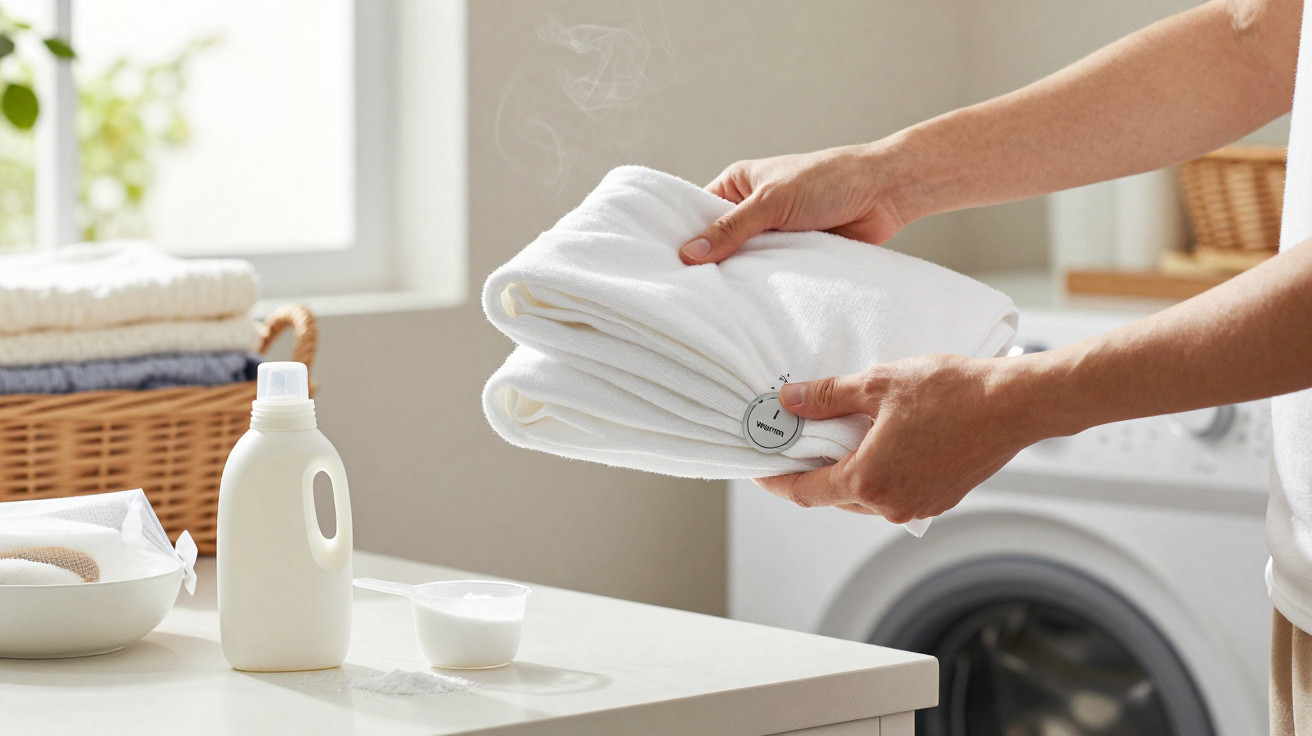
Fresh, warm and “properly clean” – at least, that was what she believed. A fortnight later, she was itching at small red bumps on her arms and searching “why do my sheets smell a bit off?” at 1am as her partner slept soundly beside her.
In the blue glow of her phone screen, one sentence caught her eye: “You might be washing your sheets at the wrong temperature.” She paused. The wrong temperature? Surely hot was always better than cold? Her gran always advocated boiling washes. TikTok promotes cool cycles as the planet-friendly choice. Meanwhile, the care label on her cotton duvet cover offered only cryptic symbols that might as well have been hieroglyphics.
Caught between routine, vague advice remembered from years ago and modern eco-guilt, most of us are making the wrong call. Our beds, quietly, reveal the consequences.
The big sheet-washing myth most people never question
Ask ten people how they wash their bed sheets and you are likely to hear ten different methods, each defended with complete certainty. One person relies on a 90°C “blitz” wash. Another will only use 30°C to “protect colours and the planet”. Someone else presses the default setting and hopes for the best.
There is a widespread assumption that hotter must mean cleaner, safer and more hygienic. At the other end of the scale is the belief that low-temperature eco cycles are the responsible adult option. Both sides can feel a little smug. In reality, our laundry routines often reflect what our parents did, rather than what works best with today’s fabrics, detergents and the microscopic inhabitants of our bedding.
The uncomfortable reality is that the usual error is not simply washing too cold or too hot. It is failing to match the temperature to what is actually lurking in your bed.
Consider everyday life. In one UK survey, nearly 40% of respondents admitted they do not change their sheets weekly. Plenty of people quietly leave them for two, three or even four weeks when life becomes busy. We all know that friend who proudly says, “I just air them out and they’re fine.”
Then there is everything else: perspiration after warm nights, dead skin, body oils, make-up, fake tan, pet fur, pollen and the occasional tea or wine spill. Scientists routinely detect dust mites, bacteria and traces of faecal matter even in the bed of someone considered clean. Yes, really.
A viral TikTok trend showed people soaking their sheets in the bath and watching the water turn brown. It was undeniably shock-value content, but it also offered a glimpse of what a 30°C “quick wash” can leave behind. The sheets looked clean when they came out of the machine. The bathwater suggested otherwise.
Now imagine all that being moved around at 30°C with only a small dose of cheap detergent. The outer surface may smell of lavender, but deeper in the fibres, the picture can be very different. That seemingly minor temperature decision affects your sleep, your skin and even the lifespan of your bedding.
There is a more practical explanation for this: temperature is chemistry, not merely a comfort setting. Cooler washes can remove light sweat and daily dust, particularly when paired with modern detergents. Yet many bacteria and dust mites are more persistent. To prevent them breeding happily in your pillowcases, they require higher heat, suitable detergent boosters, or both.
However, regularly subjecting delicate fibres to very high temperatures makes them coarser, fades their colour and damages elastic. The crisp, hotel-style feel disappears sooner, leaving you to replace sheets more often. So scorching everything is not the miracle solution either.
The real problem lies in the lazy middle: lukewarm washes that are neither hot enough for a hygienic deep clean nor cool and gentle enough to care properly for fragile fabrics. This is where odours remain, skin problems worsen, and sheets wear out without ever feeling genuinely fresh.
The question, then, is not simply “hot or cold?”. It is: what does your particular bed need today?
The temperature that actually makes sense for your bed sheets
For standard cotton bed sheets, the most dependable range is generally 40–60°C, depending on your circumstances. This is the point where hygiene and fabric care can work together. For most healthy adults without significant allergies, a 40°C wash using a good-quality detergent is usually sufficient when sheets are changed weekly.
If you have been unwell, perspire heavily, sleep naked, allow pets on the bed or leave changing your sheets longer than a week, increasing the temperature to 60°C becomes far more sensible. At this setting, bacteria and dust mites have much less opportunity to remain. It is not about punishing heat; it is about cleaning with purpose.
Treat 60°C as a “reset button” wash. It is not required for every wash, but it is useful when bedding genuinely needs a deeper refresh. A common mistake is treating every load identically, regardless of the season, the condition of the sheets or who has been sleeping in them.
On a dull Wednesday in Manchester, a mother of two looks through her washing machine programmes while her toddler pulls at her leg. “I just press the one that takes the least time,” she admits with a shrug. “The 30°C quick wash. I just need them dry before bedtime.”
She is far from the only one. Laundry is seldom a cherished ritual; it is an everyday task fitted around work emails and school runs. Every additional minute or degree can feel indulgent. That is why people pick the “eco” programme, select 30°C and trust modern detergent to compensate.
The issue is that most fast, low-temperature programmes are intended for lightly soiled clothes, not bedding carrying weeks of sweat and skin cells. This explains why sheets can smell pleasant while warm, only to develop a slight musty smell once they cool. That odour is not mysterious: it is residue and microbes that were never fully removed.
Dermatologists regularly encounter the results. Patients arrive with unexplained body acne across their back and shoulders, eczema flare-ups or irritated scalps. One of the understated questions often asked is: “How often are you changing and washing your bed linen, and at what temperature?” It may sound mundane, but the replies can be revealing.
From a microbiologist’s perspective, a bed is a warm, slightly moist and nutrient-rich environment. Bacteria thrive there. Dust mites feed on shed skin. Lower-temperature washes can lift surface dirt, but they may leave behind certain microbes and allergens, particularly when the drum is overloaded or too little detergent is used.
The boil-wash enthusiasts are not entirely right either. Repeated 90°C cycles on contemporary cotton blends, elastane trims and decorative finishes can distort fibres, destroy elastic and cause pillows and duvets to become lumpy. You may gain a short-lived feeling of sterility, but the bedding quickly ages, pills earlier and becomes rougher.
The real skill is to assess three straightforward factors: the fabric, how soiled the sheets really are and who has slept in them. Set the temperature from there instead of relying on autopilot. It seems minor, but over a year’s worth of sleep, it affects your comfort, health and household budget.
How to correct your sheet temperature mistake in real life
Begin with one straightforward principle: let the heat reflect the story of that week. If you have had a typical few nights without much sweating, 40°C with decent detergent and a drum that is full but not packed tight is normally enough for ordinary cotton sheets.
After a heatwave, night sweats, illness, or postponing a sheet change for “just one more week”, move up to 60°C. This matters particularly for pillowcases, which gather facial oils, make-up residue and hair products. Think of pillowcases as the frontline between your skin and the fabric around it.
For more delicate materials, including linen, bamboo blends and anything marked “silk”, stay nearer 30–40°C. Choose a longer cycle and mild detergent instead of relying on aggressive heat. The important thing is making a conscious choice, rather than allowing the default programme to choose for you.
Let us be honest: nobody really does this perfectly every day. Most of us have weeks when the laundry pile takes over. That is exactly when people rush to put everything into one large mixed load at one temperature simply to finish the job.
Try a small change in mindset. When time is limited, wash the items that spend most time against bare skin at the appropriate temperature instead of cleaning everything together on a middling setting. Sheets and pillowcases are more important than that extra hoodie.
A few less obvious errors can also make the selected temperature less effective: cramming the drum so water cannot circulate, using too little detergent “to save money” and repeatedly selecting short cycles designed to refresh rather than deep-clean. The result may look clean and smell acceptable, but it never feels properly reset.
“Your washing machine isn’t a magic box,” says one London-based textile care expert. “It’s a tool. If you always use the same setting, you’re not cleaning – you’re just agitating.”
- For weekly cotton sheets: 40°C cycle, full but not overstuffed drum, good-quality detergent.
- For sweaty weeks, illness or allergies: 60°C wash for sheets and pillowcases to cut down bacteria and dust mites.
- For delicate fabrics (linen, bamboo, silk blends): 30–40°C, gentle detergent, longer cycle, line-dry if possible.
- Change pillowcases more frequently than sheets if you have acne or sensitive skin.
- Allow the machine to complete its full spin cycle so sheets dry more quickly and do not remain damp, where odours can develop.
That is the subtle power move: using your washing machine as something you actively “drive”, rather than as a white box that makes things wet and noisy for an hour.
Why this small temperature change stays with you
Most domestic errors do not arrive as one dramatic disaster. They build gradually: a bedroom that smells slightly stale, waking with an itchy throat, or the low-level irritation of sheets that look clean but feel slightly… worn out. Then there is that small pang of guilt when changing the bed and realising you cannot remember when you last did it.
Changing your sheet-washing routine is not about joining some perfect-home cult. It is about being more realistic about how you live and choosing a setting that suits that reality. Use more heat when life is sweaty and chaotic. Go cooler and gentler when fabrics need care. Most of the time, aim somewhere in between.
On an ordinary Sunday, when your duvet cover comes out of the machine smelling genuinely clean even after it has cooled, feeling soft rather than thin, and your skin stops protesting overnight, you will know you have found your own sweet spot. It is not a Pinterest-perfect makeover. It is simply life working a little more smoothly in the background.
We spend a third of our lives in bed, surrounded by the choices we made at the washing machine the previous week. Once that becomes clear, the temperature dial is no longer an afterthought; it becomes a quiet form of control. It does not announce itself, but you notice it whenever you slip between the sheets and your body relaxes without quite knowing why.
| Key point | Detail | Benefit for the reader |
|---|---|---|
| Adjust the temperature | 40°C for “normal” weeks, 60°C for sweat, illness and allergies | Reduces microbes and odours without damaging sheets |
| Consider the fabric type | Cotton is more tolerant; delicate materials need 30–40°C | Extends the life of bedding while maintaining comfort |
| Avoid treating every load the same | Do not always use one programme for everything | Delivers a real feeling of cleanliness and wellbeing in bed |
FAQ:
- How often should I really wash my bed sheets? Ideally once a week for most people, especially if you sweat at night or sleep naked. Every two weeks is the upper limit where you’ll start to notice more odour, dust mites and skin irritation for many households.
- Is washing sheets at 30°C ever enough? Yes, for lightly used bedding, delicate fabrics or if you’re topping up between deeper washes. Use a longer cycle and good detergent, and don’t overload the drum so water and soap can do their job properly.
- Do I need to boil wash my sheets to kill germs? No. For normal domestic use, 60°C is usually enough to significantly cut bacteria and dust mites, especially when paired with an effective detergent. Regular 90°C washes can damage fibres and aren’t necessary most of the time.
- What temperature is best if someone has been ill? Go for 60°C on cotton sheets and pillowcases, wash them separately from other laundry if you can, and dry thoroughly. This gives you a solid hygienic reset without wrecking your bedding.
- Are “eco” low-temperature cycles bad for hygiene? Not automatically. They work well for lightly soiled clothes and some fabrics. They’re less ideal for heavily used bedding that hasn’t been changed in a while. Use them wisely, not as a one-size-fits-all solution for your entire laundry basket.





Comments
No comments yet. Be the first to comment!
Leave a Comment