
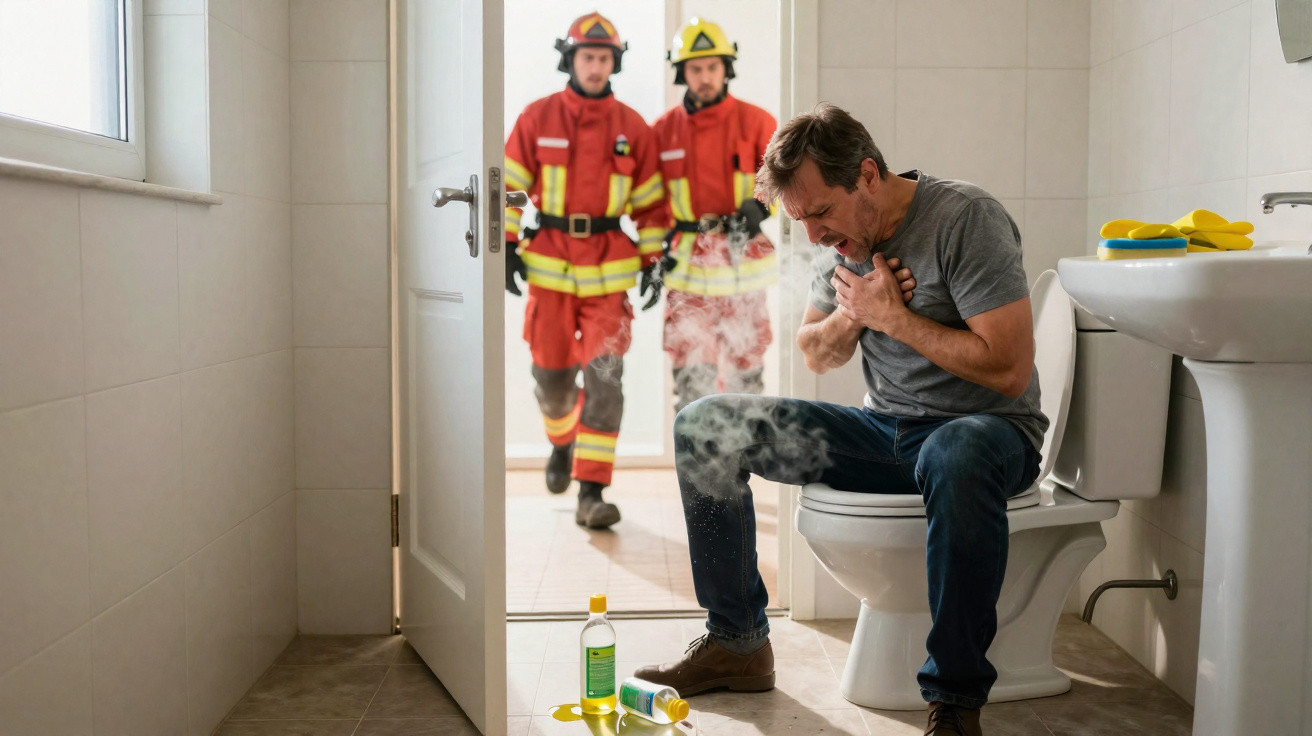
What started as a routine bit of cleaning ended with a full fire service response for a man in the south of France. After combining two seemingly everyday household cleaners, he inhaled the fumes and became so short of breath that firefighters had to be called out. The incident underlines how hazardous the wrong mix of domestic chemicals can be - even in an ordinary flat.
Bathroom cleaning ends in an emergency: what happened
The incident took place on a Thursday evening in the Albi area, in the Tarn département. At around 18:00, the fire service received an emergency call: a 35-year-old man was suffering severe breathing difficulties, felt dizzy, and was unable to help himself. Control immediately dispatched several vehicles.
When crews arrived, they found the man inside his home, with a sharp, stinging smell hanging in the air. It quickly became apparent this was not a fire but a chemical incident originating in the bathroom.
“The man had mixed two widely used cleaning products in a spray bottle - producing a toxic gas that attacked his airways.”
Firefighters brought him out of the flat, administered oxygen, and requested an ambulance. A short time later, paramedics transported the 35-year-old to a nearby hospital to assess how badly his airways had been affected.
Which mixture became so dangerous
According to the fire service, the man had prepared a spray cleaner by combining a sodium hypochlorite solution (commonly known as chlorine bleach) with standard household vinegar. His aim was to tackle limescale and dirt in the bathroom.
The logic probably seemed straightforward: a powerful disinfectant plus something that dissolves limescale should, together, clean even better. In reality, that pairing can do the opposite of “extra clean”, producing a hazardous cocktail of gases.
Firefighters said he sprayed the mist inside a poorly ventilated shower. In a confined space like that, the gas can build up extremely quickly. Just a few breaths may be enough to severely irritate the mucous membranes.
What happens in the body: why the gas is so insidious
When the two products react, strongly irritating gases are released. They affect the eyes, nose, throat and lungs, triggering a cascade of symptoms:
- Burning sensation in the eyes and nose
- Persistent cough and tightness in the chest
- Shortness of breath, up to panic and fear of suffocation
- Headaches, dizziness, and sometimes nausea
The Tarn fire service warns these fumes are not merely unpleasant in the moment. Depending on the concentration and length of exposure, they can directly damage the lining of the airways. In the worst case, this can lead to chemical burns in the windpipe and bronchi, fluid build-up in the lungs, or prolonged breathing problems.
“Even small amounts of this gas mixture can cause serious symptoms in sensitive people - especially in enclosed bathrooms with no open windows.”
Major fire service response over a “domestic accident”
Control sent a total of 13 firefighters in three vehicles. That may sound excessive for a “cleaning accident”, but there is a clear reason: the crews must not only rescue the affected person, but also make the property safe while protecting themselves from the gas.
On site, firefighters entered the bathroom wearing breathing apparatus, ventilated the rooms thoroughly, and checked whether any dangerous concentrations remained. Only once the risk had been removed could anyone else go back inside.
Incidents like this tie up resources that may be needed elsewhere. That is why fire services repeatedly stress how important it is to handle cleaning products safely. A supposedly clever cleaning trick can disrupt duty cover - and, more importantly, put lives at risk.
Dangerous cleaning combinations in the home
The Tarn case is not a one-off. Many people simply do not know which cleaning products should never be combined. The most problematic mixes are often products intended for different tasks.
Common prohibited combinations
| Combination | What can be produced | Risk |
|---|---|---|
| Chlorine-based cleaners + acids (e.g. vinegar, descalers) | Irritating chlorine compounds | Airway irritation, eye irritation, lung damage |
| Chlorine-based cleaners + ammonia (found in some bathroom cleaners) | Chloramines | Coughing, shortness of breath, bronchial irritation |
| Descalers + drain cleaners | Strongly exothermic reactions, splashing | Chemical burns to skin and eyes |
| Different “strong” cleaners used one after another in the toilet | Uncontrolled reactions in the ceramic | Gas formation, discolouration, material damage |
Anyone who reads the labels on cleaning products will usually see warnings such as “do not mix with other products”. Many people ignore this because they assume they are in control. This incident shows how misleading that confidence can be.
How to clean your bathroom and toilet without risk
A few basic rules can significantly reduce the danger without leaving the bathroom dirty. Recommendations commonly given by emergency responders and toxicologists include:
- Use only one product at a time.
- If switching products, rinse thoroughly with plenty of water in between.
- Open a window while cleaning, or at least ventilate well.
- Never inhale cleaners; avoid spray mist as far as possible.
- Wear rubber gloves, and for strong products, basic safety goggles as well.
- Never decant into other bottles or relabel containers.
“The safest option: one product for limescale, one mild product for dirt - and water. That is usually all a normal bathroom needs.”
How to respond properly in an emergency
If, while cleaning, you suddenly develop a severe cough, burning eyes, or shortness of breath, do not keep scrubbing - act immediately:
- Leave the cleaning products where they are and exit the room straight away.
- Open windows wide, create a through-draught, and leave doors open.
- Get fresh air and do not go back into the bathroom.
- If breathlessness or dizziness persists, call the emergency services.
- If you can, tell the call handler which products are in the room.
That allows responders to prepare appropriately and decide whether they need breathing apparatus to enter, or whether it is safe to re-enter without protection.
Why supposed “home hacks” are so widespread
Online, countless cleaning hacks promote simple household ingredients as miracle solutions. Many trace back to times when fewer ready-made cleaners were available and people had to make do with what they had in the kitchen. Today, those tips spread through short videos and forums - often with no explanation of the chemistry involved.
They become dangerous when paired with modern products. A strong bathroom cleaner may work very differently from the simple soap-based solutions used by previous generations. If someone then starts mixing, they can end up doing far more harm than the original limescale ever did.
How manufacturers warn - and where they fall short
Manufacturers of cleaning products are legally required to provide clear hazard information. Pictograms, signal words and safety phrases are meant to deter consumers from mixing products. In practice, however, many bottles are left open and disorganised under the sink, labels get smeared, or are simply no longer read.
A fair issue is that the warnings often feel technical and abstract. When people feel safe in everyday life, they may skim past the advice or fail to take it seriously. Some experts therefore call for clearer symbols and plainer language - such as highly visible “Never mix” graphics on the front label.
Until that happens, the responsibility remains with the consumer. The incident in the Tarn département shows how thin the line can be between the everyday and an emergency. One grab for the wrong bottle at the wrong moment - and suddenly 13 firefighters are in the stairwell, making safe a bathroom that was only meant to be cleaned.
Comments
No comments yet. Be the first to comment!
Leave a Comment