
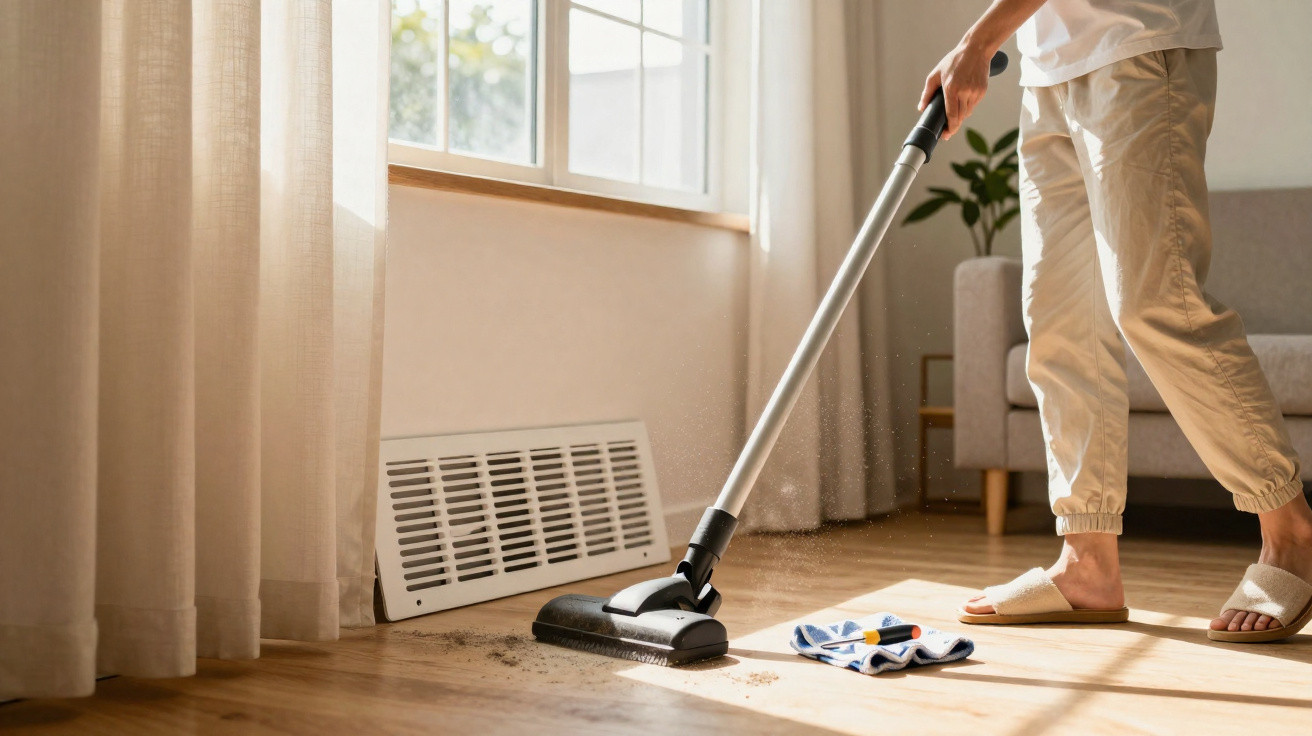
Anyone who hoovers and mops regularly - and even cleans under the bed and sofa - often ends up wondering: why does everything look dusty again already? The cause is rarely a lack of effort. More often, it’s because two major dust traps are almost always overlooked. Week after week, huge amounts of particles build up in exactly these places, with very real consequences for health and indoor air quality.
Why dust builds up in completely unexpected places
When people clean, they usually focus on anything horizontal: table tops, shelves, window sills and the floor. That feels sensible - dust falls downwards. In reality, it behaves differently indoors: it floats in the air, clings to textiles, and gets stirred up again with every movement of air.
That’s why areas that are rarely touched or moved can become genuine dust magnets. They often don’t look dirty at first glance, yet they can hold more particles than any skirting board.
"According to environmental authorities, indoor air is often two to five times more polluted than outdoor air - and dust plays a central role in that."
This dust is not just harmless fluff. It can contain, among other things:
- Allergens such as dust-mite residue and pollen
- Pet hair and skin flakes
- Fine soot and abrasion particles carried in from outside
- Mould spores from damp areas
If you have sensitive airways, asthma, hay fever, or small children at home, this kind of exposure can quickly lead to constant sniffles, irritated eyes, headaches or a cough at night. The encouraging part is that people who tackle the two biggest dust hotspots consistently often notice a clear improvement within a few weeks.
Dust trap number 1: net curtains and curtains
Textiles are ideal dust collectors. Fabric holds onto particles rather than repelling them. That’s why net curtains and curtains are often the dustiest items in many homes - yet they rarely make it onto the cleaning list.
Why curtains are particularly critical
Curtains can hang at a window for months with barely any movement. Every draft, every open window, and every time you walk past the fabric pushes fresh dust into the folds. Because net curtains are typically light-coloured and the dust spreads evenly, the build-up is easy to miss.
"In many homes, net curtains contain more fine dust and allergens than the entire living-room floor."
There’s more: if you take rapid airing seriously, each time you open the windows you drive particles from outside straight into the fabric. In summer, pollen joins the mix; in winter, fine particulate pollution from traffic and heating systems adds to it.
How often you really should clean curtains
The fix is less work than many assume. A practical schedule is:
- Once a month: take down net curtains and shake them vigorously outdoors.
- Every three months: run a gentle cycle in the washing machine at around 30°C (follow the care label).
- In between: for delicate fabrics, carefully vacuum with a soft brush attachment.
Shaking them outside removes a large share of loose particles on its own. If you hang net curtains back up while slightly damp, you often won’t even need to iron them, as the fabric smooths out under its own weight.
For curtains that must be dry-cleaned only, a small compromise helps: vacuum them at least every few weeks and have them professionally cleaned once a year. That way, far fewer allergens build up - and the fabric tends to last longer.
Dust trap number 2: ventilation grilles and air ducts
The second problem area is much less obvious, but it affects the whole home directly: ventilation grilles and air shafts. Whether in the bathroom, the kitchen, on an external wall, or as part of a central ventilation system - these are all places where air is channelled past a single point.
How ventilation grilles blow dust back into your home
Where air moves, dust settles. Over time, a thick layer forms on and behind the grilles: fine particles mixed with grease, pollen and pet hair. When airflow increases, these deposits can loosen and spread through the room like an invisible haze.
"A dirty ventilation grille acts like a dust launcher: instead of cleaning the air, it keeps circulating new particles."
Typical consequences in heavily affected homes include:
- Irritated airways and a persistent urge to cough
- Frequent headaches and tiredness
- Worse symptoms for allergy sufferers
- Mould growth in damp air ducts
Bathrooms and kitchens add moisture to the equation. Dust and humidity together create an ideal environment for mould colonies inside the ducts - a problem that’s difficult to spot from the outside.
Cleaning ventilation grilles: step by step in ten minutes
Routine upkeep takes less time than many expect. This simple process works in most households:
- Carefully unscrew the grille or release it from its fixing.
- Vacuum away loose dust using a brush attachment, including around the visible edge of the shaft.
- Soak the grille in warm soapy water, then wipe it down with a sponge.
- Rinse thoroughly and allow it to dry completely.
- Refit securely and check it sits firmly.
For standard wall vents, doing this every three months is usually enough. For heavily used kitchen vents - for example, next to the hob - a shorter interval may be sensible, as grease and dust can combine and stick stubbornly.
If you have a more complex system with multiple filters and duct runs, it’s wise to bring in a specialist once a year. In many areas, heating and ventilation companies offer set servicing packages that include filter replacement and duct inspections.
How to align your cleaning routine with the real dust hotspots
The key is not cleaning harder, but cleaning smarter - in the right places. Many people spend ages getting windows streak-free, while the net curtains in front haven’t seen a wash cycle for a year.
A workable routine might look like this:
| Area | Action | Interval |
|---|---|---|
| Net curtains | Shake outdoors | Monthly |
| Net curtains | Washing machine (gentle) | Quarterly |
| Ventilation grilles | Vacuum and wipe damp | Every three months |
| Complex ventilation system | Professional service | Annually |
If you put these few tasks in your diary - for instance, around the change of seasons - you’ll often notice dust on furniture and floors becomes much less stubborn, because fewer particles are being released from hidden “reserves”.
Health, allergies and a few useful extra tips
Dust is more than an aesthetic annoyance. In homes with toddlers or older people, lighter indoor air can make the difference between restful nights and constant infections. GPs and respiratory specialists repeatedly report patients whose symptoms noticeably improve after a thorough reduction of dust in the home.
A few additional measures can amplify the impact of cleaning curtains and ventilation grilles:
- Use cross-ventilation regularly instead of leaving windows on the night-latch/tilt position for long periods.
- Wipe dust with slightly damp cloths so particles are not stirred up again.
- Use a HEPA filter in your vacuum cleaner, especially in households with allergy sufferers.
- Avoid piles of textiles: fewer decorative cushions, open fabric storage, and throws that are left lying around.
If you have pets, keep an especially close eye on curtains near your animals’ favourite lounging spots. Cats often jump onto the window sill, and dogs rub against curtains - hair ends up straight in the fabric. Regularly removing loose hair with a grooming brush reduces the overall dust load even further.
Terms like “fine particulate” can sound abstract, but they refer to very ordinary particles that can penetrate deep into the lungs. The longer they circulate indoors, the more they can burden the body. That’s precisely why it’s worth paying attention to these two unassuming sources of dust. If you build curtains and ventilation grilles into your routine, you don’t need to clean obsessively every day - you simply target the points where dust really accumulates.

Comments
No comments yet. Be the first to comment!
Leave a Comment