
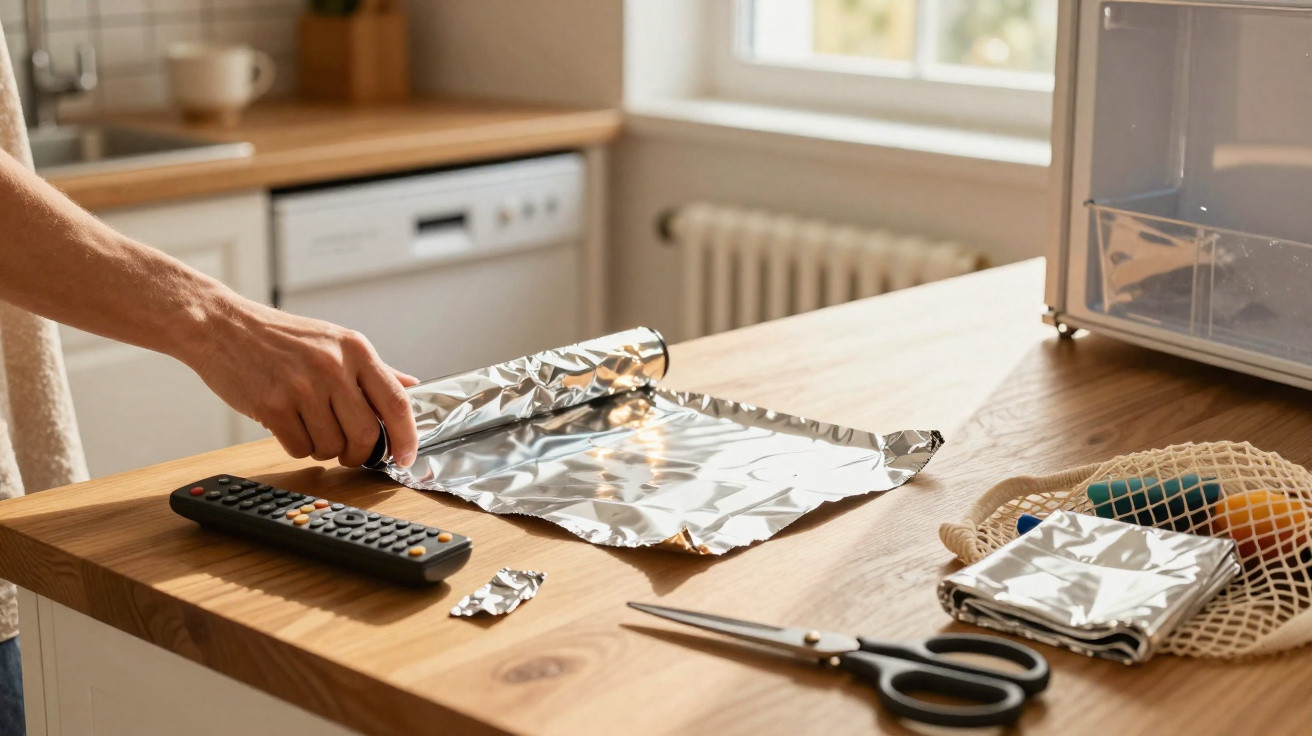
Aluminium foil usually sits in the drawer next to cling film and baking parchment, doing a fairly repetitive job. Yet that thin sheet of metal can do far more than cover leftovers or shield a pasta bake. A handful of simple tricks can save electricity, hassle and, in some cases, the cost of replacing something. At the same time, there are real pitfalls if the foil ends up in the wrong place. This guide focuses on both.
Why aluminium foil can do far more than just wrap food
Aluminium foil conducts electricity and heat, can be shaped easily, is sturdier than paper yet still flexible. That combination makes it handy for quick fixes-from a contact issue in a battery compartment to reducing static in a tumble dryer. If you understand what it’s good at, you can use that roll in the cupboard more purposefully while also avoiding health risks and damage to appliances.
"Aluminium foil isn’t a miracle cure – but it’s a surprisingly versatile emergency tool for everyday problems."
1. Bridging contact problems in a battery compartment in seconds
When a remote control only responds to every third button press, or a battery-powered toy keeps cutting out, the cause is often simple: the batteries no longer sit firmly, or the small metal springs have lost tension. This is where a tiny piece of aluminium foil can help.
Fold the foil tightly into a small wad and wedge it between the battery terminal and the contact point. It doesn’t act as a replacement battery; it simply serves as a conductive bridge to make up the missing bit of distance.
- Use only a very small piece.
- Position the foil so it cannot slip.
- Never allow it to touch the positive and negative terminals at the same time.
This is best as a stopgap-useful in an emergency, when travelling, in a hotel, or in a motorhome. Long-term, it won’t replace a correctly sized fresh battery, and it won’t fix a genuinely faulty contact inside the device.
2. Refreshing scissor blades for the short term
Anyone who crafts regularly or cuts gift ribbon will know the moment when a favourite pair of scissors suddenly feels reluctant. A common tip is to cut through folded aluminium foil several times. It’s not the same as sharpening with a proper stone, but it can help smooth the cutting edges.
If the blade feels dull due to sticky residue, paint, or minor unevenness, repeatedly snipping through a few layers of foil often works surprisingly well. The edges can be slightly evened out, and some build-up may lift away.
Even so:
- For high-quality kitchen scissors or hairdressing scissors, it’s better to use a specialist.
- If there are deep nicks or rust, the foil trick won’t help.
- If you use the scissors for fabric, avoid wearing them out by constantly using them on paper and foil.
3. Making cutlery shine in the dishwasher
A long-running tip online suggests putting a crumpled ball of aluminium foil into the cutlery basket of the dishwasher to make everything look shinier. The idea is based on a chemical reaction that can be noticeable, especially with tarnished silver.
With standard stainless-steel cutlery, the difference is usually subtle. However, with older items that are slightly discoloured, you may sometimes see a better shine. It matters that the foil is placed loosely as a ball in the basket, so it doesn’t snag anywhere inside the machine.
Many professionals advise against using this on every wash cycle, because small fragments can break off and end up in the filter or pump. Used occasionally-when you want a good silver spoon to look bright again-it can be an option, but not a permanent routine.
4. A ball in the tumble dryer: less static cling, shorter run time
Putting an aluminium foil ball in the tumble dryer sounds like an internet myth at first, but there’s a real reason behind it. As laundry dries, it often builds up static electricity, particularly with synthetic fibres. The result: T-shirts stick together, you hear crackling, and lightweight items attract dust. A foil ball can partially discharge that static.
Here’s how to do it:
- Tear off a larger piece of aluminium foil and form it into a tight ball (roughly tennis-ball size).
- Compress it again so there are no sharp edges sticking out.
- Put it in the dryer with the wet laundry and run the programme as normal.
Many people report slightly shorter drying times and noticeably softer laundry, especially with towels and bedding. The ball can be reused several times. Once it starts to look very ragged, replace it so that tiny pieces don’t end up in the lint filter.
5. Reflecting heat behind a radiator – with limitations
In older properties, this tip comes up repeatedly: stick a sheet of aluminium foil behind the radiator so less heat is lost into the external wall. The basic idea-redirecting warmth back into the room-isn’t wrong, but kitchen foil is only a limited solution.
Proper reflector panels combine a reflective layer with insulation and are more fire-resistant. Kitchen foil, by contrast, is thin, tears easily, and is hard to fasten neatly. If you still decide to use it, keep these points in mind:
- Fix the foil to the wall only, not to the radiator itself.
- Keep sufficient distance from hot parts.
- Avoid creases where dust and dirt can collect.
In many cases, ready-made radiator reflectors from a DIY shop make more sense. They can be cut to size, are sturdier, and often work out cheaper over time because you’re not constantly using new foil.
6. Reducing ice build-up in the freezer compartment
When centimetre-thick ice starts building up in the freezer, defrosting becomes unavoidable. It takes time, makes a mess, and few people enjoy it. Another aluminium foil trick claims to slow down how quickly ice accumulates.
Some users place pieces of foil on glass shelves or against the back wall so new frost forms on the foil instead. When defrosting, those pieces are then supposed to peel away more easily. Experiences vary widely, and there’s little solid scientific evidence for the effect.
If you want to try it, take care to:
- Avoid covering ventilation slots.
- Ensure there are no loose ends that could tear when loading and unloading.
- Check regularly for water collecting behind the foil.
More effective than any hack is consistently checking the door seal and keeping door opening to a minimum. Warm, moist air is the main driver of heavy ice build-up.
7. An emergency tool for travel and quick fixes
Keeping a small piece of aluminium foil in a rucksack or a drawer can be surprisingly useful. It can be scrunched into shape in seconds, flattened again, and adapted to whatever you’re dealing with.
Typical spur-of-the-moment uses
- A temporary cover over a mug or bowl
- A base for sticky foods, such as a cut melon
- Short-term paint splatter protection around a door handle
- A makeshift funnel for transferring small quantities of grains or screws
- A torch reflector while camping to spread and redirect light
That adaptability is exactly what makes the material so practical. It’s rarely a good long-term fix, but as a quick helper in a pinch, it can be genuinely useful.
Safety rules: when aluminium foil should not be used
Avoid acidic and salty foods
It’s common to wrap half a block of salted feta in foil and put it in the fridge, or to bake a marinated chicken breast in the oven fully wrapped. Authorities warn against precisely these kinds of uses. Acid or salt can cause aluminium to migrate from the foil into the food.
Practical rule of thumb:
| Suitable | Not ideal |
|---|---|
| Briefly covering neutral foods in the oven | Storing tomatoes, citrus fruits, salad with dressing for longer periods |
| Grilling dry foods with a layer of baking parchment in between | Direct contact with heavily salted or marinated meat |
| Wrapping dry baked goods for the same day | Keeping food in the fridge for several days |
If you want to be cautious, combine methods: place food in a glass or porcelain dish, then use the foil as a lid. That avoids direct contact while still helping with heat retention and odour control.
Metal and microwaves – a risky combination
Metal reflects microwave radiation. That’s why pieces of aluminium foil in a microwave can spark, make loud noises, or damage the appliance. Many manufacturers explicitly warn in their instruction manuals not to use loose foil in their machines.
Some modern microwaves allow specific coated aluminium containers, but only when this is clearly stated. Standard kitchen foil from a roll should not go in the microwave without such approval-not even “just briefly” to reheat leftovers.
How to sensibly reduce foil use
As handy as these tricks can be, aluminium foil is made from bauxite and its production uses a lot of energy. If you use it, it’s worth doing so thoughtfully and sparingly. Many everyday tasks can be handled with alternatives:
- Lunchboxes made of stainless steel or plastic instead of wrapping sandwiches
- Reusable food covers or simply using a plate as a lid on bowls
- Baking parchment or reusable baking mats for oven dishes
For the few situations where aluminium foil is genuinely hard to replace-such as acting as a conductive bridge in a battery compartment or as a ball in the tumble dryer-a small supply is usually enough. Foil with food residue belongs in general waste; clean foil can be folded and reused as long as it isn’t torn.
Knowing these tricks and using them deliberately means you can get far more out of a single roll than merely covering a casserole dish. At the same time, your usage stays sensible-which helps your budget, your appliances, and ultimately the environment.


Comments
No comments yet. Be the first to comment!
Leave a Comment