
Grease crusts, brown marks, crumbs: for years, grime builds up between the panes of an oven door - and hardly anyone can reach it.
Plenty of people clean the inside of their oven regularly and give the outer glass a quick wipe. The space between the two panes, however, usually remains the forgotten item on the cleaning list. You can see the dirt, but it feels out of reach - or so most people assume. A straightforward tip borrowed from professional kitchens shows how to clean that exact area without taking the door apart.
Why dirt between oven door panes is so stubborn
Ovens run at high temperatures; fat spits, sauces bubble over, roasting juices drip. Some of that combination ends up hidden inside the door. Steam can be drawn between the panes through small openings, then dries and leaves residue behind.
Over time, it turns into an unattractive mix of:
- baked-on grease splashes
- dried sauce remnants
- fine crumbs and dust
- brownish streaks that are easy to spot from the outside
The catch is that, on many models, the design makes this gap difficult to access. Basic cleaning tools cannot reach far enough, and your fingers certainly will not. Some manufacturers make doors where the panes come out fairly easily. Others use sealed constructions with concealed screws or clips.
As a result, many households simply leave it alone. People worry about damaging the door or refitting the glass incorrectly. This is exactly where the simple professional trick helps: it sidesteps complicated dismantling and uses something found in almost any wardrobe.
"The key move is not to dismantle the oven, but to use the access the door already provides - from underneath."
The basic cleaner: a vinegar-and-water mix instead of specialist chemicals
Before tackling the awkward areas, you need a solution that is effective yet gentle. The good news is that two everyday ingredients are enough.
How to mix the cleaner properly
- 1 spray bottle
- 1 part water
- 1 part clear household vinegar
- 1 microfibre cloth or another absorbent cloth
Pour water and vinegar into the spray bottle in a 1:1 ratio and give it a quick shake. This mixture cuts through grease, lifts discolouration and works well on porous layers of grime. At the same time, it is generally kind to glass and most seals.
If you are sensitive to the smell of vinegar, add a few drops of washing-up liquid and dilute the mix a little more with water. Strong, highly caustic oven cleaners are not ideal for the space between the panes. As they dry, they can leave residues that you may not be able to polish away later.
If your oven has removable door panes
On some appliances, the door or panes can be removed following the manufacturer’s instructions. If yours is one of them, take the standard approach:
- Let the oven cool completely and unplug it if possible.
- Remove the door or panes as described in the manual.
- Spray on the vinegar-and-water mix and leave it briefly to work.
- Wipe with a microfibre cloth; repeat for heavy build-up.
- Wipe again with clean water and dry thoroughly.
As thorough as this method is, many households never get that far. That is why the practical trick below is worth knowing - it works without a screwdriver.
The coat hanger trick: clean the gap without dismantling the door
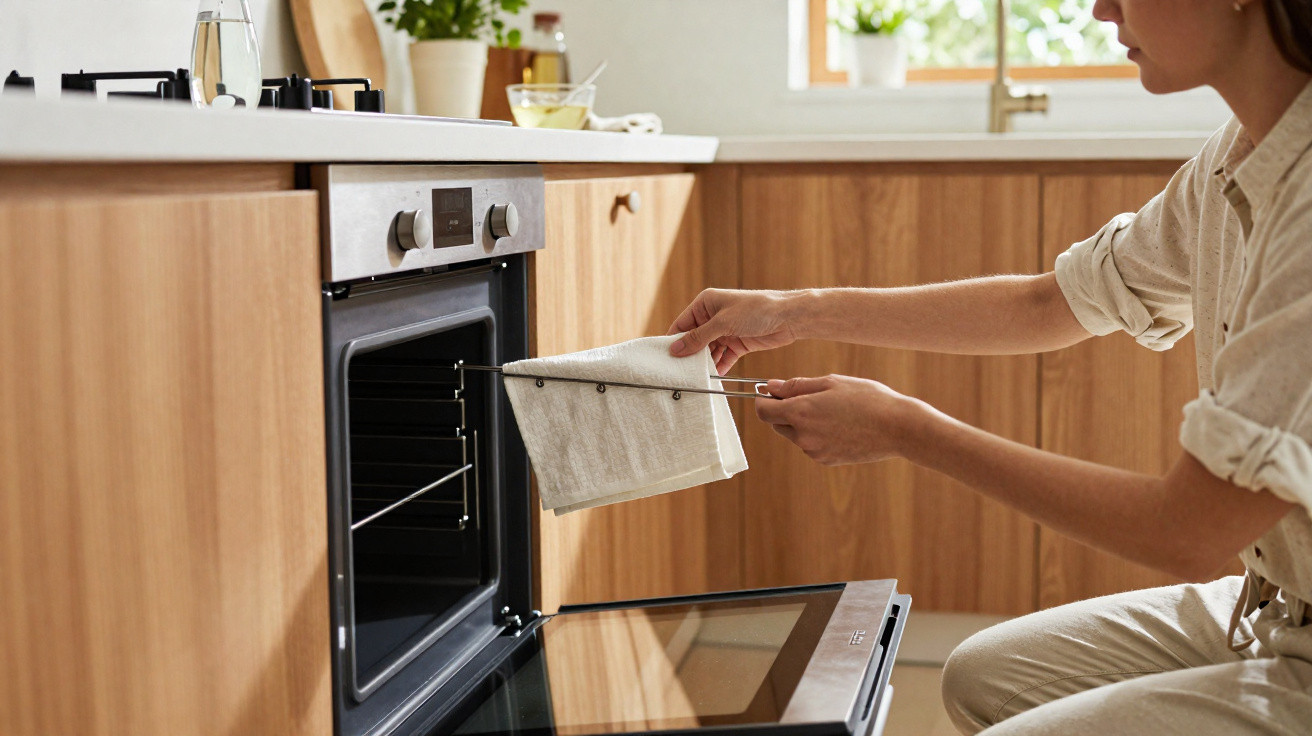
This method comes straight from real-world practice: professionals use a simple, thin metal coat hanger to reach between the panes. Because it is long, it gets into places no sponge can.
Step by step: how to clean using a coat hanger
Before you begin, make sure the oven is completely cold.
Pull out the drawer beneath the oven
Many freestanding cookers have a drawer under the door. Take it out fully so you can see the underside of the oven door. You will often find narrow slots or openings there that lead into the gap.Prepare the metal hanger
Use a thin wire coat hanger and straighten it until you have a long, slim rod.Fix a cloth to one end
Wrap a small piece of microfibre cloth (or thin cotton cloth) tightly around one end of the wire. Secure it with a strong elastic band or sturdy tape so it cannot slip off.Dampen the cloth with cleaner
Spray the vinegar-and-water mix directly onto the cloth until it is well damp, but not dripping.Reach into the gap
Carefully guide the prepared hanger through the slots on the underside of the door. You will quickly feel when you have reached the space between the panes.Wipe the glass surfaces
Move the hanger slowly back and forth, alternating between horizontal and vertical motions. This helps you cover the full glass area. For stubborn spots, stay in one place and rub a little longer.Rinse the cloth and repeat
Pull the hanger out, rinse the cloth thoroughly, dampen it again with the solution and continue until the glass looks noticeably clearer.
"With a simple wire coat hanger and a little vinegar water, you can reach the area many owners assume is inaccessible - without calling in a service engineer."
How to stop new layers of grime building up
Once the gap is clean, you will not want it getting clogged again soon. A few habits make a big difference in reducing what settles between the panes.
Simple habits for a consistently clear view
- Use baking trays with raised edges: overflowing bakes and roasting fat are more likely to stay in the tray rather than running towards the door.
- Cover fatty foods: aluminium foil or a lid noticeably reduces splatter on the glass.
- Wipe light dirt straight away: after cooking, when the oven is only lukewarm, quickly wipe the inside of the door with a damp cloth.
- Do a monthly visual check: a quick look at the inner pane from the outside will show early streaks before they become a bigger job.
If you do a quick wipe regularly, you avoid a major cleaning session later. The vinegar cleaner also works well on the outside of the door and on side metal panels - just wipe again with clean water afterwards so you do not leave streaks.
Common mistakes when cleaning an oven door
When you are dealing with baked-on grime, it is tempting to reach for harsh tools. Some of them do more harm than good.
- Wire wool or metal scourers: these scratch glass permanently and can make it pick up dirt more easily.
- Sharp blades used directly on glass: ceramic hob scrapers may work on cooktops, but on an oven door the wrong angle can leave marks.
- Using too much water: excess liquid in the gap can seep into seals or electronics.
- Cleaning while the oven is still warm: heat intensifies cleaning fumes and can make surfaces more sensitive.
Soft cloths, the vinegar-and-water mix and - if needed - a little bicarbonate of soda on heavily crusted areas inside the oven (not between the panes) are safer choices.
How often is a deep clean actually worth it?
The space between the oven door panes does not need meticulous cleaning every week. For many homes, a more intensive clean once or twice a year is enough, depending on how often you roast and bake.
If you use your oven almost daily - for traybakes, frozen pizza or roasting - it is worth keeping a closer eye on the door. Discolouration tends to develop faster on gas cookers or very old appliances in particular.
The coat-hanger-and-vinegar method stays manageable if you do not wait until a thick layer has formed. The thinner the grime, the faster it lifts - and the shorter the next cleaning session will be.
Why vinegar is a quiet cleaning hero in many kitchens
Household vinegar earns its place in oven cleaning in several ways: it breaks down grease, has a mild disinfecting effect and helps neutralise odours. Many professionals rely on it because it is inexpensive and does not depend on obscure ingredients.
If you have stainless-steel surfaces around the oven, you can also use the vinegar mix there sparingly. The key is to buff dry afterwards so you do not leave marks. For delicate finishes, it is sensible to test it on a small, hidden area first.
Paired with the coat-hanger trick, the usually frustrating space between the panes becomes something you can tackle in a few minutes - without specialist tools, without a technician, and without pricey cleaners from the supermarket shelf.

Comments
No comments yet. Be the first to comment!
Leave a Comment