
It’s Saturday morning. The sun is casting a low light across the kitchen tiles and you think, “Today I’m going to give the floor a proper mop.” You fill the bucket in no time, add a splash of cleaner, dip in the cloth, wring it quickly and get started. After the first few passes the floor looks shiny and you feel pleased with yourself - until you come back a few minutes later and find streaky puddles everywhere. The children skid about, the dog pads muddy little prints through the damp mess, and you wonder why mopping so rarely feels genuinely clean.
Most people know that moment when it clicks: something isn’t quite right. The frustrating truth sits in a gesture that seems insignificant - a grip, a twist - and suddenly the whole floor is far too wet.
Why your mopping cloth dumps more water on the floor than you realise
Watch people cleaning - in flats, offices, communal hallways - and you’ll notice the same routine again and again: cloth into the bucket, a quick squeeze, a half-hearted twist, back onto the floor. Hands free again in seconds; the cloth still drips a bit, but “it’ll dry soon enough”. The problem is that “soon enough” turns into ages. Instead of lifting dirt, you end up pushing it - along with diluted cleaner - across a thin layer of water. And if you’re unlucky, the surface feels stickier afterwards than it did before. This is the exact point where you find out whether you’re cleaning - or just making a paddling pool.
Picture a caretaker who cleans ten corridors every day. She dips the mop, sets it into the wringer, presses hard, then gives it another twist. Her floors are walkable within minutes and nothing smears. Now compare that with your last attempt at home: a textile floor cloth, briefly wrung out by hand, a bucket with no wringer. Ten minutes later it looks like it’s just rained indoors.
A small study by a cleaning product manufacturer found that many private households leave up to 40 percent of the water in the cloth, while professionals get it down to under 15 percent. It sounds like a dry statistic, but it explains very neatly why your floor takes so long to dry again.
What changes everything is pressure, angle and the order of movements. If you only squeeze the cloth, you mainly compress the middle. The fibres around the edges stay saturated. That trapped water then runs straight onto the floor as soon as you pull the cloth along the surface. If you press and twist, the pressure spreads more evenly. Water is forced out of the whole fabric, not just the centre.
Let’s be honest: hardly anyone does this every day with the patience of a trained cleaner. But this “forgotten” technique is exactly what turns a mopping cloth into a tool - rather than a slippery invitation to fall over.
The correct wringing technique: a small trick with a big impact
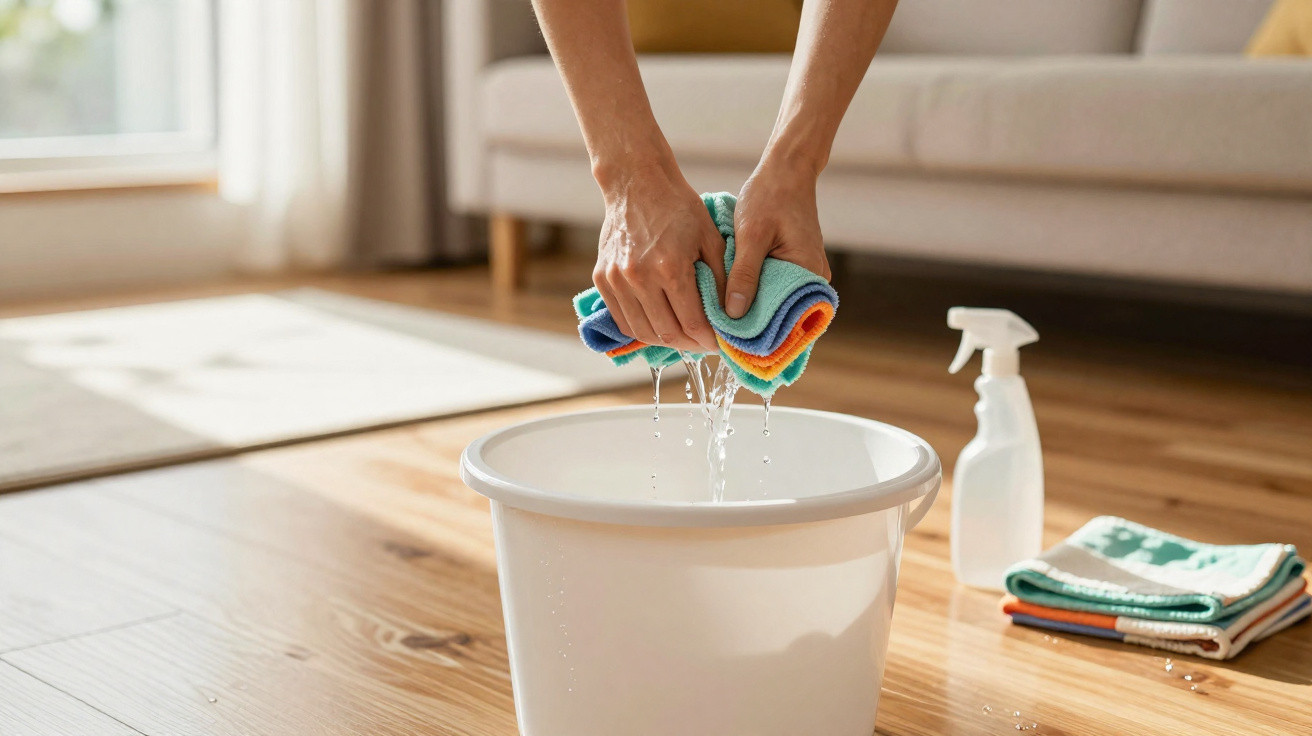
The key is a movement that feels almost old-fashioned: properly wringing the cloth, not merely squeezing it. First, submerge the mopping cloth fully in the bucket and let it soak right through. Then lift it out with both hands and hold it over the bucket - not dripping across the room.
Grip both ends so they hang down in parallel. Now for the part most people rush: pull your hands in opposite directions, as if you’re twisting a wet washing line. Start gently, then twist harder until you can feel the fabric becoming slightly thinner and tighter. That’s the moment most of the excess water is out - and your floor will be left lightly damp rather than flooded.
Many people stop after the first half twist. Their hands slip, the water is cold, and they just want to get it done. There’s often a small worry underneath too: “If I wring too hard, the cloth will be too dry and the dirt will stick.” In reality, the opposite is true. A cloth that’s too wet dilutes the grime and spreads it into a film. A well-wrung, merely damp cloth picks up dirt instead of shunting it around.
If your hands are sensitive, use rubber gloves or a simple wringer - but the principle stays the same: spend two extra seconds wringing rather than ten extra minutes waiting for the floor to dry and re-mopping.
“The moment water stops running out in streams and only comes out in individual drops is the ideal point to stop,” explains a long-standing professional cleaner I met in a Berlin office building. “Many people expect the cloth to be dripping wet. That’s exactly where the problems begin.”
- Fully submerge the cloth, not just dampen it - only then do dust and grease properly release from the fibres.
- Always wring out over the bucket, never over the floor - it sounds obvious, but it saves you from invisible trails of water.
- Twist until only drops come out, not thin streams - that’s your internal “stop” cue.
- Rinse and wring more often rather than cleaning the whole room with an over-wet, dirty cloth.
- For parquet and laminate, press the cloth once more briefly inside a dry towel - that single extra step helps prevent floors swelling.
Why an almost dry mopping cloth makes your living room quieter
If you pay attention to the sound while mopping, the difference becomes obvious. A cloth that’s too wet makes a smacking, slurping noise, leaving that faintly sticky sound as you drag it over tiles or laminate. A properly wrung cloth moves more quietly; you’ll mostly hear a soft scrape, almost like a brush on a smooth floor.
That sound isn’t just about acoustics - it’s a small signal telling you how much water you’re laying down. Suddenly you realise mopping isn’t only “cleaning”; it’s almost a little technical exercise. Once you’ve noticed it, it’s hard to believe how casually you used to pull whole bucketfuls of water around the house.
| Key point | Detail | Benefit for the reader |
|---|---|---|
| Reduce water in the cloth | Twist with both hands in opposite directions until only drops come out | Faster drying, fewer streaks, lower slip risk |
| Rinse more frequently | It’s better to dip and re-wring regularly than to keep going with a dirty cloth | Dirt is removed rather than spread; the floor feels clean for longer |
| Match the floor material | On wood and laminate floors, wring the cloth even drier or press it inside a towel | Helps prevent swelling and stains; extends the life of the floor |
FAQ:
- Question 1
How damp should a mopping cloth ideally be?
It should feel clearly damp, but not be dripping. If you hold it briefly over the bucket and there’s no continuous stream of water - only individual drops - you’re in the right range.- Question 2
Do I need to buy a special mopping cloth?
Not necessarily. Microfibre cloths absorb a lot of water and release it well; cotton cloths are tougher and familiar. More important than the material is how you wring it out and how often you rinse it while mopping.- Question 3
Why does my floor feel smeary after mopping?
Usually because the cloth is too wet or too dirty. The cleaner becomes too diluted, dirt loosens and then settles as a film. A clean, well-wrung cloth and a little less cleaner often help a great deal.- Question 4
How often should I rinse the mopping cloth in the bucket?
At the latest when you can see slightly grey or brown water running off the edge of the cloth. In heavily used rooms that can be every few square metres; in cleaner areas, less often.- Question 5
Is a mop wringer really better than wringing by hand?
For larger areas, yes - it spreads pressure more evenly and is kinder to your hands. At home, hand technique is usually enough, as long as you use a proper twisting motion and allow yourself those few extra seconds.

Comments
No comments yet. Be the first to comment!
Leave a Comment