
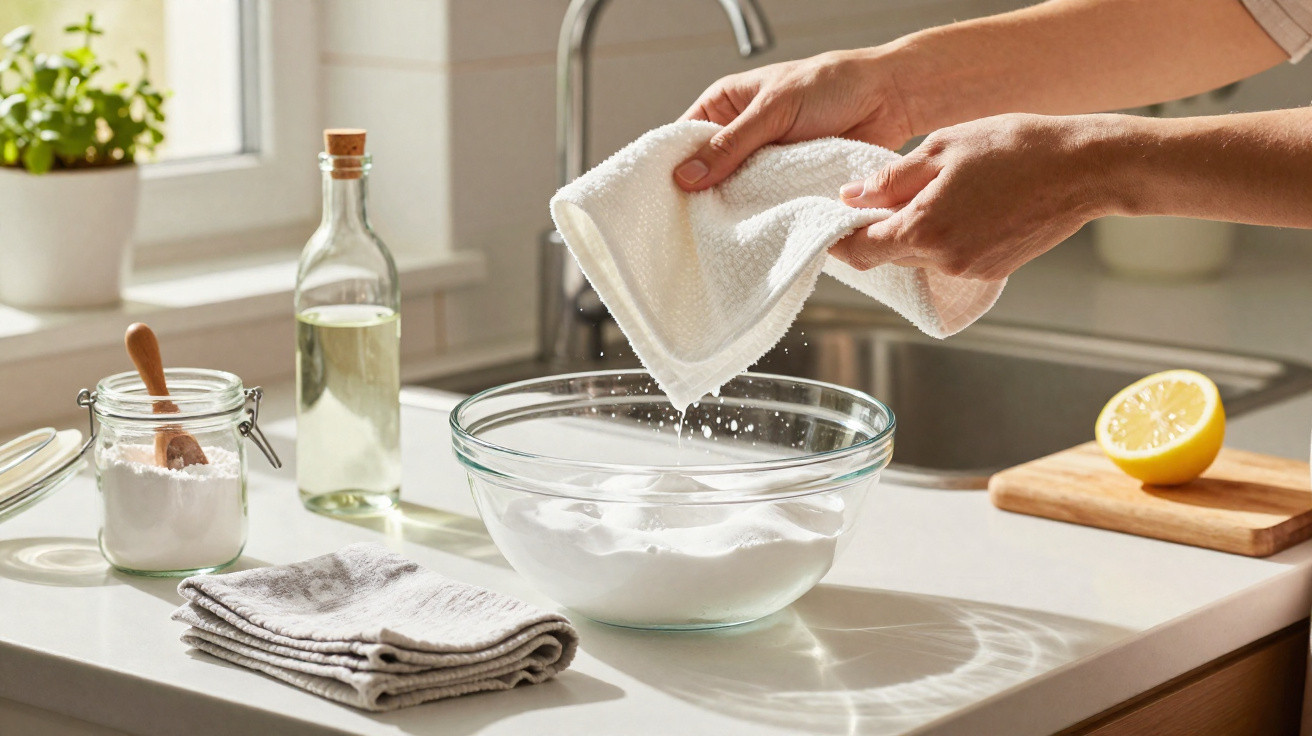
Kitchen towels that are months old, grey, stiff and covered in stains - then suddenly almost like new again.
All without chlorine or specialist cleaners.
A lot of people give up on kitchen towels surprisingly quickly: red wine, tomato sauce, coffee, grease - and after a while it feels as though only the bin or harsh bleach will do. Yet in many cases you can bring back much of the original whiteness with a straightforward household trick. The secret is a simple combination found in most kitchens.
Why kitchen towels turn grey, stiff and musty so quickly
Kitchen towels get heavy use. They soak up grease, pick up sauce splashes, dry hands, dishes and worktops. With every use, tiny particles work their way into the fibres.
- Fats and oils from pans and plates
- Pigments from coffee, tea, red wine and tomato sauce
- Food residue that becomes lodged in the weave
- Detergent left behind when it doesn’t rinse out completely
- Limescale from hard tap water
If you add the wrong washing habits into the mix, they can start looking tired very fast:
Cooler wash programmes don’t fully break down grease. Overdosing detergent often makes things worse, because powder or liquid can cling to the fibres. If you rarely run a hot wash, a grey film builds up that seems impossible to shift. On top of that, limescale from hard water settles in the fabric, leaving it stiff and dull.
"The well-known ‘grey film’ isn’t fate - it’s made up of grease, limescale and detergent residue that build up in layers within the fabric."
At this point, many reach for chlorine bleach. It can make fabric look brighter at first, but it also weakens fibres, may strip patterns of colour and can leave towels feeling rough. Over time, the cloth can yellow, tear more easily and lose absorbency. Chlorine can also irritate skin and airways, and it adds to wastewater pollution.
The surprisingly simple combination: bicarbonate of soda and vinegar instead of chlorine
A cupboard-friendly alternative is bicarbonate of soda (sodium bicarbonate, often sold as “baking soda” or “bicarbonate”) plus clear household vinegar. Each works well on its own; used together, they can be even more effective.
Why bicarbonate of soda works so well for kitchen towels
Bicarbonate of soda is widely seen as a gentle all-rounder. When used for laundry care, it helps in several ways:
- loosens grease films and food residue
- lightly brightens without burning or damaging fibres
- neutralises odours, such as frying fat or onions
- helps lift set-in stains like tea or coffee
Unlike aggressive bleaching agents, bicarbonate of soda barely attacks the fibre structure. Cotton and linen stay softer, and towels usually remain usable for longer.
Vinegar as a natural descaler and freshness booster
Clear household vinegar does a different job in the laundry room - but it’s just as valuable:
- dissolves limescale deposits within the fibres
- removes detergent build-up that makes fabric look grey
- reduces bacteria and therefore unpleasant smells
- helps the fabric feel supple again
Because it’s mildly acidic, it works into the gaps between fibres and helps stop towels turning hard. When followed by a normal wash cycle, there’s no lingering vinegar smell.
How the “de-greying bath” for kitchen towels works
You don’t need any specialist products for this. A bowl, hot water and a few basics are enough.
| Ingredient | Amount | Purpose |
|---|---|---|
| Bicarbonate of soda | 3 tablespoons (about 30–40 g) | Degreaser, odour neutraliser, gentle brightening |
| Clear household vinegar | 250 ml | Descaling, freshness, breaks down detergent residue |
| Water | 2–3 litres, hot but not boiling | Carrier medium, opens fibres |
| Kitchen towels | Light cotton or linen | should be colourfast |
Step-by-step instructions
- Put the kitchen towels into a large enough bowl or bucket.
- Sprinkle the bicarbonate of soda evenly over the towels.
- Pour the vinegar over slowly - the foaming shows the acid–base reaction.
- Top up with hot water until the towels are completely submerged.
- Leave to soak for at least 6 hours; for heavy soiling, ideally leave overnight.
- After soaking, wash the towels in the washing machine with your usual detergent. Do not add chlorine.
- Don’t overfill the drum so the towels rinse properly.
- Air-dry the towels - sunlight can boost the brightening effect even more.
"Many report that kitchen towels look noticeably lighter after just one soak, and the typical greasy smell almost completely disappears."
When nothing else works: a heat treatment for hopeless cases
For towels that genuinely seem beyond saving - dark grey, stiff and marked with old stains - an extra heat step can help:
- Heat 2–3 litres of water in a large saucepan
- Stir in 1–2 tablespoons of bicarbonate of soda
- Add the towels and let them simmer gently for 15–20 minutes (do not boil vigorously)
- Then wash as normal in the machine
The heat opens the fibres so the bicarbonate of soda can penetrate further and loosen deposits more effectively. This approach suits sturdy cotton towels best, and is less suitable for delicate fabrics with prints or appliqués.
How to prevent the grey film from coming back
Once you’ve got towels looking white again, you won’t want to sacrifice them again a few weeks later. A few simple routines can greatly slow down a relapse.
Everyday tips for keeping kitchen towels brighter for longer
- Change towels regularly - ideally daily or every two days.
- Keep heavily soiled towels (deep-frying fat, sauces) in a separate pile.
- Don’t leave them damp in a scrunched-up heap: hang or spread them out to dry.
- Run at least one wash per week at 60 °C to shift grease and germs.
- Avoid overdosing detergent; follow the manufacturer’s guidance properly.
- Use a bicarbonate of soda soak now and then as a maintenance treatment.
If you live in a hard-water area, you can add a water softener in the machine or use vinegar in the fabric-softener compartment. That reduces limescale build-up and keeps towels softer for longer.
What to do with colours, patterns and delicate fabrics
This method is mainly intended for classic, light cotton or linen towels. With brightly printed towels or delicate materials, it’s worth being cautious:
- Test first on an inconspicuous corner to check the colour doesn’t run or fade.
- For very colourful towels, shorten the soaking time slightly.
- Don’t put any metal parts (for example, eyelets) into the hot saucepan, as they may tarnish.
If you use purely decorative towels that absorb little moisture, it’s best to avoid harsh treatments. These are usually designed to look good rather than to cope with heavy kitchen wear.
What’s behind the effect of bicarbonate of soda and vinegar
Sodium bicarbonate is mildly alkaline. Alkalis dissolve grease well and help lift colour pigments without “etching” the fabric. Vinegar, on the other hand, introduces acidity and tackles limescale, soap residue and some odour sources. When the two briefly react, carbon dioxide is produced - and the bubbles can mechanically help dislodge grime from the fibres.
What matters most isn’t the chemistry display, but the combination of alkaline degreasing, acidic descaling, heat and time. That mix is exactly why even old kitchen towels can end up looking significantly cleaner, brighter and fresher again - without chlorine and without specialist chemicals from the shops.


Comments
No comments yet. Be the first to comment!
Leave a Comment