
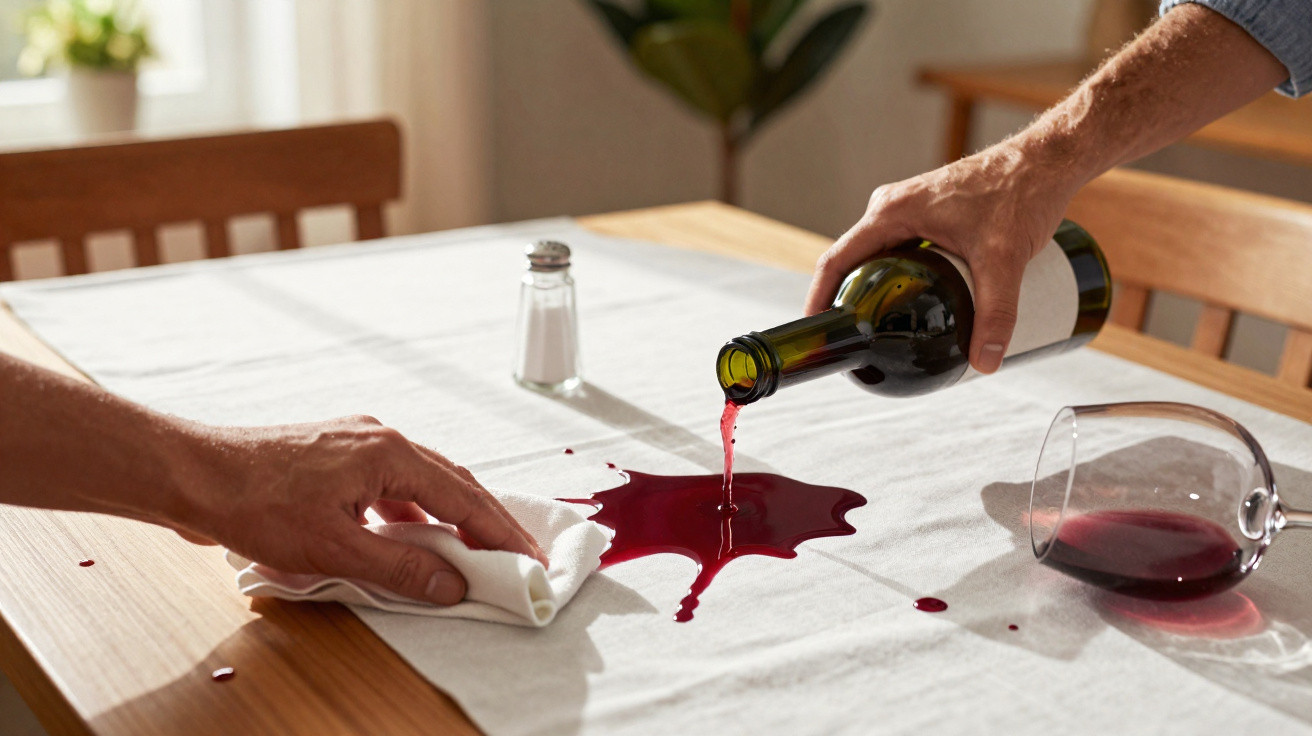
A dark sweep of red wine leaps from the glass, lands in slow motion and works its way into your cream sofa or white shirt. For one second, the whole room goes still. Then somebody cries, “Quick, get the salt!” and everyone rushes about as though this were the one inviolable rule of adult life.
You dash to the kitchen, seize the salt and tip a heavy white heap over the spreading mark. Heads nod in relief. The emergency seems to be over. Conversation starts again, the music is turned back up and the evening carries on, a little battered but intact.
Then, the following morning, daylight arrives and you sweep away the dried salt. That is when a different sort of alarm takes hold. The stain has not vanished. It appears… sealed in. It is darker and more resistant, as if it has made a small home in the fibres. Clearly, something has gone wrong.
Why a pile of salt can make red wine stains worse
For years, the salt method has been passed around dinner parties like a private ritual. Spill red wine, cover it in table salt and feel wonderfully capable. The reasoning sounds neat: salt absorbs moisture, wine is liquid, so salt must solve the problem. It is such a tidy little calculation that few people stop to question it.
But red wine on a textile is not merely “wet stuff”. It is a rush of pigment, tannins, alcohol and acids moving deep into minute fibres as soon as it lands. By the time you have reached the salt cellar, plenty has already taken place. This is not a simple surface puddle; it is dye attempting to become part of the fabric.
Consider what salt really does. Its crystals remain on the surface and draw out water, certainly, but they also concentrate everything left behind: pigments, tannins and colourants. Beneath that crisp white layer, the mark is not disappearing. It is being reduced, thickened and concentrated, rather like a sauce simmering over a low heat.
There is a part nobody tends to mention: the next morning, once the glow of the party has faded and you brush away the salt with a sense of unease. On a cotton napkin, a gentle burgundy mark may have become a sharper brownish ring. On linen or wool, it can look pressed into place. So you scrub, beginning the familiar loop of regret, cleaning products and hopeful thinking.
Professional cleaners encounter this scenario constantly. Clothes arrive with salt still attached in places, almost like forensic proof of a frantic late-night rescue attempt. Many of those marks would have been easier to treat had they been left alone. Salt does not simply fail; it can push a stain from “irritating” into “semi-permanent”.
At fibre level, the process is easy to understand. Materials such as cotton and linen contain countless tiny channels and pores. Wine enters them almost immediately. Adding salt removes loose water, while holding colourants in close contact with the fibres for longer. As the textile dries beneath the salt, pigments have extra time to bond, much like hair dye left on for too long. Salt does not neutralise colour; it produces the perfect conditions for colour to adhere.
What to do during the first 60 seconds
With red wine, the real difference-maker is speed rather than salt. Your first action is deceptively straightforward: blot, never rub. Take a clean cloth, kitchen paper or even the inside of a cotton T-shirt. Press lightly, lift it away, turn to a dry area and repeat. The aim is to draw the wine up and out before it settles into the fibres.
After removing as much wine as possible by blotting, use cool water. Do not use warm or hot water. Heat can effectively “cook” a stain into certain fibres. Pour a small amount carefully onto the reverse of the mark so that it drives the wine outwards, then continue blotting. Treat it as though you are rinsing hair dye away, rather than scrubbing mud from a boot.
If the material permits it, a small amount of mild washing-up liquid or laundry detergent, diluted with cool water, can loosen pigment and break surface tension. Dab lightly in brief sessions and keep a steady hand. The aim is not to remove the stain in one dramatic act, but to prevent it becoming a permanent tattoo.
Take a white cotton shirt in a restaurant as an example: those sixty seconds matter more than any supposedly miraculous product. A friend spills a rich Rioja over himself, freezes, then recalls reading that rubbing is the enemy. He calls over the waiter and requests sparkling water and a bundle of napkins. No salt. No fuss.
They go to the bathroom, where he blots patiently and adds small splashes of fizzy water. The tiny bubbles help bring some of the colour towards the surface. By the time he reaches home, the table-side crime scene has become a faint pink shadow. A proper wash completes the process. The shirt survives for another dinner.
There is a quiet point to take from this: the usual folk remedy often answers our desire to “do something” more than it benefits the fabric. It seems active, firm and almost ceremonial. Creating a mound of salt is visible and theatrical; patient blotting looks dull. But dull is what works. Salt offers an illusion of control while discreetly setting the stain.
Researchers who examine stains refer to capillary action, adsorption and fibre binding sites. Put simply, liquid races into microscopic spaces, and pigments adapt once they find somewhere to cling. The longer they remain there, the more established they become. Salt hastens the drying and concentration stage, precisely what you should avoid while the colour can still be shifted.
Treating red wine stains sensibly
A better way to tackle red wine involves several gentle actions, rather than one aggressive intervention. Begin with blotting and cool water. When the initial panic has passed and the fabric is damp rather than soaked, switch to a suitable cleaner. On washable materials, cool water mixed with a few drops of liquid laundry detergent is a remarkably effective starting treatment.
Leave the stained section in that solution for 15 to 30 minutes. Rinse from the fabric’s reverse side afterwards, forcing the mark outwards. If colour remains, an oxygen-based stain remover may help, particularly on white and pale-coloured items. Rather than chlorine bleach, these products use active oxygen to break down colour molecules more gently.
For carpets and sofas that cannot go in a washing machine, the technique changes while the principle remains the same. Apply small quantities of solution with a cloth, then blot it back out. Do not soak the area, grind at it or rub in circles as though polishing shoes. Allow the cleaner time to act before lifting it away. At times, leaving it alone for ten minutes achieves more than ten minutes of frantic scrubbing.
On a hectic evening, people grab whatever happens to be close by: white wine for red wine, sparkling water or baking soda. The collection of folk remedies is endless. A few offer limited help, some achieve nothing and others plainly make the situation worse. Each is driven by the same emotional response: that sudden rush of embarrassment and urgency when a dark mark appears in a bright room.
With a pale sofa, for example, the urge is to act forcefully and immediately: hot water, harsh chemicals and excessive quantities. More product can feel like greater power. In practice, hot water can set the mark, chlorine bleach can turn fabric yellow, and scrubbing can damage fibres, making them grip pigment more firmly next time. Counterintuitively, a gentler method is more likely to preserve the material over time.
There is another danger with a cherished shirt or wool coat: leaving the task too long. You promise yourself you will “deal with it properly tomorrow”, and then it slips your mind. When you finally return to it, the pigment may have bonded completely, and no home treatment will fully undo the damage. Let’s be honest: nobody really does that every day.
“The worst stains we see are almost never the fresh ones,” says one London dry cleaner I spoke to. “They’re the ones that have been pre‑treated at home with salt, hot water or mystery sprays, then left to sit. By then, we’re not removing a stain, we’re arguing with history.”
A straightforward mental checklist can cut through both panic and bad advice:
- Blot before anything else; do not rub.
- Choose cool water, never hot water.
- Avoid salt and home chemistry experiments.
- Test every product on an inconspicuous area first.
- If you are uncertain, contact a professional sooner rather than later.
This is not about responding perfectly to every single spill. On a weekday evening, with children shouting and pasta boiling over, nobody is calmly measuring out oxygen bleach. It is about abandoning one harmful reflex-the salt avalanche-and replacing it with a small habit that matches the way fabrics and pigments actually work.
Why the salt myth endures, and what it reveals about us
The salt myth has endured for a reason. It fulfils our wish for one simple instruction in a chaotic world: spill red wine, add salt, problem solved. It is binary, reassuring and easy to repeat. Families, dinner guests and social media users pass it on, and it is seldom challenged because it brings comfort before it brings evidence.
With some older, coarse tablecloths that have loose weaves, people may even have seen apparent partial success, strengthening the tale. Salt absorbed a little surface liquid, the lighting was poor and the fabric pattern disguised what remained. The stain looked “better”, and so the treatment became legendary. Nobody examined what might have happened without salt in the first place.
We also fail to appreciate how quickly a stain changes from a dramatic mishap into chemistry. Once you have experienced that evening-friends laughing, wine splashing, salt being poured and a ruined cushion discovered later-you see the sequence differently. The issue was not the wine or the clumsiness, but the automatic reaction that changed a recoverable mark into a lasting scar.
At a deeper level, this concerns the way we deal with small household emergencies. We are drawn to forceful moves: pouring, scrubbing, drowning and over-treating. Fabrics, however, respond better when we behave like careful technicians rather than alarmed firefighters. One soft cloth, a little cool water and patience can go much further on a sofa or shirt you value than a loud intervention.
More emotionally, red wine stains are seldom only about pigment. They appear on birthday tablecloths, first-date shirts and carpets from long, wandering conversations. On a Sunday morning, as you look at a blotch that refuses to shift, you are not simply irritated with the textile. You are negotiating what remains and what is lost from that occasion.
We have all known that suspended moment when a dark splash lands where it should not. The room, the people and the story you will tell later all depend on your response. Letting go of the salt myth is more than a laundry tip; it is a small decision to choose knowledge over habit, calm over spectacle and care over reflex.
| Key point | Detail | Benefit for the reader |
|---|---|---|
| Salt sets the colour | By absorbing water, salt concentrates pigments in the fibres and helps them bind | Understand why a “miracle remedy” can worsen the problem |
| Speed matters more than the product | Blotting immediately with cool water limits how far the wine penetrates | Adopt a simple action that saves clothes and textiles |
| Choose gentle methods | Mild detergent, cool water, active oxygen and light handling | Reduce the risk of permanent stains and damage to fabrics |
FAQ
- Does salt ever work on red wine stains? It can seem helpful on certain old, rough fabrics because it absorbs surface liquid, but it often drives pigment deeper into the fibres. Over time, it is more likely to create permanent staining than blotting and rinsing with cool water.
- What is the very first thing I should do after a wine spill? Blot carefully using a clean, absorbent cloth or paper towel. Work from the outside edge towards the centre, and do not rub, as this can spread pigment or force it further in.
- Is white wine really good for removing red wine? Not particularly. White wine slightly dilutes the red wine but does not break down its pigments. Cool water works equally well without wasting extra wine or introducing sugar and acids to the stain.
- Can I use hot water to treat a red wine stain? On many materials, particularly wool and certain synthetics, hot water can permanently set the stain. Begin with cool water; using heat is only appropriate where a care label or professional cleaner confirms it is safe.
- When should I give up and go to a professional cleaner? If the textile is delicate, costly, marked “dry clean only”, or your initial gentle treatment does not lighten the stain, let a professional take over. Tell them about every home treatment you have tried so they understand what they are dealing with.



Comments
No comments yet. Be the first to comment!
Leave a Comment