
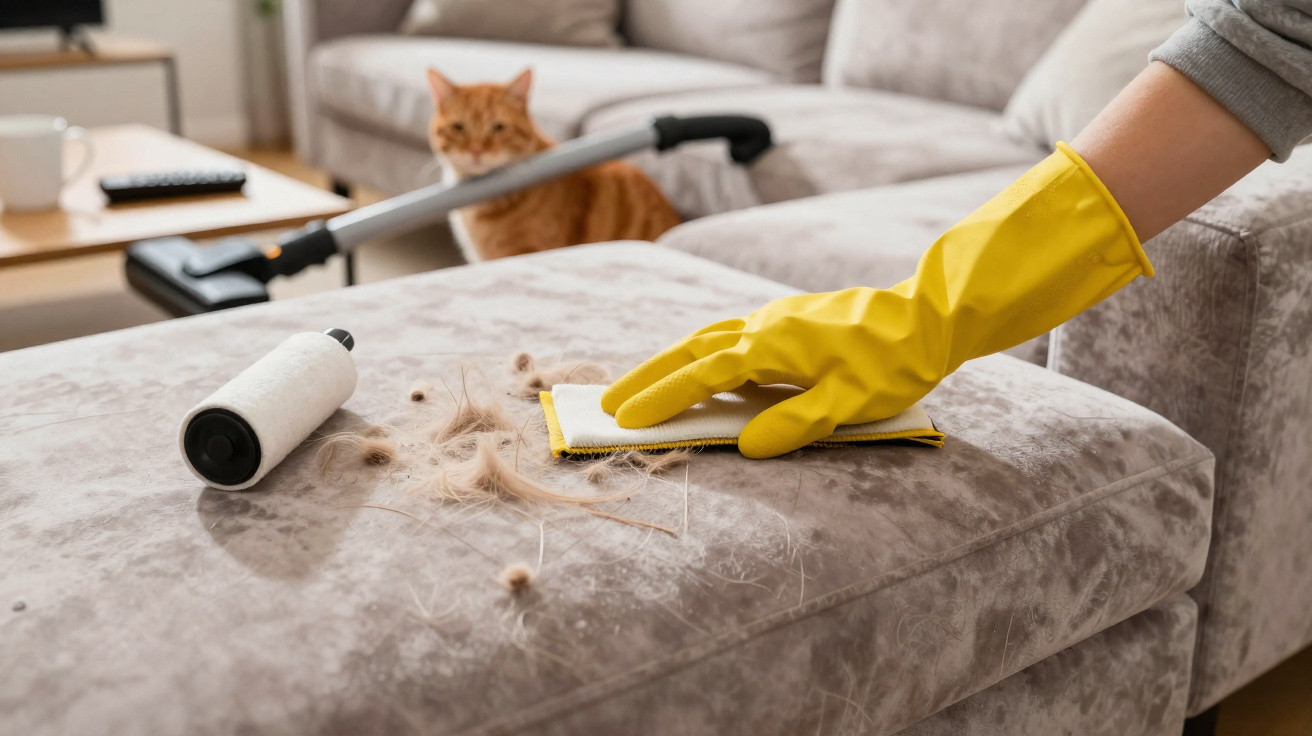
Pet hair attaches itself to sofas with the persistence of a bad habit. Vacuum cleaners thunder, lint rollers empty, guests message “on my way,” and suddenly you are wiping a cushion with your sleeve. The answer may already be beneath the sink: an unassuming rubber glove.
I had used the final sheet on the lint roller. The vacuum lead was too short, the dog was staring at me, and my patience seemed to be beneath the coffee table alongside the lost remote. So I went to the sink, picked up one dishwashing-style rubber glove, and swept it slowly across the upholstery. The hairs collected as iron filings do around a magnet, bunching into tidy clumps that I could simply pinch off. There was no noise. It was quicker than anything I had purchased. From that point, the glove changed everything.
Why a rubber glove is more effective than you expect
We often spend money trying to tackle pet fur: rollers, brushes and battery-powered gadgets that promise wonders before clogging on their first use. A glove looks far too basic to make a difference, which is exactly why it is so easily overlooked. Rubber has a mild tackiness, similar to the feeling of pinching a balloon, and that grip combines with friction to gather loose hairs into easy-to-remove bundles. Rather than working hair further into the fabric, it lifts and directs it. A simple rubber glove can outpace a £20 lint roller.
Take Emma from Leeds, for example. She inherited a velvet armchair as well as a ginger tom with strong views. Masking tape had failed her, while a travel brush had tangled after only three passes. With the glove, she went from “hopeless” to holding a palmful of fluff in roughly 90 seconds. A further sweep along the arms brought the loose threads from the seams out in tiny caterpillar-like rolls. She gave it a brief low-powered vacuum afterwards and could sit down without leaving covered in orange specks. The chair appeared never to have encountered a cat.
There is straightforward physics at work here. Hair is lightweight, difficult to control and frequently charged, whereas rubber sits low on the triboelectric scale; moving it over upholstery produces a slight static attraction. Combined with the glove’s subtle grip, this draws strands forwards instead of forcing them into the weave. A little humidity can improve the result, while short strokes in one direction prevent the fabric nap from resisting. It works like a gentle squeegee for upholstery, encouraging hair to collect and come away.
The rubber glove method: steps and mistakes to avoid
Choose the right glove: latex offers the most grip, nitrile suits anyone with sensitivities, and silicone is a durable option. On most upholstery, begin with a dry glove, moderate pressure and long strokes in one direction. Follow the fabric grain, allowing hairs to form soft strands, then remove them as they collect. For a particularly stubborn sofa, give the glove or your palm a light mist-two spritzes rather than a soaking-and repeat. Start dry, then add a whisper of moisture. Use your fingertips as a small rake around piping and corners, before completing the job with a soft pass from a vacuum upholstery attachment.
The biggest error is rubbing in circles as if polishing shoes. Doing so pushes hair into the weave and roughens the surface. Instead, use straight strokes, lift the glove and begin again. Avoid using too much water, as linen and cotton can develop water marks. Take extra care with delicate fabrics and loose loops, including silk, bouclé and certain chenilles: test an inconspicuous area first and apply the lightest touch. If latex causes itching, choose nitrile or a soft silicone grooming glove instead. Everyone has experienced the “quick clean” that becomes an hour of swearing; this glove method gets you out of that cycle quickly. It should be effortless.
Realistically, this is not something most people will do daily. Make it a two-minute routine before visitors arrive or once the dog has finished its zoomies. Store a glove in the coffee table drawer and regard it as the sofa equivalent of the TV remote.
“We use gloves on site because they don’t shed adhesive and they reach what machines miss,” says Zara, an upholstery cleaner in Bristol. “It’s gentle, quiet, and it respects the fabric.”
- Best uses: velvet, corduroy, microfibre, wool blends, car seats and pet beds.
- Challenging fabrics: loose-loop bouclé, raw silk and very open linen-use a light touch and test first.
- Faster approach: complete one dry sweep, one lightly misted sweep, then finish with a 30-second vacuum.
- Storage: clip a glove inside the sofa skirt or keep it alongside spare remote batteries.
A simple hack that changes your view of pet hair
This is less about the glove itself than the sense of control it puts back in your hands-quite literally. Fur stops feeling like a personal failing when a few strokes can clear a cushion and let you sit down without the usual fluff. It’s quiet, quick, and oddly satisfying. You may start making another pass while the kettle boils or before you begin scrolling. The technique works elsewhere too: on stairs, in the car boot, on the dog’s preferred blanket, and even on the driver’s seat after wearing dark jeans. Pass it on to the friend who has attempted everything and insists their sofa “just attracts hair.” The message is simple: no expensive equipment is necessary. All you need is a glove and two minutes. That is welcome news.
| Key point | Detail | Benefit for the reader |
|---|---|---|
| Glove type matters | Latex grips best; nitrile for allergies; silicone for durability | Choose an option that is safe and effective for your home |
| Dry, then lightly damp | One dry sweep gathers; a mist boosts clumping | Quicker results with less effort and no water marks |
| Stroke direction | Long, one-way strokes with the fabric’s grain | Stops hair becoming embedded and protects the weave |
FAQ:
- Does any rubber glove work, or do I need a specific brand? Most household gloves work. Latex grips strongest, nitrile is gentler and allergy-friendly, and soft silicone grooming gloves are great on upholstery and car seats.
- Won’t rubber snag delicate fabrics? Use light pressure and test a hidden spot on silk, bouclé, or loose weaves. Stick to straight strokes, not scrubbing, and switch to a microfiber cloth if the fabric protests.
- Is it better to use the glove wet or dry? Start dry. If hair resists, mist the glove or your palm lightly-think two spritzes. Water should help clump hair, not soak the fabric.
- Will this work on rugs and car interiors? Yes. Short-pile rugs, boot carpets, and car seats respond brilliantly. For deep-pile rugs, use the glove to lift surface hair, then vacuum for the rest.
- How do I clean the glove afterwards? Peel off the hair, rinse under warm water, let it air-dry, and hang it by a clip. No detergents needed unless it’s visibly dirty.

Comments
No comments yet. Be the first to comment!
Leave a Comment