
The woman standing before me was not furiously scrubbing. Instead, she moved at an unhurried, almost leisurely pace, cleaning one small patch and then the next, as though she had discovered something the rest of us had overlooked.
Her home was not pristine in the glossy-magazine sense. Crayons lay on the table, a sock had found its way beneath the radiator, and a mug of tea sat half-drunk. Even so, the floors were clean, the worktops uncluttered, and nothing appeared sticky – a modest miracle when you share a home with other people.
When I asked how many hours she devoted to cleaning, she laughed. “Not more than you,” she said. “Probably less.” She then revealed the understated routine that makes dirt almost… disappear.
The tiny daily choice that makes mess stop spreading
Picture this: four people return home after a wet day. They keep their shoes on, drop their bags, fling down their coats, and within ten minutes crumbs seem to be everywhere. The number of people is identical and the same amount of everyday life is going on, yet some homes become a mess almost instantly while others remain neatly under control.
The reason is not costly equipment or commercial-strength cleaning products. More often, it is a small, rather unglamorous habit that few people mention. It takes place in the first thirty seconds after somebody comes through the front door.
The habit is to create a proper entrance “transition zone”, use it consistently, and make it part of daily life. It sounds basic, but it can transform the home.
Think of the last time you visited someone whose home seemed unusually peaceful, despite children or pets. You probably paused at the entrance without anyone asking. Your shoes naturally came to rest on a mat, while your bag went in a clearly designated place. There was an unspoken understanding of where belongings arrive and where they remain.
One family I spoke to for this article lived in a compact flat with two children and a dog that sheds as though it is a second job. Previously, they vacuumed every other day yet still discovered grit in their beds. Once they changed only their entrance routine – adding a thick washable mat, a shoe basket, a rail of hooks and a firm rule that “nothing crosses this line” – they needed to vacuum just twice a week.
They had not magically turned into perfectly tidy people. They had simply stopped bringing the outdoors through the entire flat. Soil, hair, sand and dead leaves all remained within the first two square metres.
The reasoning is almost painfully obvious. Much of the grime that leaves us cleaning for hours does not begin indoors: it is brought in. It comes in on shoes, wheels, bags, pets’ paws and children who rolled about in grass “for fun”. Once it gets beyond the threshold, it spreads and combines: crumbs mix with dust, dust meets moisture, and before long you are back on your knees with a sponge.
Making the entrance a purposeful filter interrupts that chain reaction. You are not putting in more effort; you are simply changing where the dirt ends up. Rather than cleaning ten surfaces across four rooms, you maintain one small, carefully chosen space more regularly and clean the remainder of the home less often. It is rather like placing a firewall in front of your inbox.
There is a psychological benefit too. A clearly arranged entrance with an obvious rule becomes a ritual: you pause, put things down and take a breath. The house feels different from the second you enter, and everyone else gradually learns to follow the same pattern.
The quiet entrance ritual that shrinks your cleaning time
The routine is straightforward: do not pass the invisible boundary of your entrance while you are still carrying the outside world with you. Shoes, dripping umbrellas, muddy paws and heavy bags all stay in one thoughtfully arranged area. You come in, stop, unload and then continue into the home feeling lighter.
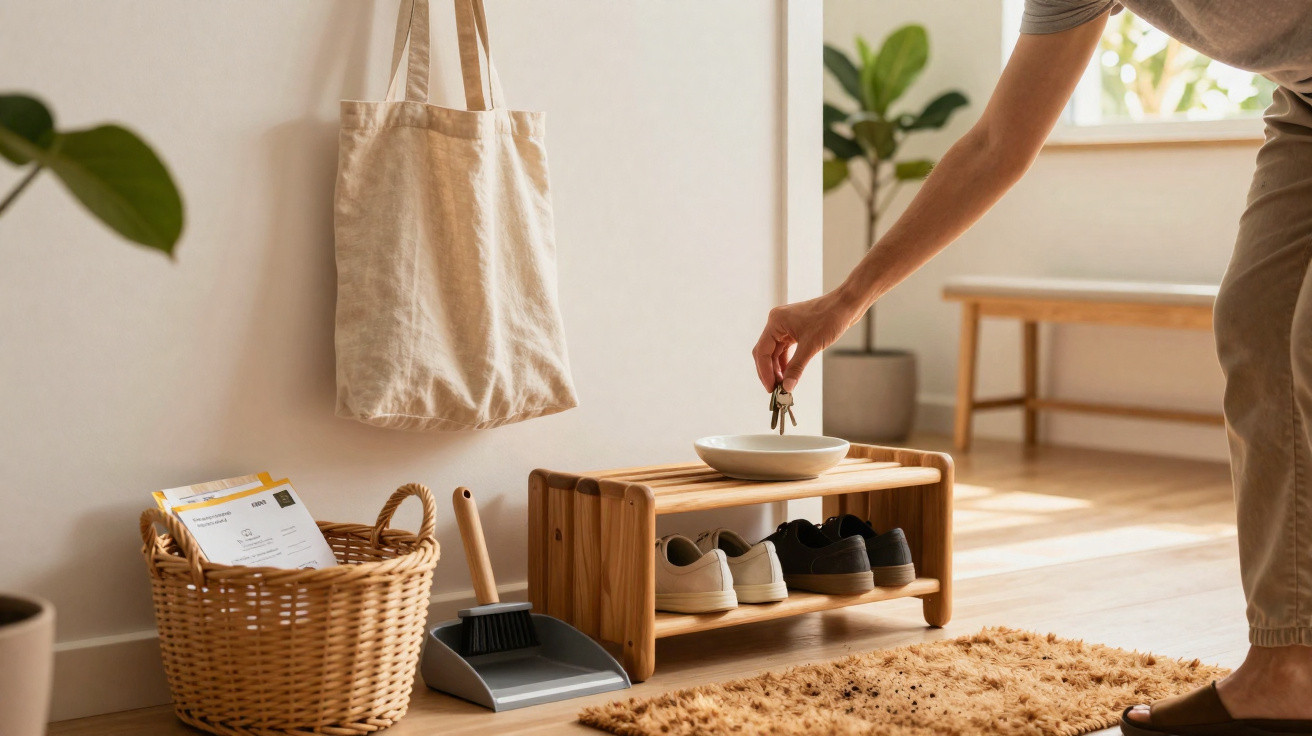
In practical terms, create a small “airlock” between the front door and the rest of the property. Use a doormat that genuinely catches dirt, a defined shoe space rather than a hopeful idea, hooks positioned at the height people actually use, and a tray for post and keys. It need not be elaborate; it simply needs to be deliberate.
It is not the items themselves that prevent mess, but the repeated action. Every arrival follows the same brief sequence: shoes in the same place, bag in the same place, then a quick check to see whether anything needs wiping before it gets carried further inside.
Many of us get stuck imagining an immaculate Pinterest-style hallway, then abandon the idea because our entrance is narrow, dark or shared. Alternatively, we make a lovely arrangement for one week before ordinary life turns it into a corner of chaos. Let’s be honest: nobody genuinely manages a perfect set-up every day.
The change only lasts when following the routine takes less effort than ignoring it. Hooks should sit where hands naturally reach, not where they make the wall look balanced. The shoe basket should not be on the other side of the hallway. And the mat should feel comfortable beneath wet feet rather than rough like sandpaper.
On a tiring Tuesday, no one will walk an extra three metres to use an attractive coat stand. Your future self needs the effortless option directly in front of them, preferably where it cannot be overlooked. The less thought the system requires, the more likely it is to become automatic.
“The day we put a big, ugly-but-comfortable mat and a wide shoe tray by the door, the sweeping stopped feeling endless,” a reader told me. “The kids still drop their stuff everywhere, but at least the mud dies at the entrance.”
To keep it effective without making it complicated, remember four principles:
- A stop zone within one step: Your “landing strip” should begin no more than one step inside the front door.
- Shoes do not travel: Do not make exceptions for a quick trip; “just this once” is how the routine disappears.
- A mat that works quietly: Pick one that absorbs water and catches grit, rather than one that is purely decorative.
- A two-minute reset: Shake the mat and sweep this small section once daily; that is usually enough.
Small details that quietly cut your cleaning in half
This entrance routine becomes even more effective when paired with a handful of other tiny, almost effortless adjustments. None of them really feels like announcing, “I’m cleaning now.” They are simply everyday actions redirected slightly. The benefit appears a few days later, when you realise you have not had to scrub a sticky hallway for some time.
| Key point | Details | Why it matters to readers |
|---|---|---|
| Turn the doormat from decoration into a tool | Choose a weighty, washable mat with a textured upper layer and rubber backing, large enough for at least two feet per person. If possible, use one outside and another inside. | It catches grit, water and pet hair before they can spread, meaning less mopping and floors that look respectable for longer between thorough cleans. |
| Make taking shoes off the norm rather than the exception | Place a visible shoe rack or tray beside the door, along with a small bench or stool for support. Keep inexpensive guest slippers or thick socks in a basket. | This limits the dust and bacteria carried through the home and reduces vacuuming time, particularly in bedrooms and carpeted areas. |
| Set up a “drop zone” to collect clutter | Install hooks at several heights, add a bowl or tray for keys and coins, and use a slim basket for post and school papers. | It stops backpacks, coats and miscellaneous items spreading over chairs and tables, turning tidying into a five-minute reset rather than a Saturday task. |
Once these small systems are established, cleaning takes on a different character. You no longer deal with messes that have spread and grown across several rooms. Instead, you carry out quick upkeep in a few problem areas. The entrance receives a 60-second daily refresh, while the rest of the home can go longer between more demanding cleaning sessions.
Sharing a home with other people will always create crumbs, smears and mysterious “how did this sticky patch get here?” moments. During a difficult week, you may not vacuum as regularly as you intended. In a better week, though, you may notice that the floors do not feel gritty even after you have missed a day.
On a peaceful evening, you may find yourself completing the entrance routine automatically: shoes off, bag down, keys in the tray, quick look at the mat. That is the point when the practice stops feeling like a new household rule and becomes part of the background rhythm. Your cleaning time has reduced not because you worked harder, but because the dirt simply travelled less.
FAQ
- Do I really need a no-shoes rule at home? You do not need to impose a rigid rule for it to help. Simply changing into indoor slippers or socks most of the time means far less grit and germs come indoors. Those who follow this most consistently usually spend noticeably less time sweeping.
- What if my entrance is tiny or I live in a studio? Make use of vertical space and slim storage. A narrow wall-mounted rack, hooks over the door and a shallow shoe tray can form a “landing strip” in under one square metre. What matters is that shoes and bags always stop in the same spot, however small it is.
- How often should I clean the doormat and entrance area? Shaking or vacuuming the mat every few days, plus quickly sweeping the entrance daily, is generally sufficient. Ironically, this small daily job makes larger weekly cleans shorter and less demanding.
- My family ignores the system. What can I do? Rearrange the area so that the easiest choice is also the right one. Put the shoe tray exactly where they naturally remove their shoes. Hang hooks at children’s height. Give gentle reminders rather than lectures. People adjust more quickly when the set-up lets them succeed with no real effort.
- Does this really make a difference if I have pets? Yes, particularly if you have dogs that go outdoors. Keeping a towel or pet wipe near the door, giving paws a quick wipe, and using a good mat can prevent a surprising amount of mud and hair from entering. The floors will not be perfect, but they will remain cleaner for longer periods.
Comments
No comments yet. Be the first to comment!
Leave a Comment