
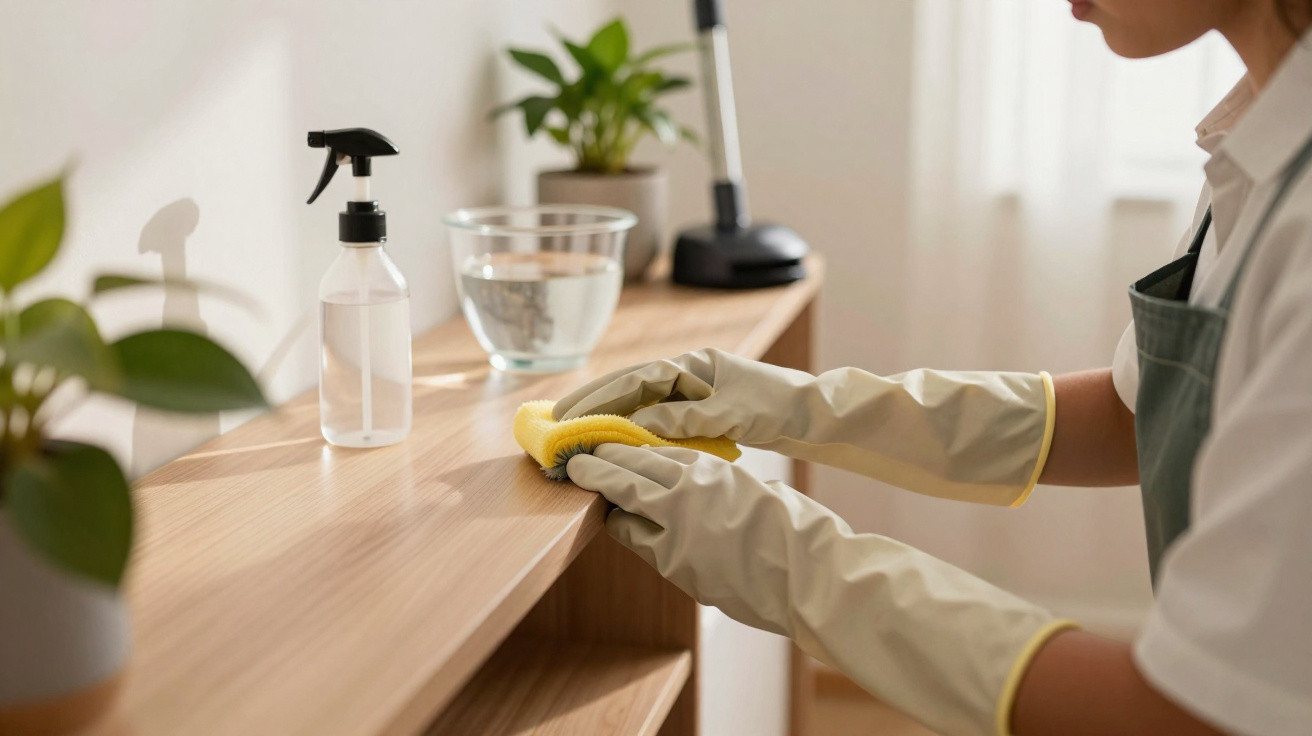
You pick up a cloth, wipe one corner of the worktop, get sidetracked by a splash on the splashback, and then spot fingerprints on the fridge handle. Ten minutes on, the cloth is grey, your back is aching, and the room somehow still looks… untidy.
Professional cleaners see this happen with a quiet sense of frustration. It is not that you are “bad” at cleaning; they simply recognise the underlying issue: you are wiping in the wrong sequence. A poor sequence creates more work, takes more time and sends dirt round in circles.
Cleaning experts say one straightforward order can change everything. The same products. The same cloths. Far less effort.
The difference lies in the order you wipe.
The invisible rule professional cleaners never miss
The first rule professionals share is almost tediously simple: work from high to low, and from the cleanest areas to the dirtiest. That is all. Yet many of us do precisely the reverse, starting with whichever mess irritates us most at that moment: a sticky mark on the coffee table, crumbs across the island or a smear on the bathroom basin.
When you tackle the first thing that catches your eye, unseen dirt is pushed downwards in a completely haphazard pattern. Dust drops from shelves on to worktops you have just wiped. Cleaning spray settles on areas already cleaned. Grease from a stove corner ends up on the fridge handle. You put in the effort, but the room seems to undo it.
Professional cleaners use a subtle choreography. It can appear almost unhurried: high first, then low; light dust before stubborn grime; a clean cloth before a “sacrifice” cloth. With every pass, the room becomes cleaner rather than constantly returning to square one.
A hotel cleaner in Manchester put it this way: “You’re not just cleaning surfaces, you’re directing traffic.” On entering a room, she does not begin with the most obvious mess. Instead, she deals first with the places that do not demand attention: wardrobe tops, frame edges and lamp bases. Only after that does she work towards the surfaces guests will actually notice.
Professional teams use much the same approach in home kitchens: upper cupboards, shelves, extractor hood, splashback, worktops, then finally the floor. A 2022 survey by a UK cleaning franchise found that homes cleaned from top to bottom required about 20% less wiping time on worktops, simply because less dust and fewer crumbs had settled back on them.
They point out that energy is finite, and the order determines whether you use it well. Every wipe should take you nearer to “done”, rather than sending you back to “start again”. Repeating the same sequence of surfaces each time helps your mind settle. Instead of jumping from one stain to the next, you become less of a firefighter and more of a calm director.
There is a hygiene reason for this too. Different surfaces do not merely look different; they can carry different amounts of bacteria. Expert cleaners regard lightly dusty spots, such as display shelves and high ledges, as “cleaner zones”, while sticky, food-splashed and bathroom surfaces are treated as “dirtier zones”. Cleaning from clean to dirty avoids transferring the worst germs on to areas that were already fine.
Picture dirt travelling along a one-way street. The cloth moves in only one direction: from less contaminated surfaces to more contaminated ones. Once it reaches the “dirty end” of the street, it does not come back.
The cleaning experts’ sequence that makes every wipe matter
What does this ideal order look like in an ordinary home? Cleaning experts usually describe it through two simple principles: high to low and clean to dirty. In practical terms, choose a starting point that is both relatively clean and high up, then continue steadily downwards and into dirtier areas.
In a kitchen, a professional sequence could be: the top of the fridge and high shelves, upper cupboard fronts, extractor hood, splashback, small appliances, worktops, the outside of the bin and, last of all, the floor. In a bathroom, it might be top shelves and light fittings, the mirror and upper tiles, the basin area, the exterior of the toilet, then the floor around it.
The same principle applies in the living room. Begin with picture frames, lamps and the tops of bookcases. Move on to side tables, then the coffee table, then the TV unit. Leave the floor until the end. Once you recognise this pattern, it is difficult not to see it everywhere. Your cloth no longer wanders without purpose; it follows a route.
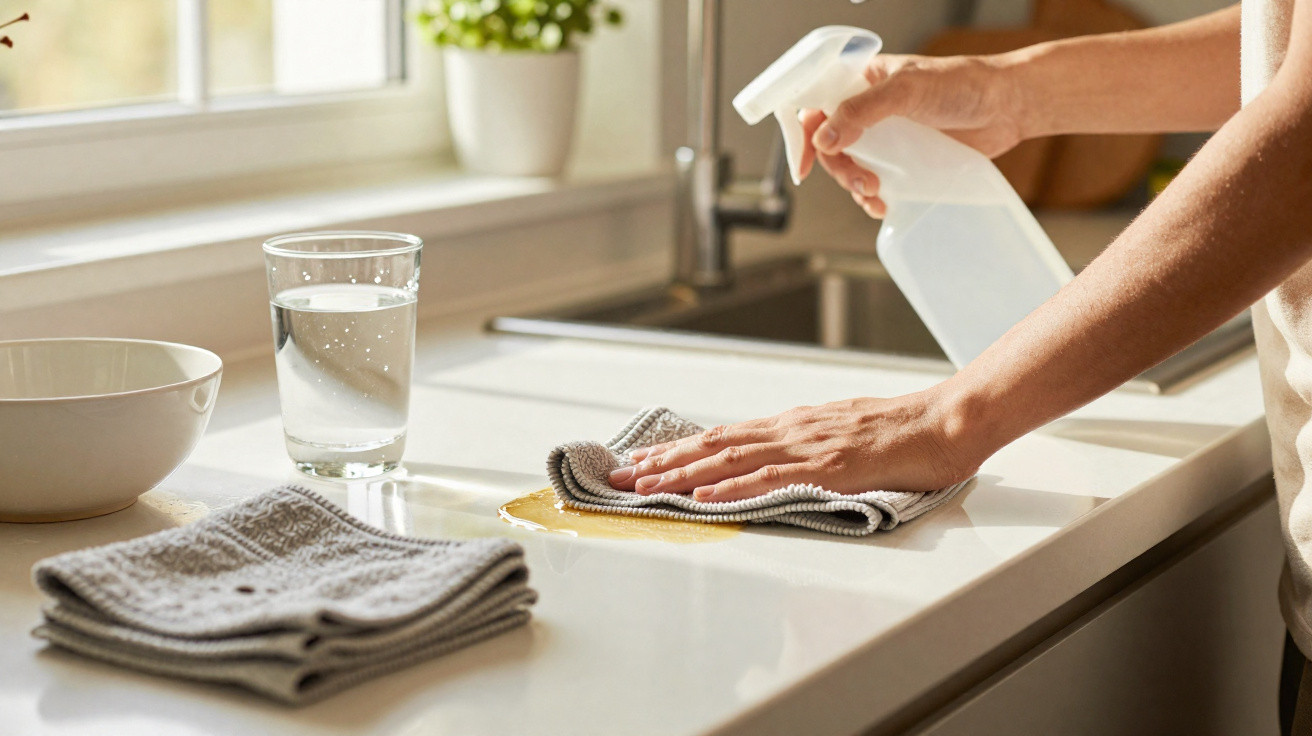
Cleaning coaches also refer to “zones of clean”. Each collection of surfaces is treated as its own small world, and within that world you still move from cleanest to dirtiest. On a kitchen worktop, for instance, start with the clear food-preparation space, continue to the coffee station with its grains of sugar, and leave until last the sticky patch where juice was spilt that morning.
Here is the detail many people overlook: do not wipe back into a cleaner zone using the same side of the cloth. Fold the cloth into quarters, using one section for the cleanest area. As you progress to a dirtier patch, turn it over to a fresh section. The cloth then supports the sequence instead of undermining it.
This order offers another understated advantage: it helps your motivation hold up for longer. Starting with accessible, less grimy areas gives you quick wins, and the room begins to improve rapidly. By the time you reach the more unpleasant jobs, you are already standing in a space that feels fresher. The mental burden eases slightly.
Small habits that transform the whole cleaning routine
The method cleaning experts recommend is rather like making a to-do list for your cloth. First, choose the room and settle on a “starting height” you will use every time. In the kitchen, that could be the top of the fridge; in the bathroom, it may be the mirror. Next, select a clockwise or anti-clockwise route, and follow that direction around the room on every clean.
Then combine the two main rules: high to low and clean to dirty. Start with a light dusting at your chosen height, wiping in one steady direction. Do not move lower until you have completed that level throughout the room. This layered technique stops the chaotic ping-pong effect. Rather than thinking, “Oh, I forgot that corner!”, you know its turn will come when you reach that height.
Professionals also prepare their tools around this sequence: one microfibre cloth for light dusting, another that is slightly damp for smudges and splashes, and a tougher cloth, perhaps with degreaser, for the final grimy zones. Each cloth has its own task, and none is reassigned halfway through.
This is also where some empathy is needed. Most of us clean when we are already tired, irritated or short of time. A flawless routine can feel like one more judgement. Professional cleaners understand that. They see hurried parents using kitchen roll, students scrubbing with one forlorn sponge and older people bending too far for too long.
They are not demanding a military-style ritual. They are sharing shortcuts that genuinely respect your energy. Begin modestly: choose one room in which to test the “order rule”. Perhaps it is only the bathroom on Sundays, or the kitchen after dinner twice a week. You don’t have to become a cleaning influencer overnight.
Let us be honest: nobody really does this every day. On some days, you will simply spot-clean the disaster area and carry on. That is fine. The important part is that, when you do choose to clean properly, you have a sequence that guides you rather than the other way round.
One experienced housekeeper summed it up with a laugh:
“People think we clean faster because we’re stronger or more disciplined. No. We’re just too lazy to wipe the same surface twice.”
Her “lazy” methods are well worth borrowing. She keeps a mental map of every room divided into three levels: above eye level, between eye and hip level, and below hip level. She never begins with the floor while shelves are dusty. She never cleans the toilet and then returns to the basin using the same side of the cloth. She also always finishes in the direction of the door, so she does not tread dirt back in.
- Always work from high to low, so falling dust cannot spoil what you have already cleaned.
- At each level, wipe cleaner zones before dirtier ones.
- Fold cloths and rotate their sides as you work towards heavier grime.
- Travel around the room in one direction to prevent “forgotten” patches.
- Finish near the exit, so your final step really is stepping out.
The quiet satisfaction of a room that stays cleaner for longer
There is a reason this “order of wiping” has become something of a secret handshake among cleaning experts. After trying it a few times, the room does not merely look different when you finish; it behaves differently afterwards. Surfaces remain cleaner longer. Fresh dust does not draw attention to old streaks. One dropped crumb does not immediately destroy the impression that the room has “just been cleaned”.
The sequence also alters how you feel as you clean. Rather than battling random stains, you are following a route you selected. That creates a subtle shift in your mind: the job has an endpoint. You know what comes next, and you know when it is complete. On hectic days, you can stop midway and still feel you have made progress because you have finished an entire “layer” or height.
We all know the moment of looking around and wondering, “How did it get this bad?” Often, the explanation is not that you failed to clean. It is that your efforts did not build on one another. A more intelligent wiping sequence makes each future clean easier, leaving you less often to deal with the consequences of last week’s mistakes.
Experts would say this is not about perfection; it is about building small wins. You might begin with only one habit: working from high to low. Or the folded-cloth technique. Or simply leaving the floor until last. In time, you will probably develop your own personal choreography to suit your home, family and energy levels.
Next time you reach for a cloth, stop for half a second. Look upwards rather than down. Ask yourself: “Where’s the highest, cleanest place I can start?” Then continue in one direction, at one height and through one zone at a time. The science is straightforward, but the feeling at the end is not.
| Key point | Detail | Benefit for the reader |
|---|---|---|
| High to low | Begin with higher surfaces and work downwards | Stops dust and crumbs falling on to newly cleaned areas |
| Clean to dirty | Wipe less-contaminated zones before grimier areas | Limits cross-contamination and keeps cloths effective for longer |
| One consistent route | Move around the room in a fixed direction and height sequence | Makes cleaning quicker, calmer and easier to repeat on busy days |
FAQ:
- What’s the single most effective change I can make? Start each room by cleaning from high to low. Even if you alter nothing else, this by itself reduces repeat work and streaking.
- Do I really need multiple cloths for one room? Not always. A single cloth folded into quarters can work as four small cloths, provided you change sides as you move into dirtier areas.
- How often should I follow this full sequence? Use the entire order for your “proper” cleans, perhaps weekly or fortnightly. Between those sessions, quick spot-cleaning is perfectly fine.
- Does this method work in tiny spaces, like studio flats? Yes. In smaller homes, the order is even more important because mess transfers more quickly from one surface to another.
- What if my family keeps ruining my clean surfaces? You cannot control everybody’s habits, but a clear wiping order makes it easier to refresh important zones, such as worktops and bathroom surfaces, without having to clean the whole room every time.

Comments
No comments yet. Be the first to comment!
Leave a Comment