
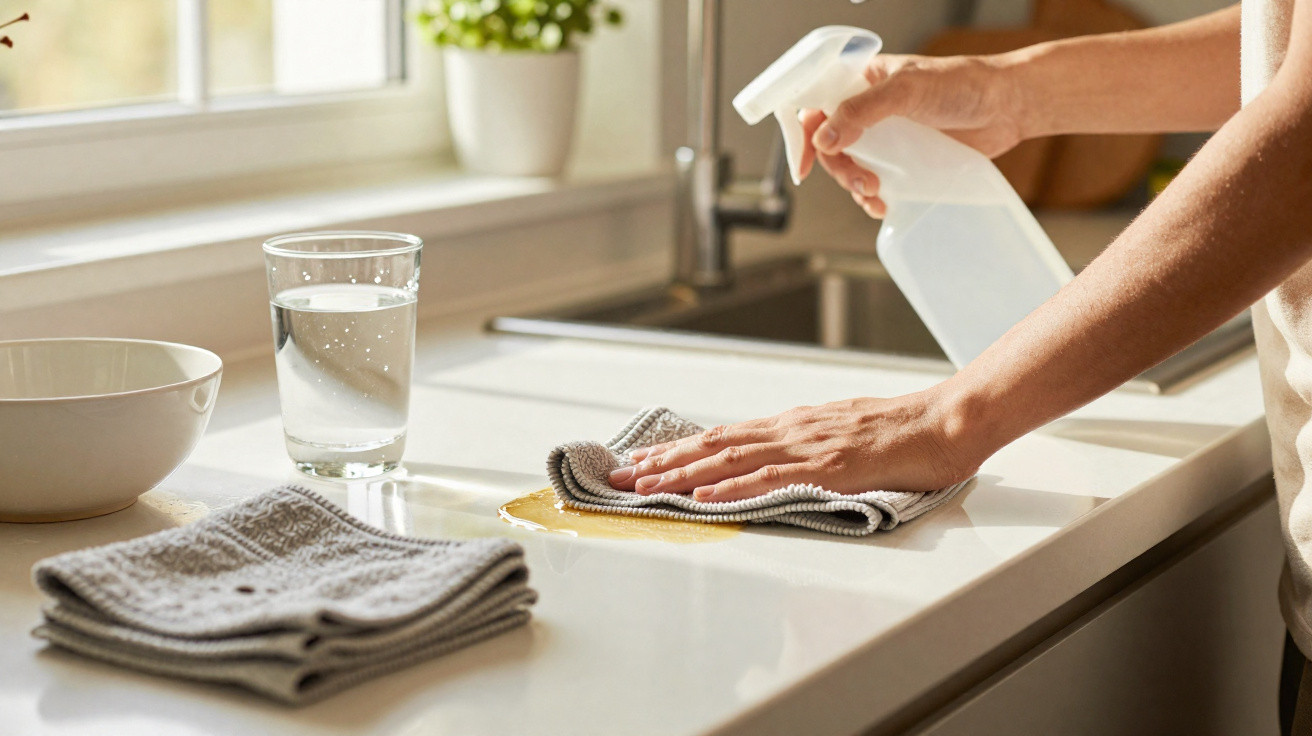
The lemon spray smells fresh, music plays in the background, and your kitchen worktops gleam.
You take a step back, pleased with the result. For a moment, the room could almost belong in a lifestyle magazine. You open the window, reply to a message or make yourself a coffee. Then, when you return, it is there again: a pale grey film across the surface, fine streaks visible in the light and crumbs stuck around the sink.
You have only just cleaned. And yet it already looks… worn.
You wipe it down once more, now slightly irritated. The same thing happens the following day. The more cleaning you do, the sooner everything seems to become dirty again. It feels a little ridiculous, almost as though the house is playing a trick on you. You may start questioning whether your products do anything at all, or whether your home is somehow working against you.
The reality is not quite so dramatic. But it is much more subtle.
The invisible mistake that undermines your cleaning
The usual error is not your cleaning product, your timetable or even the frequency of your cleaning. It is what is already on your cloth or mop when it meets the surface. Without noticing, many people spread a light layer of grease and dust, then wonder why everything looks grimy again within 24 hours.
If you wipe a worktop with a dirty cloth, an overly wet sponge or cloudy bucket water, you are not truly lifting away the dirt. You are simply redistributing it. Some remains in the cloth, some stays on the surface and some is carried to the next area. At first, the surface seems clean because it is damp and reflective. Once it dries, however, the reality shows itself.
In bright sunlight, the effect is unforgiving. The light reveals streaks, fingerprints and the faint greasy ring left where you placed the bottle. What seemed like a “proper cleaning session” turns out to be a short-lived illusion. Dust is not the real problem. Residue is.
A cleaning specialist from a professional hotel chain once admitted that the greatest difference between household and professional cleaning is not the product brand. It is the frequency with which cloths are changed and tools are rinsed. In hotels, a visibly dirty cloth is removed from use immediately. At home, we often use one cloth for the kitchen, dining table, handles and sometimes even the bathroom. This is how surfaces start attracting dirt more quickly: they already carry a microscopic layer of grime.
Social media is full of oddly satisfying clips showing people mopping large floors with one bucket of water that becomes grey after the first pass. It can look efficient and almost therapeutic. In practice, grey water means every square metre of flooring is being washed in a diluted mixture of dust, grease and old soap.
Picture polishing your glasses with a cloth you have just used on your shoes. You would never do that. Yet the equivalent happens with worktops, tables and sinks. We tolerate tools that are “a bit dirty” even though they touch nearly every surface in the home. Those surfaces are then left with a sticky coating that catches fresh dust faster than a genuinely clean one.
There is another issue, too: using too much product. Powerful degreasers, multi-purpose sprays and floor cleaners used neat “for better results” can leave a chemical layer behind. Initially, that layer may feel smooth or even look glossy. Soon afterwards, it becomes a magnet for dirt. Dust sticks to it, crumbs cling to it and fingerprints settle into it far more readily. The cleaner becomes the source of the problem, not because it is poor quality, but because it has not been removed.
How to clean so surfaces genuinely stay clean
The central technique is almost disappointingly simple: use clean tools, then remove the cleaning product. In practice, this means having more than one cloth, replacing the water more regularly and ending with a quick rinse. It is not glamorous, but it works exceptionally well.
For hard surfaces such as worktops and tables, approach the job in two stages. Use the first cloth for the “dirty work”: spills, grease and crumbs. It will become visibly soiled. Then use a second cloth, lightly dampened with clean water, for a quick pass that removes product residue. This second step may take only 20 seconds per surface, but it can dramatically extend the time a surface continues to look fresh.
The same principle applies to floors. If possible, use two buckets: one for rinsing the mop and one containing clean solution. Replace the rinse water as soon as it resembles thin soup. Yes, it is inconvenient. Yes, it is effective. A floor washed in dirty water attracts marks again almost immediately. One cleaned with fresher water remains matt and calm-looking for longer, without that tacky feeling beneath bare feet.
Most of us make the same mistake because we want to be “efficient”. One cloth for the entire kitchen and one bucket for the whole house feels sensible, practical and time-saving. In truth, it only hastens the return of dirt. The home looks good for an hour, then gradually becomes dull again.
There is also the tendency to overload surfaces with cleaner. If a little works, surely more must be better? So we spray until the worktop is nearly dripping or add extra floor cleaner “for the smell”. The outcome is a pleasant scent alongside a film that never fully rinses away. That film then becomes the stage on which dust puts on its daily show.
The kind truth is that you are not lazy; you are human. We all reach for the same cloth through habit. We all think, “It still looks okay, I can use it again.” When we are tired or running late, we all skip the rinse. Nobody gets up in the morning thinking, “I’m going to thoughtfully manage my microfibre saturation levels today.”
Still, a small change in routine can achieve more than an expensive new spray. Replace cloths a little sooner, use less product and allow time for a quick final pass with clean water. Under exactly the same light, the room can suddenly look professionally cleaned.
“The secret isn’t scrubbing harder,” says one veteran cleaner who’s worked in private homes for 20 years. “It’s not dragging yesterday’s dirt into today’s cleaning.”
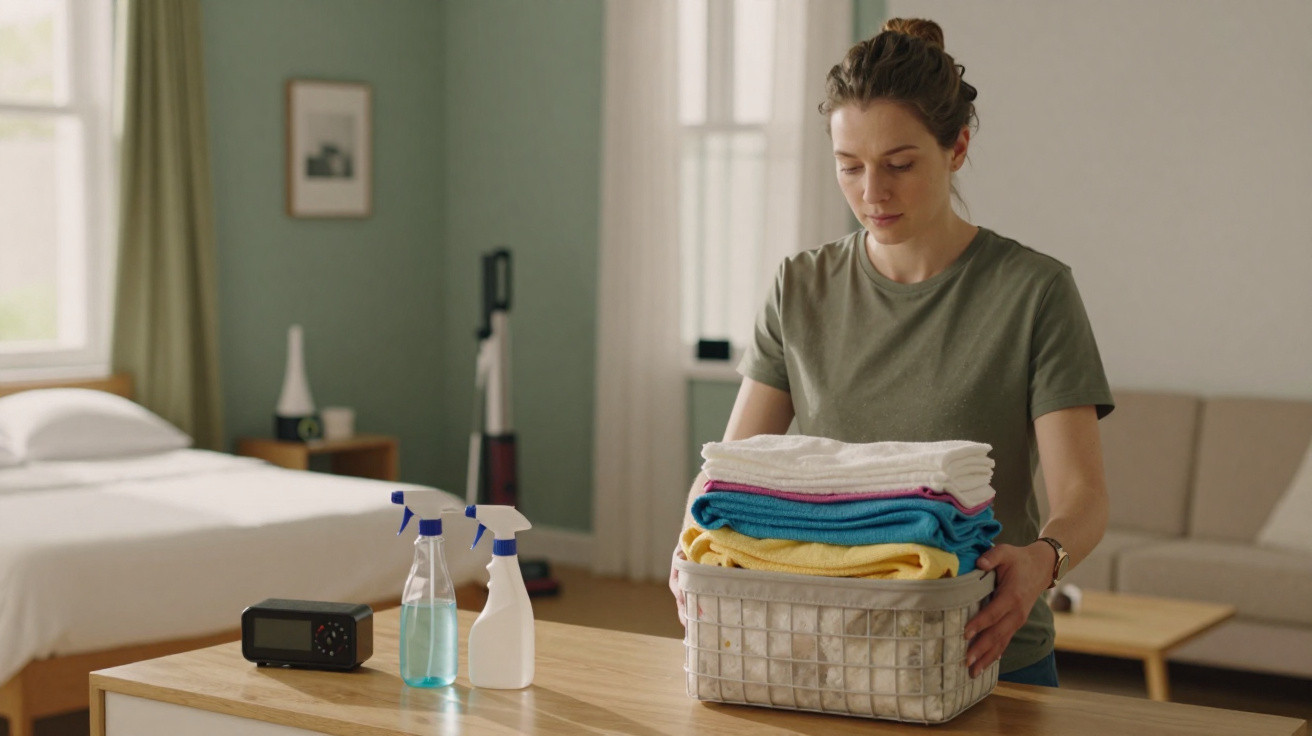
To make this simpler, turn it into an easy ritual rather than an endless-feeling chore. Before beginning, prepare several cloths or pads, decide which is for each area and give yourself permission to stop using them once they are dirty. There is no need to feel guilty. When a cloth looks worn out, it is not a badge of honour; it is a sign to change it.
- Keep a visible stack of clean cloths in the room you clean most often.
- Allocate one cloth to each “zone” - the cooking area, table and appliances, for example.
- Give every surface a brief, gentle final wipe with clean water.
- Use less product than you believe is necessary.
- Replace mop water as soon as it becomes visibly cloudy.
Living with cleaner surfaces, rather than merely cleaning them
There is a psychological element to this, too. When surfaces remain clean for longer, your relationship with the home shifts. You no longer feel that you are endlessly pursuing an impossible standard. You clean once and the result lasts. That sense of consistency can be unexpectedly calming.
On a busy weekday, entering a kitchen that still looks good after Sunday’s clean can transform your mood. You cook differently in a space that feels uncluttered and clear. You begin noticing details again: the colour of the worktop or the way daylight falls across the tiles. The house stops feeling like an endless list of jobs and becomes a setting you can genuinely enjoy.
We have all experienced spending two hours on a “big clean”, only for the effect to disappear two days later. It is demoralising. You may begin to think you are naturally untidy, or that “this house just gets dirty fast”. Often, it is not a personal failing at all. It is residue on the surfaces and on the cleaning tools.
Altering the way you use a cloth may sound insignificant. Yet that is precisely where the practical difference is made. You do not need a flawless cleaning routine. You do not need to disinfect the skirting boards every Tuesday at 5 p.m. Let’s be honest: nobody really does that every day.
What makes a difference is something more understated. Understanding that there is a reason a table attracts crumbs like a magnet. Recognising that a bathroom sink looking dull the next morning is not simply “your fate”. Knowing that a second, quick wipe with clean water can give you another day of visible freshness. These small realisations can change the way you view a sponge forever.
Once you recognise that “common mistake” - spreading yesterday’s dirt while doing today’s cleaning - it is impossible to overlook it. You will spot the grey cloth in your hand before it touches the white worktop. You will look twice at the mop water. Your home will not suddenly become a showroom, but it will remain genuinely clean for longer. And that is quietly, deeply satisfying.
| Key point | Detail | Benefit for the reader |
|---|---|---|
| Clean with clean tools | Replace cloths or water as soon as they are dirty, and keep zones separate | Surfaces stay neat for longer, with less repeated work |
| Reduce product residue | Use less cleaner and finish with a wipe using clean water | Less sticky film to attract dust and marks |
| Choose a simple ritual over perfection | Repeat small habits without obsession or an unrealistic schedule | A more enjoyable home and less mental load associated with cleaning |
FAQ:
- What is the main mistake that makes surfaces become dirty again quickly? Using dirty cloths, sponges or mop water, which spread a thin layer of old dirt and product residue instead of properly removing it.
- How often should I replace my cleaning cloths? Change them as soon as they look visibly dirty or feel damp and greasy; in reality, this often means using several cloths during a full kitchen or bathroom clean.
- Do I really need to rinse with clean water afterwards? Yes. A quick wipe with a lightly damp cloth removes surplus product and residue, helping surfaces remain cleaner and less sticky over time.
- Can I simply use stronger products to fix the issue? Stronger products that are not rinsed properly usually leave more residue, which can make dirt stick more quickly rather than slowing it down.
- What is the easiest change I can make today? Take one extra clean cloth: reserve the first for the dirtiest areas, then use the second only for a light wipe with clean water on the surfaces you want to keep pristine.
Comments
No comments yet. Be the first to comment!
Leave a Comment