
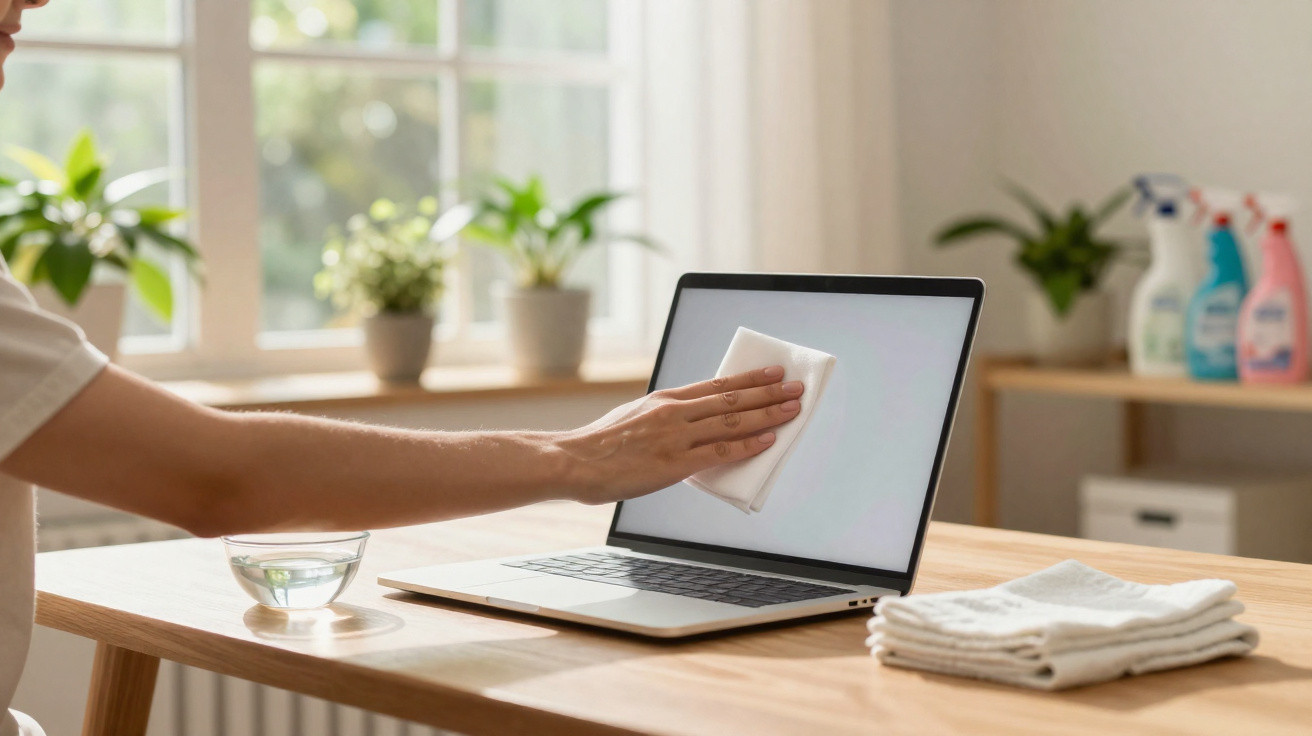
There is a small, almost instinctive ritual many of us follow: pick up a spray bottle, mist your phone or laptop display, then wipe it until the surface squeaks.
For a few moments, detergent or disinfectant scents linger in the room, delivering that chemical sense of reassurance: “ahh, now it’s clean”. Then it is back to scrolling, streaming or working. It is an everyday scene, so familiar it barely registers.
But stop and consider it. Your screen has not been in contact with raw chicken, nor has it been sitting on the bathroom floor. Even so, we often clean it as though it were a chopping board in flu season. With every spray, more unseen substances enter the air you breathe throughout the day in your bedroom or home office.
What looks like an innocent screen-cleaning habit may be adding pollution to the space where you spend much of your life. That is where the subject becomes less comfortable.
Invisible pollution and glowing screens
On a Tuesday afternoon, sunlight catches your laptop from exactly the right direction and reveals everything: fingerprints, greasy smears and specks of dust you had not even noticed. Against a bright white background, it can look unpleasant. The immediate urge is obvious: reach for the most powerful cleaner within reach and scrub until the glass resembles a glossy advert.
It is a distinctly modern response. Screens have become almost like our faces, representing us in meetings, video calls and presentations. A marked display can feel like a mark against your reputation. So we use the heavy-duty approach: multi-surface sprays, antibacterial wipes and fragranced detergents. For several minutes, the desk smells like a hospital corridor. Once the scent disappears, so does our awareness of what remains suspended in the air.
We leave believing one thing: “Clean.” Meanwhile, the room is telling a different story.
In 2022, researchers at the University of Colorado examined indoor air during ordinary household cleaning. One finding was particularly striking: cleaning products can raise indoor concentrations of volatile organic compounds (VOCs) to levels comparable with those on a polluted city street at rush hour. This can happen without anyone even opening the front door. Picture that in a compact bedroom used for calls, work and sleep, with the window only slightly open during winter.
Many people enjoy the fragrance of a “fresh lemon” cleaner or a “spring breeze” disinfectant. It suggests safety and hygiene - the very opposite of germs. However, that scent is often simply a chemical blend created to reassure your nose. Spray it around a screen and VOCs evaporate into the room, settle on dust, move through the flat and are inhaled by anyone relaxing on the sofa or playing on the floor.
The irony is harsh: we apply strong chemicals to devices carrying very little genuine dirt, then bear the cost in the one place we cannot easily clean - our lungs.
Indoor-air specialists point out that household pollution is not limited to smoke, traffic or mould. It also comes from the products we deliberately bring indoors. Detergents and disinfectants emit tiny molecules that can remain airborne for hours. In sensitive people, many are associated with headaches, irritation or respiratory problems. Some react with ozone entering from outdoors, producing secondary pollutants directly above your desk.
Put a screen at the centre of that situation. Unlike a kitchen worktop, it has no need for daily disinfection. It does not come into contact with raw meat or soil. Instead, it contains delicate coatings, sensors and vents that can be damaged by harsh chemicals. Using detergents on a screen creates a double disadvantage: poorer air for you and a reduced lifespan for the device.
The question therefore changes. Rather than simply asking, “How do I get rid of these streaks?”, ask, “What am I putting into the air while I clean?”
Clean screen, clean air: a low-tech approach
The simplest change is almost disappointingly straightforward: leave detergents and disinfectants out of your screen-cleaning routine. Begin with a soft microfibre cloth, such as one intended for glasses. Switch off the device, allow the display to cool, then wipe gently in straight horizontal strokes. Avoid circular movements and do not press as though polishing a car. Slow passes are enough to lift grease and dust.
If the display is particularly grimy, lightly moisten one corner of the cloth with plain water. It should not be wet enough to drip, only barely damp. Clean with the damp section, then use the dry part to finish. For persistent marks, distilled water with a small splash of white vinegar applied to the cloth - never straight onto the screen - will usually do the job. It seems low-tech, almost old-fashioned - and that is precisely the point.
Most screens do not need anything that smells as though it came from a laboratory. Usually, they simply need a little time and a gentle touch.
Here is what few people like to acknowledge: let us be honest, nobody really does this every day. Screens are cleaned infrequently, often hurriedly before an important call or just before a visitor is due to see the television. That is when people tend to overdo it. They reach for any bottle claiming “99.9% of germs destroyed” and think, “Why not? Stronger must be better.”
During a recent visit to a friend who works remotely, I watched him clean his monitor using a multi-surface disinfectant spray, squinting through the fumes. Within minutes, the room had a sharp smell, his throat felt scratchy and he opened the window despite it being winter. The monitor did not require hospital-grade hygiene; he had simply panicked about fingerprints before a client presentation.
The smudges disappeared. His home office also became a small chemical cloud.
This is where many people become caught between two worries: germs and the fear that something is “not really clean” on one side, and unknown chemicals and indoor pollution on the other. The useful reminder is to consider what a screen actually is. It is glass, plastic and perhaps a fine anti-reflective coating. It is not a chopping board, a sink or a bathroom handle. Apart from the occasional cough or sneeze, it does not require battlefield-level disinfection.
Once you stop treating it as a danger zone, the cleaning routine becomes gentler, quieter and far easier to breathe through.
Technology journalists who test gadgets throughout the day tend to offer much the same advice:
“If you wouldn’t spray it directly into your eyes, don’t spray it directly on your screen - or into the room you sit in eight hours a day.”
The wording may appear extreme, but it identifies the real concern: not what settles on the glass, but what remains in the air. To keep things straightforward, many professionals follow a short checklist:
- Start with a dry microfibre cloth, every time.
- If necessary, apply a very small amount of distilled water to the cloth, never to the display.
- Use light movements and avoid vigorous rubbing.
- Clean only once the device is switched off and cool.
- Avoid fragrances, bleach, ammonia and multi-surface disinfectants altogether.
These small habits do not look dramatic. There are no impressive bubbles or citrus-scented claims of complete cleanliness. Nevertheless, they quietly alter the balance: fewer chemicals indoors, a longer-lasting device and a mind that is not assaulted by sharp odours whenever you remove a fingerprint.
Rethinking “clean” in the age of screens
Indoor pollution is often pictured as a distant industrial problem involving chimneys, motorways and factories. The less pleasant truth is that much of it can begin on your own desk. Whenever you spray disinfectant onto a surface that does not genuinely need it, you exchange a smudge for a cloud. Individually, the effect may seem small. Across months and years, however, that small-scale environment is where we actually live.
Once you recognise this, the room feels different. The soft hiss of a spray bottle is no longer merely background noise; it is a decision. Some people react by going “full natural”, while others simply switch to milder products. Many just clean slightly less often, but with greater care. At an instinctive level, that is the important change: replacing automatic behaviour with deliberate choices.
Starting with screens means protecting more than a sheet of glass. It is an experiment in another form of cleanliness, one that values the air you breathe as much as the shine you see. That approach often extends to other areas: bathroom products, fragrances in the living room and how you ventilate your workspace after wiping a table.
This is not about paranoia or perfection. It is about being attentive. Small rituals repeated daily influence both your surroundings and your health more than any single dramatic action ever will.
| Key point | Detail | Benefit for the reader |
|---|---|---|
| Ditch harsh cleaners | Avoid detergents and disinfectants on screens | Reduces indoor chemical exposure and protects devices |
| Use simple tools | Microfibre cloth, a little water, gentle movements | An easy, inexpensive routine you can adopt immediately |
| Rethink “clean” | Focus on real risk rather than marketing promises | Restores control over your home air and everyday habits |
FAQ:
- Can I use alcohol wipes on my phone screen? Only if your phone manufacturer explicitly says it is safe. Even then, use them sparingly rather than making them part of a daily routine.
- How often should I clean my screens? For most people, once a week is sufficient. Clean more often only when the display is visibly dirty or sticky.
- Are screen-cleaning sprays from electronics shops safer? They are generally gentler than household disinfectants, although a microfibre cloth and water will often work equally well.
- Do screens really affect indoor air quality? Screens themselves do not, but the cleaning products used on them can release VOCs and other pollutants into the room.
- What is the safest “recipe” for cleaning screens at home? Use a soft microfibre cloth, slightly dampened with distilled water, and wipe patiently and gently - nothing more complicated is needed.
Comments
No comments yet. Be the first to comment!
Leave a Comment