
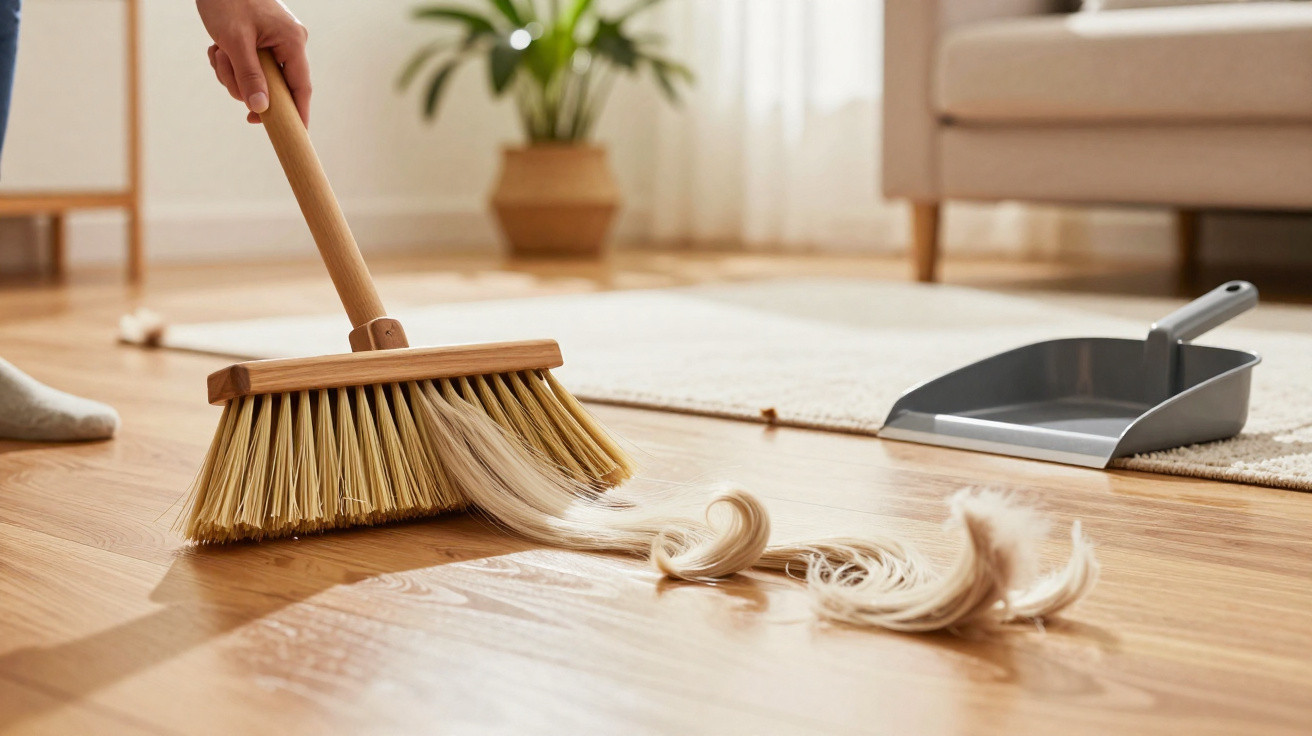
You bend down to gather a clump, only to watch the rest drift away as though it is deliberately avoiding you.
Dust is not the first thing that catches your eye.
It is the hair. Long strands gleam in the light and float across the tiles like slow-moving cobwebs, while a soft layer of pet fur grips chair legs and skirting boards. Before visitors arrive, you reach for the broom “just for a quick sweep”, pull it across the floor… and the hair appears to breed. It winds around the bristles, escapes in small spirals and creates stealthy trails along the grout.
The more you push it, the more it disappears beneath the sofa or into narrow gaps. After ten minutes, you have gone over the same area four times and the floor still does not properly look clean. The issue is not how much effort you are making, but the direction in which you are moving.
What if your sweeping method is actually the problem?
Why hair “fights back” when you sweep the wrong way
Many people sweep as if they are rubbing out a whiteboard drawing: broad, rapid side-to-side strokes. That approach can work reasonably well on dust. With hair, it creates a minor disaster. Pet fur and long human hair do not behave like crumbs. They flex, catch, drift, build up static and cling to whatever they touch - including the broom.
Sweeping against the way hair is lying does not truly gather it; it spreads it out. Every pass sends lightweight strands to the side or lifts them back into the air. You may find yourself watching, almost mesmerised, as they skim across the floor rather than gathering into a tidy pile. This is not simply bad luck: physics and direction are working against you.
Picture a long strand lying along a floorboard. Move the broom parallel to that board and the hair travels with it, like a miniature train on tracks. Sweep across it, however, and the bristles catch, twist and flick the strand away. Pet fur behaves similarly once everyday foot traffic has arranged it into patterns around the home. Sweeping “against the grain” makes fur scatter, lodge in joins and wind tightly into the broom instead of moving ahead of it.
The air displaced by sweeping matters too. A quick, wide sweep in the wrong direction shifts a surprising volume of air. That unseen current can raise light hairs enough for them to travel beyond your reach. On smooth flooring, hairs can even ride this cushion of air beneath cupboards or skirting boards. The more forcefully you sweep, the more likely you are to create these little gusts.
Direction becomes even more important on textured surfaces and around grout lines. Hair tends to settle lengthways in the channels. If you brush across those channels, you effectively press hairs into them like taut wires. Move along the grooves instead and the strands are more likely to roll together than snag. Nothing about the floor has changed; only the direction of your stroke has. Yet that can mean the difference between “finished in five minutes” and “why is this taking half an hour?”
The right direction: how to make hair follow the broom
Approach sweeping as you would brushing hair: work from the roots to the ends, following the direction in which the strands naturally sit. On the floor, the “roots” are the walls, while the “ends” meet at the central point where you plan to collect the debris. Begin at the room’s edges and sweep towards one gathering spot, keeping the broom moving in a consistent line that guides the hair onwards.
For long human hair, hold the broom at an angle so its bristles are directed slightly towards the way you want the strands to travel. Small, controlled movements are more effective than sweeping arcs. Allow the hair to form a modest wave in front of the broom. Once that wave appears, continue behind it; changing direction halfway through breaks the line and scatters the hair again.
Where floors have obvious lines - such as timber boards, tiles or laminate - use those patterns to choose your route. Sweep along the lines rather than cutting across them. With pet hair, particularly fur from short-haired cats and dogs, imagine you are moving a very light, timid cloud. Hold the broom lower so that more bristles remain against the floor, then draw the cloud forward instead of striking down at it. A single steady stroke with the “grain” achieves more than three frantic passes across it.
Consider a typical evening. You arrive home from work, step inside and spot a hallway that looks like a runway of fur and strands stretching from the entrance to the sofa. The vacuum seems like too much work, so you take the broom. Habit makes you begin in the middle. Hair shoots in six directions: some rolls beneath the shoe rack, some slips under the radiator, and some wraps around the broom in a tangled knot that you automatically try to remove with your fingers.
Without really intending to, you alter your approach and sweep towards the door because it feels more natural. All at once, the hair begins to gather in a line. Your mind immediately notices the change because it looks like genuine progress. A compact bundle builds on the tiles instead of a hazy smear. You continue in that direction, aligning the strokes with the route people normally walk. A task that should take two minutes now genuinely takes two minutes. The mess is the same; your angle is not.
Some cleaning experts who observe household habits have quietly recognised this tendency for years. Pet-owner surveys frequently refer to “never-ending fur tumbleweeds”, including in homes vacuumed regularly. Yet recordings of those owners cleaning often show them sweeping in all directions, pursuing visible hairs as if playing floor ping-pong. Once they are encouraged to choose one direction and maintain it, hair gathers more quickly and the broom remains cleaner.
The reasoning is surprisingly straightforward. Hair is long and flexible, so it aligns more readily than it compresses. Consistent broom movements bring more strands into line with one another on every pass, creating small ropes of hair rather than disorderly tangles. These ropes are simpler to contain, lift and throw away. Instead of resembling a battlefield of individual strands, the floor becomes a few orderly rows that can be scooped up at once.
Practical tweaks: small changes that transform sweeping hair
First, decide on a “hair exit”: one destination for everything you collect. This could be a dustpan placed near the middle of the room, a doorway or a bin. From the furthest corner, work in slow, controlled lanes towards that point. Treat it like mowing the lawn: overlap each pass slightly so no strip is missed, while remaining consistent with your overall direction.
If you share your home with a prolific shedder or somebody with exceptionally long hair, add one extra step. Before the main sweep, make a light preliminary pass along the skirting boards and beneath furniture, always moving debris towards the pile you will form later. This loosens persistent strands hiding in corners and angles. Use short movements, almost as though tracing the room’s outline. Once the perimeter is clear, the main section of flooring is far easier to sweep in straight lines.
On coarse flooring, allow the broom to glide rather than jab at the surface. Keep its handle slightly angled, so that the bristle tips skim over the floor and draw hair from tiny grooves. If a plastic broom seems to make every strand cling, first wipe its bristles with a barely damp microfibre cloth or lightly mist the floor. You are not washing it; you are reducing static so that hair follows gravity rather than electricity.
People who find hair difficult to remove from the floor are usually not lazy; they are simply making the wrong movements. One especially common error is panic-sweeping the same patch repeatedly while changing direction every few seconds. That often leaves hair around chair legs, beneath rugs and stuck to your socks. Another mistake is using just the broom tip as though it were a pencil, which makes hair spin sideways rather than travel forwards.
Guilt can also play a part. During a busy week, floor cleaning often ends up at the bottom of the list. Let us be honest: nobody really does it every day. When you eventually pick up the broom and the hair refuses to cooperate, the frustration is greater. That does not mean you are poor at cleaning. It simply means your technique has not been adapted to the way hair behaves.
One cleaning coach I spoke with summed it up simply:
“Dust is easy. Hair has a personality. If you move with it, it follows. If you fight it, it wins.”
Viewing hair as something with a personality can be helpful. Rather than treating it purely as dirt, you begin to see it as something that needs to be directed. That small mental adjustment affects how you grip the broom, position your arms and control your pace. The floor starts to feel like an area you are managing rather than a problem you chase every weekend.
For an easier reminder on hectic days, use this short checklist:
- Choose one direction and keep to it.
- Sweep from walls and corners towards a single central pile.
- Follow the “grain” of planks, tiles or foot-traffic routes.
- Use shorter, gentler strokes around furniture and confined spaces.
- Make a final pass around skirting boards, always directing hair towards the pile.
When sweeping hair becomes unexpectedly satisfying
After trying directional sweeping, you may find that the floor becomes oddly easy to read. You begin to spot where the pet normally sleeps, where hair is likely to collect and the direction in which a light draught from the window carries it. Rather than responding to random clumps, you start anticipating them. There is a quiet pleasure in that - not perfection, but control.
You may even find yourself teaching someone else without meaning to. Perhaps it is a child, partner or housemate making wild zigzags across the kitchen. You watch the fur spread, then demonstrate one straight lane; the hair rolls tidily into the middle as if it has suddenly learnt the rules. Small household wins such as this do not make headlines, but they influence how a home feels on a Tuesday evening.
We hear plenty about major cleaning hacks, miracle products and sophisticated vacuums with LED lights and six settings. Direction is rarely mentioned. Nevertheless, this invisible detail can determine whether five minutes of sweeping leaves a room calmer or merely moves the mess around. The next time a stubborn hair keeps circling your broom, pause before blaming it. Adjust your angle and let the strand show you where it wants to go.
| Key point | Detail | Benefit for the reader |
|---|---|---|
| Sweeping direction matters | Hair responds to aligned, consistent strokes rather than random zigzags. | You spend less time battling the same areas, while more hair is actually removed from the floor. |
| Work with the floor’s “grain” | Travel along tiles, planks and traffic patterns instead of across them. | This stops hair snagging in grooves and spreading beneath furniture. |
| Guide, do not chase | Select one collection point and gently direct everything towards it. | Sweeping becomes calmer, more efficient and unexpectedly satisfying. |
Frequently asked questions
- Why does hair wind around the broom rather than forming a pile? Long strands catch on individual bristles, particularly when you sweep across them. Slower strokes in one consistent direction reduce tangling and help keep hair ahead of the broom.
- Should I sweep or vacuum pet hair? Vacuuming is generally quicker for larger spaces, but directional sweeping is useful for daily touch-ups, stairs, corners and places a vacuum cannot easily reach.
- Is there a particular broom that works best for hair? Brooms with soft, dense bristles or rubber brooms usually grip hair better than rigid plastic bristles, which often flick strands around instead.
- Why does hair appear again after I have swept? It often was not collected in the first place: fast strokes may have pushed it into gaps, beneath furniture or into the air, where it settles again once the air is still.
- Can a slightly damp floor make hair easier to sweep? A light mist or damp microfibre pad can limit static and encourage hair to cling together, but soaking the floor spreads dirt and makes clumps more difficult to pick up.
Comments
No comments yet. Be the first to comment!
Leave a Comment