
One was a rich ocean blue; the other, a vivid cherry red. Now both look as though they have survived three lifetimes and repeatedly lost battles with the washing machine. You may recognise that pang of regret when you take out a former favourite and discover it has become a pale, lifeless version of itself.
In a small workshop tucked behind a side street, a seamstress sees these same faded garments and smiles. In her eyes, they are not beyond saving; they simply need a little encouragement. She uses neither a plug socket nor a bottle of dye. Instead, she reaches for something altogether different.
She refers to it as “waking the fabric up.”
The quiet secret to making fabrics look new again
The seamstress begins by passing her fingers over the faded top, almost as if reading braille. Colour is not the first thing she examines. She studies the texture and how the fibres catch the light. “Color is only half the story,” she says. “Shine is the other half.”
Her technique starts well before any solution is applied to the material. Using a soft clothes brush, she lightly brushes the fabric in a single direction. Small bobbles, fluff and dust lodged in the weave all reduce the richness of a shade. She describes this stage as “clearing the sky before the sun comes out.”
Only after that does the main part of her process begin.
One afternoon, a young woman arrives carrying a pile of black T-shirts. They are concert tops, their band names now barely visible and their shoulders more rusty than jet black. She is ready to bin them, but decides to consult the seamstress first. “They’re done, right?” she says, half-resigned.
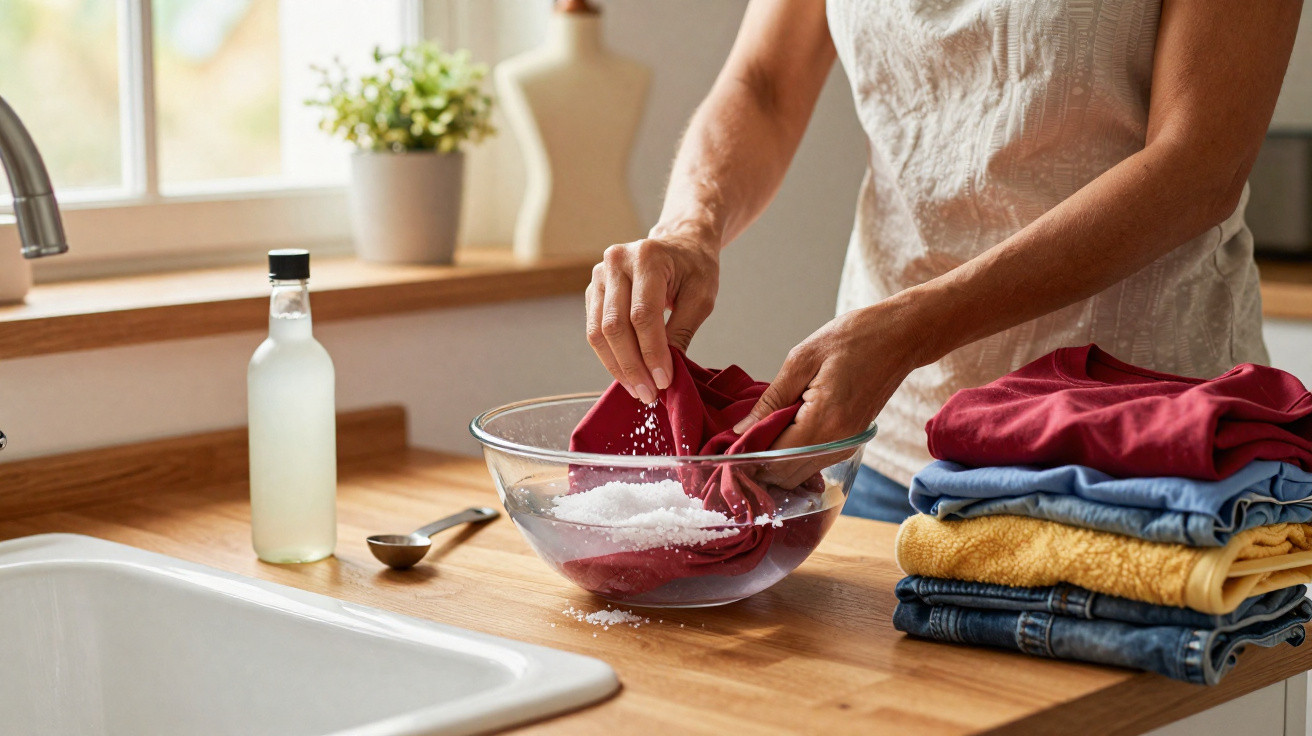
The seamstress gives a quiet laugh. “Not done. Just tired.” She prepares a bowl of lukewarm water, adding a spoonful of white vinegar and a pinch of salt. There is no dramatic foam or elaborate trick, only a calm, slightly cloudy solution. As the T-shirts soak, the two women chat.
Following a brief soak, the seamstress presses out the water carefully rather than twisting the fabric. She places one T-shirt flat on a towel and smooths it with her hands. Once dry, the black is not exactly as-new, but it appears awake. The outlines are crisper, the print more distinct and the colour less dull. The young woman looks at it for several seconds, then says, “I swear this looks like it did in college.”
The reasoning behind the process is remarkably straightforward. Regular washing deposits small amounts of detergent residue, hard-water calcium, fluff and fibres transferred from other clothing. Together, they create a fine haze across the surface. Instead of entering the colour, light reflects off that build-up.
Vinegar acts as a discreet mediator, helping to break down mineral deposits and soap traces left on the fibres. A small amount of salt slightly tightens the fibres, which may make deep shades appear darker and more consistent. Brushing removes the physical clutter resting on the surface of the fabric.
This process does not alter pigment as dye does. Instead, it changes how light and the eye interact with the material. The colour was not truly lost; it was hidden beneath a fine, unseen layer created by daily wear.
The seamstress’s no-dye, no-machine method for reviving clothes
Her approach begins at the sink rather than in the washing machine. She uses lukewarm water, never hot water. In her view, hot water “cooks the tired look into the fabric.” For a basin large enough to hold two or three garments, she adds roughly one tablespoon of white vinegar and one teaspoon of table salt.
After stirring until the salt has dissolved, she flattens each garment before putting it into the water. There are no scrunched-up bundles or forceful dunking. She slowly pushes the air out, ensuring that every part of the fabric comes into contact with the mixture. The items remain there for 20 to 30 minutes, not for hours. “Clothes don’t need a bath, just a good face wash,” she smiles.
Once the soaking time is over, she gives the garments a quick rinse in fresh, cool water and presses them gently rather than wringing them out like towels.
This is the stage at which most people hurry, but the seamstress deliberately takes her time. After rinsing, she lays every item on a clean towel and rolls the towel up like a soft sushi roll to draw out surplus moisture. There is no twisting and no tugging at seams. That step alone preserves a great deal of shape and colour.
When the towel is unrolled, she uses her hands to smooth each garment. She straightens the neckline, aligns the sleeves and carefully but firmly draws the hems back into place. Then the item is left to air-dry, though its location matters. It must be kept out of direct sunshine and away from radiators. “The sun is a gossip,” she says. “It tells everyone your clothes are old.” Intense sunlight bleaches pigments that are already weakened.
Let’s be honest: nobody genuinely does this every day. Still, using the method once on your best-loved items can add months, or even years, of wear. It is particularly useful for blacks, navies and reds, which often seem to fade most quickly.
While the garment dries, she completes what seems like a small ritual. She brings out the soft brush again and works with the grain of the cloth. On cotton knits, brushing is much like polishing shoes. With smoother materials, she may instead use an almost-dry, clean microfibre cloth, rubbing very gently. In each case, the aim is identical: to align the fibres in one direction so the surface reflects light evenly.
She does not use fabric softener on these revival days. Although softeners initially make material feel pleasant, they leave behind a coating that can mute the appearance of colour. For delicate garments, she leaves out the salt, uses vinegar alone and shortens the soak. She also never combines pale items with dark ones during this treatment, as even transferred fluff can make all the clothing seem more worn.
She once put it in a way that stayed with me:
“Most clothes don’t die from time, they die from how we treat them between one wear and the next.”
Her practical rules are almost comically simple, but they are effective. This is the small reference list she once wrote in her notebook and now shares with anyone who asks:
- Use lukewarm rather than hot water when reviving faded clothes.
- For dark or vivid colours, add a spoonful of white vinegar and a pinch of salt.
- Brush or remove fluff both before and after treatment to clear the fabric surface.
- Remove water by pressing garments in a rolled towel; never twist or wring them.
- Dry garments flat or on a hanger, away from strong sunlight and heaters.
Why this small ritual means more than simply “saving money”
There is a gentle intimacy to bringing a faded shirt back to life by hand. You give a little extra time to something you once selected, perhaps for an important evening, a job interview or an unexpectedly perfect day that remained in your memory. As the shade becomes clearer, those memories can feel sharper too.
In practical terms, this approach keeps clothing in your regular wardrobe for longer. It means fewer impulsive purchases, fewer guilty charity-shop donations of items that are almost new but slightly faded, and fewer carrier bags marked “I’ll sort it out later” sitting at the bottom of the wardrobe. The seamstress often says that the least expensive wardrobe is not the one with the smallest price tags, but the one whose contents remain lovable for the longest time.
At a more profound level, this kind of simple care can change how you see your other belongings. If water, vinegar and a soft brush can rescue a T-shirt on the brink, you may hesitate before declaring the next thing “ruined”. You may even teach your children to roll up a towel and press out the water, laughing as they splash half the sink in the process.
We have all stood in front of overflowing shelves and said, “I have nothing to wear.” What this seamstress demonstrates is that sometimes you do have something to wear. It is simply concealed beneath neglect, rushed habits and harsh washing-machine cycles.
Her small technique cannot solve every problem. Cotton bleached almost grey by sunlight, cracked prints and material worn so thin it becomes transparent are garments whose stories have reached their conclusion. But between completely new and genuinely worn out lies plenty that can still be reclaimed, without dye, specialist machines or a qualification in textile science.
That is the understated strength of her ritual: it will not make a wardrobe flawless, but it may make it feel like yours again.
| Key point | Detail | Benefit for the reader |
|---|---|---|
| Prepare the fabric | Brush and remove fluff before soaking | Colours immediately look sharper and less faded |
| Vinegar + salt solution | Soak for 20–30 minutes in lukewarm water | Revives the intensity of shades without dye |
| Gentle drying | Press in a towel, then air-dry away from direct sunlight | Extends clothing life and limits future fading |
FAQ:
- Can I use this trick on all fabrics? It works best on cotton, denim and blends; for silk or wool, shorten the soaking time and leave out the salt.
- Will this method restore completely bleached clothes? No, it cannot replace lost pigment, but it can make tired colours look cleaner and slightly deeper.
- How often can I do this without damaging my clothes? For your favourite pieces, once every few months is normally enough and remains gentle.
- Can I replace white vinegar with cleaning vinegar or other acids? Use food-grade white vinegar only; stronger cleaning formulas may be too harsh on fibres.
- Does it remove stains too? It can help with light detergent or mineral marks, but stubborn stains still require targeted stain treatment first.




Comments
No comments yet. Be the first to comment!
Leave a Comment