
The marks always seem to reveal themselves at exactly the wrong time.
Sunlight floods the living room, visitors are due any minute, and every pane suddenly appears to have been rubbed with a greasy tea towel. From across the room, it looks “clean enough”. But once the light catches it sideways, there are smudges, dried-product curves and stubborn ghost fingerprints everywhere.
I once watched a professional window cleaner at a London café work as though there was no rush at all. He took three minutes over each window. There was no commotion, no elaborate equipment and no theatrics. When he was done, the glass was not merely clean. It looked… invisible.
Over a brief conversation and a takeaway coffee afterwards, he shared the precise solution he uses, as well as the one small mistake that most of us make.
The zero-streak solution the pros actually use
Ask ten people how they clean their windows and the usual replies soon emerge: blue supermarket spray, multi-surface wipes, or perhaps a homemade vinegar blend spotted on TikTok. Professional cleaners are generally unimpressed by that selection. It is not that these products never achieve a result, but that they are formulated to “smell clean” and “shine a bit”, rather than to keep glass truly free of streaks in unforgiving daylight.
The mixture many professionals rely on is remarkably plain: water, a very small amount of washing-up liquid, and either distilled vinegar or isopropyl alcohol. Nothing else is needed. There is no fragrance, fluorescent colouring or miraculous “nano” claim. It is simply a blend that removes grease, dries quickly and leaves no residue. It is not especially glamorous. Yet it works for people whose livelihoods depend on glass looking spotless at midday.
At a high-street salon in Manchester, the manager laughed when she showed me their supposedly “fancy” window-cleaning equipment. It consisted of a worn plastic bucket, a soft sponge and a rubber-bladed squeegee older than several employees. She said they had tested expensive sprays promising “diamond shine” and “anti-fog technology”. Beneath the strip lighting, every mark was visible on both the mirrors and the shopfront glass.
They returned to a formula she had learned from the person who cleaned their frontage years earlier: one litre of warm water, a small squeeze of ordinary washing-up liquid and a splash of white vinegar. The quantities are modest – roughly one teaspoon of liquid soap and two or three tablespoons of vinegar. Add too much soap and it simply spreads residue around; use too little and grease takes over. She still recalls getting the proportions right for the first time, when customers began asking whether they had installed new mirrors.
There is a straightforward reason this basic mixture often outperforms commercial sprays. Glass has no interest in a pleasant scent; what matters is how much residue remains and how quickly the liquid evaporates. Many supermarket cleaners include surfactants, perfumes, colourants and, at times, silicone or gloss-enhancing ingredients. These additions adhere to glass, catch the light and become streaks. The professional mixture follows the reverse principle: use almost nothing that can dry onto the surface.
The washing-up liquid dissolves fingerprints, cooking residue and traffic dirt. Vinegar or alcohol tackles mineral deposits while helping the surface dry faster. Distilled water, if you are willing to use it, removes a final cause of haziness created by limescale in hard-water areas. The aim is not “clean plus shine”. It is clean then disappear.
How professionals actually use it on real windows
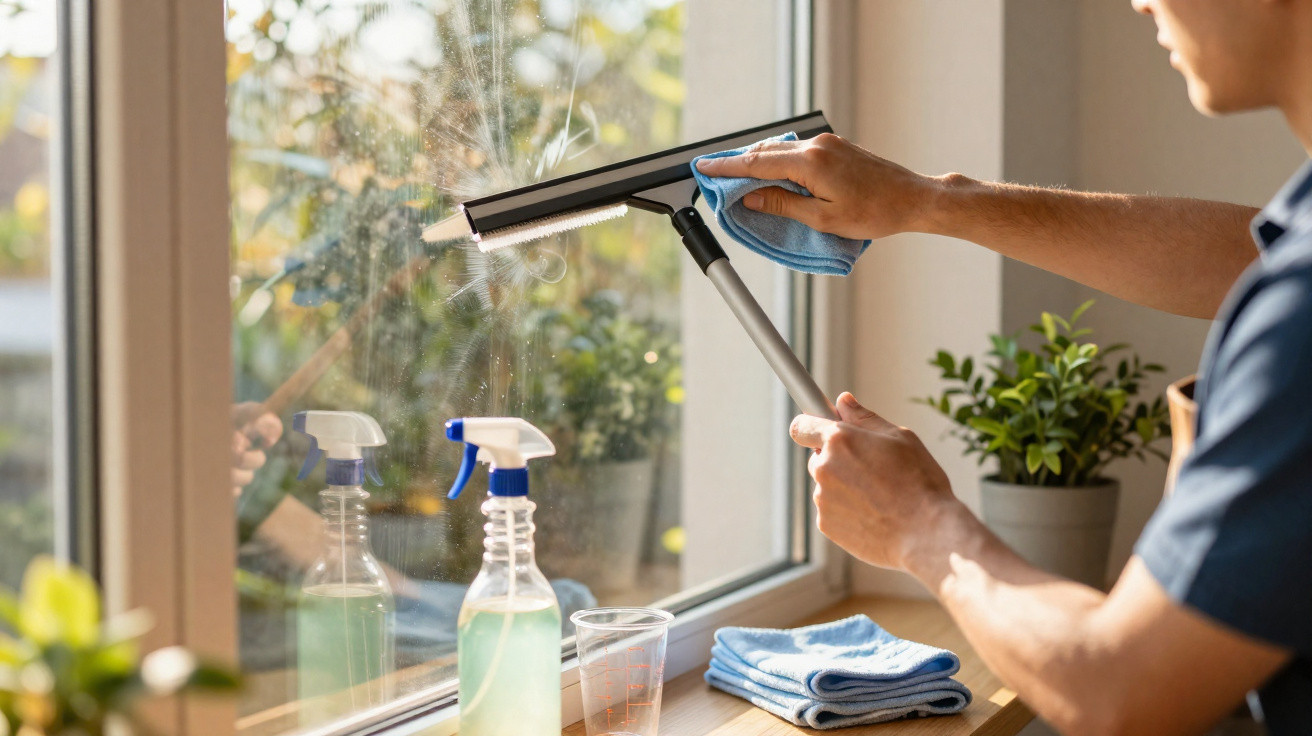
The formula is only part of the method. Watching the cleaner at that London café, I noticed he spent longer on the first pass than on everything that followed. He soaked a microfibre pad in the bucket, squeezed it until it was damp rather than dripping, and spread the mixture across the glass with relaxed horizontal movements. There was no frantic scrubbing, only slow, overlapping strokes that lifted dirt rather than moving it from one place to another.
Next came the step many of us miss: from the top corner, he drew a rubber-bladed squeegee down in one smooth movement, wiping the blade with a cloth after every pass. No circular motions and no zigzags. Just steady, consistent lines. By the third section, the pane was virtually dry. He used a cloth only around the edges, where water tends to collect and leave delicate trails.
At home, people often take precisely the opposite approach. They apply a heavy mist of cleaner directly to the window, usually more than necessary, then scrub at it with kitchen roll until their arm aches. The paper sheds slightly and leaves lint behind. Meanwhile, the cleaner begins drying as they wipe, so they pursue the streaks over the glass and create further marks as they go. Eventually, they stand back slightly breathless and wonder why the window remains blotchy in the sun.
Professional window cleaners approach glass as something to “rinse and pull dry”, not a surface that needs polishing. One cleaner compared it with shaving: you first soften and loosen everything with the solution, then remove it cleanly in a single direction instead of rubbing it back into your skin. In practical terms, that means using less product, more water and a tool – the squeegee – that pushes liquid away rather than absorbing it.
There is also a less glamorous point about how often the job is done. Professionals do not wait until windows are heavily soiled. They deal with the light film of daily dirt while it is easy to remove. At home, we are more likely to overlook the glass until spring arrives or a neighbour comments on the marks on the patio door. By then, it is not simply dusty; it may be covered in cooking oils, pollution from the air and possibly a fine nicotine layer where somebody smokes. Let’s be honest: nobody genuinely does this every day.
The emotional impact tends to arrive on bright Saturday mornings, when you suddenly notice the condition of the sliding doors. On an overcast day, they seemed perfectly acceptable. Now there is a child’s handprint preserved at eye level, dog nose smudges near the bottom and unexplained arcs left by somebody who once tried to clean a small patch with a damp sleeve. On a human level, those marks tell a story. Practically, they mean you need a technique that works through that history in one attempt, rather than after five frustrating rounds of wiping.
The tiny tweaks that change everything
Professionals usually suggest very similar recipes, with slight differences. One commonly used version is this: combine 500 ml of distilled water or cooled boiled water, one teaspoon of plain washing-up liquid, and one to two tablespoons of white vinegar or 70% isopropyl alcohol in a spray bottle. Shake it gently rather than as though making a cocktail. The goal is to combine the ingredients, not whip up foam.
For application, mist the solution lightly onto a microfibre cloth instead of saturating the glass itself. Move the cloth across the window in straight strokes or loose S-shapes until the grime comes away. Then either draw a squeegee vertically from the top, wiping its blade on a dry cloth after each strip, or use a second, entirely dry microfibre cloth to buff the surface gently.
The key is for the glass to remain faintly damp during that final stage, never soaked and running with water. Professionals describe it as “sheen, not splash” – a thin layer that can be cleared with one movement. Too much liquid guarantees drips and mineral marks from the water. Too little causes dragging, when the cloth grips and jerks rather than gliding. Once you have found that balance, you will spot it every time.
Many people blame the glass when their cloth is actually at fault. Old towels, newspaper and kitchen roll can all release fibres or create microscopic scratches on the surface. There is a reason microfibre is the trade’s understated essential: its fine threads lift grease rather than spread it, and when it is clean and dry, it buffs with almost magical results.
This is where the situation feels familiar. You arrive home tired, spot a mark on the patio door and reach for whatever is closest: the tea towel, already slightly wet from washing up. After two wipes it looks somewhat improved, so you carry on with your evening. Then the light shifts, and the mark has become a dull, greasy rectangle. The cloth did what it could, but it spread old residue from previous jobs across the glass. It is a minor everyday shortcut that quietly creates more work later.
One experienced cleaner from Leeds put it simply:
“Glass only shows two things: what you put on it, and what you left on it.”
He has a mental list for clients seeking immaculate, streak-free windows at home. It reads almost like a guide to keeping life manageable:
- Choose a simple, low-residue solution – avoid waxy, heavily perfumed sprays.
- Use one cloth to clean, then another cloth to dry, or use a squeegee; never use the same cloth for both jobs.
- Work in shade or when the glass is cool, rather than in direct midday sunshine.
- Wash microfibre cloths separately and do not use fabric softener, which removes their grip.
- Stop as soon as the glass appears clear; excessive rubbing often creates streaks.
Why this matters more than “just clean windows”
Something subtle changes once windows are genuinely, almost invisibly, clean. A room can feel unexpectedly larger. Daylight reaches further into it. The colours in your home seem slightly truer. You begin to notice details you had overlooked, from the grain in a table to the exact tone of a plant’s leaves and the actual condition of the skirting board you have been avoiding.
Clean glass changes the view outside as well. On a wet weekday, the city can seem dark and grey through stained, dull panes. After a thorough streak-free clean, that identical view appears brighter, as if someone quietly turned up the contrast on life. It is not magic. The barrier between you and the world has simply stopped demanding attention.
There is something quietly personal about knowing how to make a window disappear. Friends notice, even if they cannot always say why. Guests stand by the balcony door and remark, slightly surprised, “You can really see the trees from here.” It is a small household skill, but it can bring a sense of order to a world that often feels untidy. All it requires is a straightforward solution, a good cloth and a few unhurried, purposeful strokes.
| Key point | Detail | Benefit for the reader |
|---|---|---|
| The right solution | Water, a small amount of washing-up liquid, plus white vinegar or alcohol | A simple recipe to recreate at home without expensive products |
| The right technique | Clean first, then dry in straight lines with a squeegee or microfibre cloth | Immediately reduces streaks and hazy marks in the light |
| The right tools | Clean microfibre cloths, a squeegee and, if preferred, distilled water | Less physical effort, with a more professional and lasting finish |
FAQ:
- What is the exact window-cleaning solution professionals recommend? Most pros use a mix of water, a teaspoon of plain washing-up liquid and one to two tablespoons of white vinegar or isopropyl alcohol per 500 ml of water.
- Why do my windows still streak, even with this mix? Streaks usually come from dirty cloths, using too much product, or trying to clean hot glass in direct sun so it dries too fast.
- Is vinegar safe on all types of glass? Vinegar is fine on normal window glass, but avoid the frame’s sealant and skip it on special coatings unless the manufacturer says it’s OK.
- Can I use this solution on mirrors and shower screens? Yes, the same low-residue mix works well on mirrors, shower glass and even glossy tiles, as long as you dry them properly.
- Do I really need a squeegee, or is a cloth enough? A good microfibre can be enough for small windows, but a rubber-bladed squeegee makes larger panes faster and more reliably streak-free.



Comments
No comments yet. Be the first to comment!
Leave a Comment