
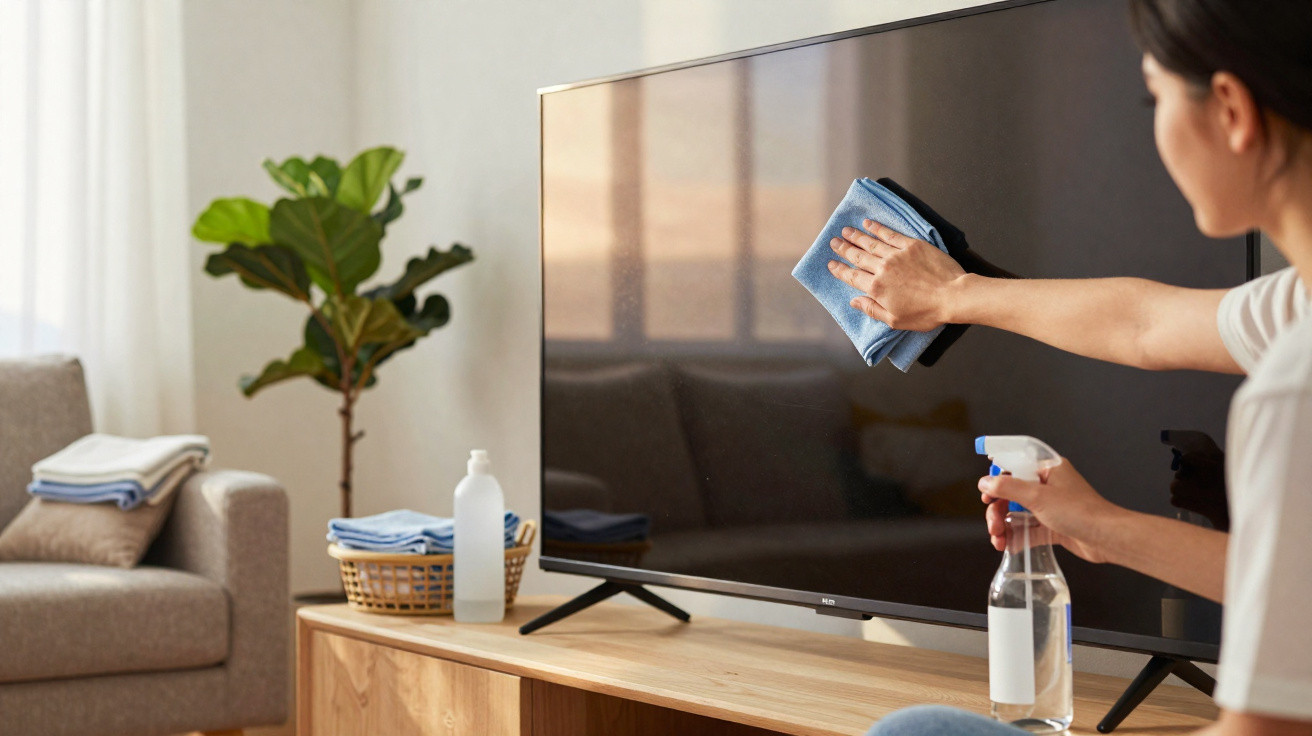
After a long day, Anna finally settled down, pressed play on her series, and found the scene’s magic… gone. Fingerprints lined the edges, streaks ran across the sky, and small dusty rings caught the lamp’s reflection. The image seemed less crisp, as though a greasy film had been laid over it.
She reached for a general-purpose kitchen spray, stopped, and noticed the small print on the TV’s frame: “Do not use detergents or solvents.” Her hand stopped immediately. Years earlier, she had already ruined one screen that way.
This time, she chose another approach: no detergent or disinfectant, only a straightforward trick she had read about but never trusted. Within two minutes, the screen looked nearly new.
Nearly as it had when she first removed it from the box.
Why your TV never looks properly clean, even after wiping it
Most people treat a TV screen as they would a window: a quick spray, circular rubbing and a swift pass along the bottom. They leave believing, “Done.” Yet when light falls across the display from an angle, every flaw becomes obvious: swirls, rainbow-style smears and areas where dust sticks more firmly than before.
Modern flat-panel screens are not glass in the way old CRT televisions were. They consist of delicate plastic layers protected by a specialist anti-reflection coating. Using glass cleaner, alcohol wipes or kitchen spray on this vulnerable surface does not truly clean it; it gradually damages the protective layer that keeps the picture deep and sharp.
Fortunately, none of those products is necessary in the first place.
An electronics repair shop in Manchester told me that roughly 1 in 10 calls about a “broken TV” begins with the same explanation: “I just cleaned the screen.” The accounts follow a familiar pattern. One person used disinfectant wipes left over from the pandemic. Another sprayed lemon-scented cleaner straight onto the display. Someone else scrubbed it with paper towels that seemed “soft enough”.
This damage does not arrive all at once. It develops gradually. Initially, the anti-glare coating wears away in places. Blacks lose their depth and begin to appear slightly cloudy. Permanent marks then emerge that wiping cannot shift, because they are no longer sitting on the surface. They have become part of it.
The irony is that these screens could have lasted for years if people had used fewer products, rather than more.
Technically, these panels are constructed rather like skin. There is the visible outer layer, beneath which sits a stack of ultra-thin materials controlling reflection, colour and contrast. Aggressive chemicals attack that upper coating and leave it microscopically rough.
After the layer has been harmed, dust attaches itself more readily. Each subsequent wipe can then work like sandpaper, pulling particles over a surface that is already compromised. This is why some screens end up permanently misty-looking after supposedly “extra careful” cleaning.
Oddly enough, ordinary dust, fingerprints and greasy marks left by children’s hands are much easier to remove than most people expect. All that is required is the right fabric, the right movement and a little patience.
The no-detergent trick that makes your TV look new again
This is the simple technique that makes the difference. Switch off the TV and allow it to cool down. A cold, dark display makes dirt easier to spot and prevents heat-related static from attracting dust. Take two clean, good-quality microfibre cloths - the sort intended for spectacles or camera lenses, rather than an ordinary dishcloth.
Use the first cloth while it is dry. Beginning at the top edge, lightly draw it across the screen in straight horizontal passes. Do not use circles or pressure. Make gentle, even strokes that move the dust downwards and away. You may be surprised by how much vanishes in seconds.
Next, take the second cloth and gently breathe on a persistent fingerprint as though you were misting a mirror. Wipe again in straight lines, using only that trace of moisture from your breath. Nothing more is needed: no detergent, no disinfectant, and the screen appears clearer.
People regularly make two familiar errors. The first is applying too much force, as if a mark will disappear when you “fight” it. In reality, this only presses particles into the coating. The second is using whichever fabric happens to be nearby: the corner of a T-shirt, a paper towel or sometimes even a kitchen sponge. All carry a concealed risk, with fibres or tiny debris that may scratch the screen.
During a busy week, a thin layer of dust may gather on your TV every few days. Let’s be honest: nobody really does this every day. That is perfectly fine. Cleaning gently once every week or two with this simple trick is enough to keep most screens looking almost as fresh as they did in a showroom.
There is another benefit to this small routine. Turning off the TV, standing in front of it and taking time over slow, straight strokes draws you out of passive mode. Rather than simply consuming an image, you are caring for the device that provides it.
“The worst thing you can do to a modern TV isn’t to forget cleaning it,” says Marco, a TV technician in London. “It’s to clean it with the wrong stuff. Gentle and dry wins almost every time.”
For a quick guide, here is the straightforward checklist that many technicians quietly suggest:
- Always clean the screen cold - switch it off, with no residual heat or fresh static.
- Use two microfibre cloths: a dry one for dust and another for lightly fogged wiping.
- Never spray anything directly on the screen, including water.
- If moisture is genuinely needed, make the cloth barely damp, never the TV.
- Avoid paper towels, alcohol, ammonia and disinfectant wipes completely.
Why this small habit changes how you watch TV
Once you have seen your TV genuinely clean - without haze or pale arcs from earlier wiping - you cannot ignore the difference. Colours appear more accurate, skin tones look more natural, and dark scenes finally resemble night instead of cloudy grey. It is not merely psychological: your eyes no longer have to look through a layer of residue.
There is also a quiet pleasure when visitors ask, “New TV?” and you can reply, “No, just cleaned it properly.” It may sound insignificant, but in a world constantly chasing “better screens” and bigger sizes, getting the full performance from the TV you already own feels almost defiant.
In practical terms, this method may help your TV last longer. A screen not being slowly worn down by detergents can retain its contrast and clarity for more time. A few unhurried minutes with two cloths and no cleaning products could delay the moment when a glossy new model in the shop window starts to tempt you.
| Key point | Detail | Benefit for the reader |
|---|---|---|
| Dry cleaning first | Soft microfibre cloth, horizontal movements, TV switched off | Removes most dust without the risk of scratching |
| Light mist, no product | Use only the moisture from your breath for greasy marks | Protects the anti-reflection coating and image sharpness |
| Products to avoid | No sprays, alcohol, paper towels or disinfectant wipes | Prevents irreversible damage that ages the screen too quickly |
FAQ:
- Can I use a tiny amount of glass cleaner if I spray it on the cloth? Technically it will “work”, but manufacturers strongly advise against it. Even small amounts of alcohol or ammonia can slowly damage the coating.
- What if my screen already has permanent streaks? If streaks don’t change at all when you wipe, the coating may be damaged. You can still clean gently to prevent worse, but the marks usually can’t be reversed at home.
- Are special “TV cleaning kits” worth it? Some use very mild formulas, others are glorified water. The microfibre cloth they include is often the real star. The dry + breath method often gives the same result for free.
- Can I use the same trick on my laptop, monitor and tablet? Yes, the principle is the same. Modern screens all use delicate coatings. Dry microfibre first, then minimal moisture from breath or a barely damp cloth.
- How often should I clean my TV like this? Most homes are fine with every one to two weeks. If you have kids touching the screen or live in a dusty city, you might do it more often, but the method stays exactly the same.

Comments
No comments yet. Be the first to comment!
Leave a Comment