
You pick up your towel, perhaps glance at your phone or call something through the door. Within two minutes, you are elsewhere in the house, thinking about work, children or coffee. The bathroom door remains partly shut, while the room stays warm and damp. Nothing noticeable happens - not today or tomorrow.
A few weeks later, though, a dark mark emerges along the grout behind the bottles. A slight musty odour lingers by the shower curtain. You clean it “just this once”, then forget about it again. Quietly, the pattern continues. Mould does not appear like a storm; it develops through a habit you never realised you had.
One small, easily overlooked action can disrupt that pattern in under a minute.
The quiet moment when mould takes hold
Many people assume mould grows because a bathroom is “old” or “poorly ventilated”. In reality, the cause is less dramatic. Mould flourishes in the warm, stagnant air left behind for 20 to 40 minutes after a shower. During that period, humidity penetrates every porous material: grout, paint, the ceiling and even a wooden door frame.
We leave while this unseen process is still under way. Water covers the shower walls, droplets bead across the floor and the shower curtain sticks to the bath. With nobody paying attention, no action is taken. The moisture remains precisely where mould thrives. The battle is lost in silence, during that brief stretch between turning off the water and the room cooling down.
One American household survey found that over 60% of bathrooms have some traces of mould around the shower. These are not necessarily serious infestations, but small dark lines, ceiling specks or faint rings around silicone seals. Mould of this kind seldom develops overnight. It results from recurring micro-conditions: steam held behind a closed door, water collecting in corners and droplets that are never removed.
Imagine a compact London flat at 7:30 a.m. The first person showers, hurries out and leaves the extractor fan off to avoid disturbing the others. The second person does exactly the same. By 9:00 a.m., the bathroom has experienced two complete humidity cycles with almost no deliberate drying. Repeat this for weeks, months and years, and that small grey patch above the shower head no longer seems random.
For a mould spore, your after-shower routine creates either a hostile desert or a tropical paradise. Mould requires only three things: moisture, warmth and a surface to grow on. The shower supplies the warmth, and surfaces are everywhere. The one factor you can genuinely control is the length of time moisture remains.
After most showers, bathroom humidity reaches 70–90%. Typical indoor air is closer to 40–60%. The extra water droplets on glass and tiles are effectively a buffet. When the room is ventilated and water is cleared swiftly, the feast ends sooner. Leave everything to dry gradually in a sealed, steamy space and the spores get time to settle and colonise. The invisible countdown begins the moment you turn off the tap.
The forgotten step: dry the shower as well as yourself
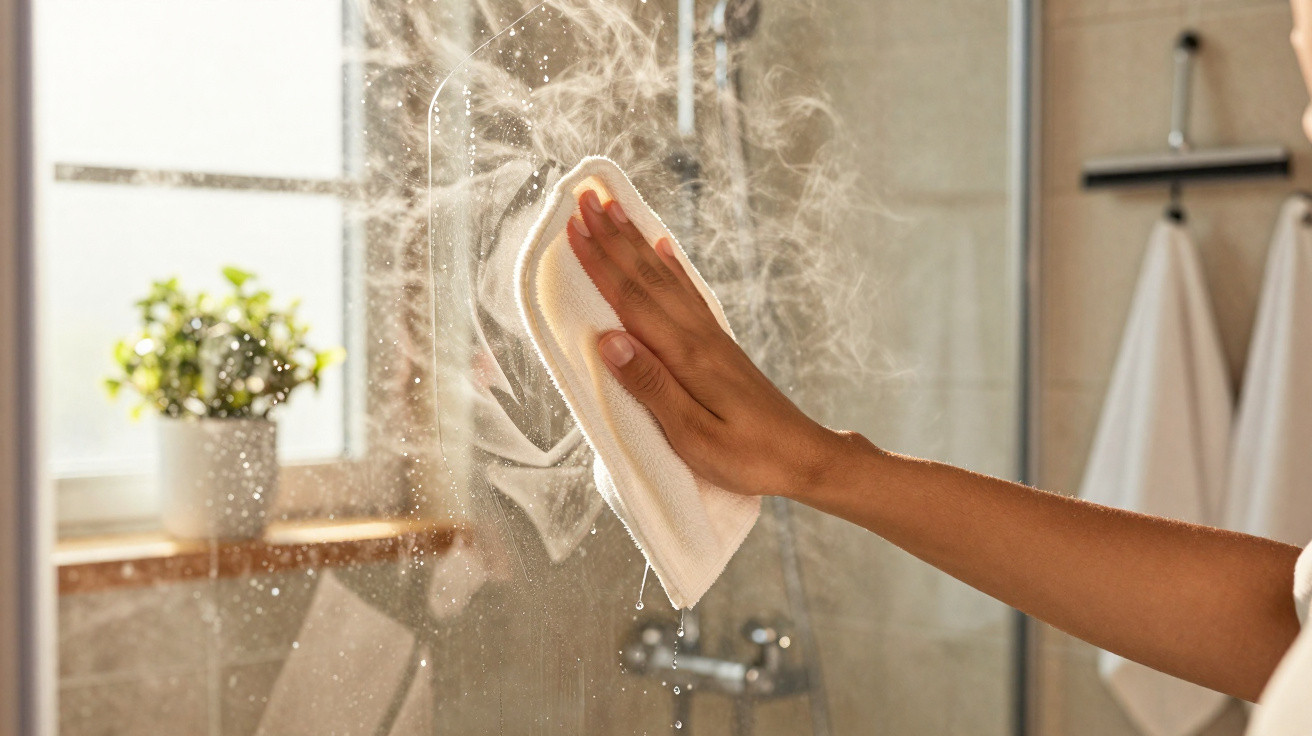
The straightforward, commonly missed step is this: once you have dried yourself, dry the shower too. It does not need to be perfect or obsessive. Simply remove the standing water and heavier droplets. Think: “towel for you, swipe for the walls”. A low-cost rubber squeegee or a dedicated small towel is the key tool.
Quickly draw the squeegee over the tiles, glass doors and bath or shower tray. Once the movement becomes familiar, it takes 45 to 60 seconds. Thick, splashy streaks turn into thin films, and corners lose their glossy appearance. You have dramatically reduced the drying time and taken away mould’s preferred resource. With a curtain, pull it gently closed and shake away surplus water instead of leaving it gathered up and dripping.
In practical terms, this means dealing with the shower once more just as your mind wants to leave the room. That is the real challenge. You may be cold or late, and your phone might be pinging in the bedroom. Running a squeegee across the walls can seem optional, even absurd. Yet that “absurd” additional minute creates the long-term difference. It changes the bathroom from a damp cave into a room that dries almost as quickly as a kitchen worktop.
During one humid London summer, a family carried out a small experiment. For a month, they allowed the shower to air-dry as normal, sometimes using the fan and sometimes not. They took photographs of the grout lines every week. Small grey flecks began to appear around the lower tiles, particularly behind shampoo bottles.
In the second month, they changed one factor only: the last person to shower had to wipe the glass and walls with a squeegee. They used the same products and fan, with the same number of showers. At the end of the month, the latest photographs looked nearly the same as those from week one. There were no additional spots and no spread of the existing ones. It was not a laboratory study with flawless controls; it was one family living an untidy real life. Even so, the visual change was clear enough for the children to notice.
Comparable reports appear in online forums and landlords’ records. Bathrooms where tenants regularly wipe or squeegee surfaces tend to have less mould on silicone seals and fewer discoloured joints, even when the extractor fan is less than ideal. Mould specialists often call this “breaking the moisture cycle”. It does not sterilise the room; it simply denies mould the repeated spells of high humidity that it favours.
Scientifically, that extra minute changes the microclimate of every surface. Water evaporates more rapidly when droplets are thinly spread and exposed to moving air. Heavy beads in edges and corners can remain for hours, nourishing microscopic colonies that are not yet clearly visible.
Drier surfaces are also less welcoming to new spores. A mould spore landing on an almost dry tile is like a seed dropped onto stone. Put that same spore on a continually damp silicone joint and it is like planting it in rich compost. Most bathrooms are not “mouldy” by default; they are just consistently wet in the same places. Alter that pattern and the whole ecosystem changes in your favour.
This is not about achieving perfection. It is about reducing the time your bathroom spends as a warm rainforest after every shower. A squeegee or towel will not win the battle alone, but it quietly removes mould’s strongest weapon: extended standing moisture.
How to create a one-minute shower-drying ritual
The simplest and most effective approach is to hang a squeegee inside the shower, within easy reach, and use it before stepping out. Do not tuck it away in a cupboard. Keep it somewhere your hand almost reaches without thinking. Begin with the largest upright surfaces: the glass door or curtain area, followed by the main wall facing you, the side walls and finally the bath or shower tray.
Work quickly rather than trying to remove every last drop. A single top-to-bottom stroke for each strip of wall will do. The aim is to clear the larger beads, not to polish the space like a window cleaner. If you prefer a towel, assign an old one as your “shower towel” and hang it from a particular hook, so that your mind connects that location with the new ritual. Eventually, those 60 seconds will feel less like a task and more like the usual final stage of showering.
This is where real life intervenes: you will not manage it after every shower. Nobody does. Some days you are running late, some evenings you are exhausted, and some mornings the children are knocking on the door. Missed days are inevitable. The important thing is to see them as a blip rather than a failure. Your bathroom doesn’t need 100% compliance to benefit; it just needs more dry days than wet ones.
Typical mistakes include wiping the glass while overlooking the tiles, leaving the curtain crumpled and wet, or firmly closing the bathroom door straight after leaving. Link the squeegee step to one simple ventilation action: either leave the door fully open or run the extractor fan for 15–20 minutes.
And a moment of plain speaking: let us be honest, nobody really does this every day. However, doing it three or four times a week will still lower the moisture curve and keep that musty smell away for far longer.
“I used to blame the building,” admits Hannah, who rents a small flat with a windowless bathroom. “Then my friend told me to squeegee the walls. I rolled my eyes. Two months later, my ceiling stain stopped growing. That stupid plastic tool is now my favourite thing in the shower.”
To make the practice last, it can help to frame it as a small “challenge” rather than a vague intention. You could even turn it into a game for the family. For one week, put a note on the mirror saying: “One minute to beat the mould.” It may sound silly, but that visual prompt often catches you at precisely the point when you are about to rush out, still dripping.
- Keep the squeegee inside the shower rather than in a drawer.
- Wipe the walls and glass from top to bottom, once for each strip.
- Quickly go over the shower tray, particularly the corners.
- Pull the curtain fully closed so that it can dry flat.
- Leave the door ajar or keep the extractor fan running afterwards.
A small habit that quietly transforms your bathroom
Consider the rooms in your home that feel pleasant without you quite knowing why. They are often places where small, regular actions prevent the need for major seasonal cleaning. Drying the shower after use firmly belongs in that category. It needs no product, renovation or weekend spent scrubbing - only a different understanding of what it means to have finished showering.
Once you begin, you may notice benefits beyond mould prevention. Glass doors remain clear for longer, soap scum is easier to manage, and the slightly sour smell of a constantly wet mat or curtain diminishes. Visitors may not identify what has changed, but many will comment on how “fresh” the bathroom feels. It is a modest, nearly invisible improvement that rewards you every day.
More deeply, this small ritual challenges the belief that mould is simply “something that happens” in homes. It shows that many household problems develop in the spaces between our actions: the ten minutes when nobody is paying attention, the routine we never thought to question. Share this tip and you are likely to hear the same response repeatedly: “That’s so obvious. Why did no one tell me sooner?”
Perhaps the real story is not mould at all, but how much can change when we notice those quiet moments in between.
| Key point | Detail | Benefit for the reader |
|---|---|---|
| Squeegee after showering | A quick pass removes droplets from walls and the shower tray | Greatly reduces the moisture available to mould |
| One-minute ritual | Hang the tool in the shower and use it before leaving | Turns an occasional action into a natural habit |
| Air and space | Leave the door ajar or run the extractor fan after showering | Helps the bathroom return quickly to a healthy environment |
FAQ:
- Do I really need to squeegee after every single shower? Not necessarily; doing it most of the time already cuts humidity cycles and slows mould growth dramatically.
- What if I don’t have a fan or window in my bathroom? Then the drying step is even more valuable; wipe surfaces and keep the door open so moisture can escape into the rest of the home.
- Isn’t mould mainly a problem in very old or poorly built homes? Any warm, damp bathroom can grow mould; construction matters less than daily moisture habits and ventilation.
- Can cleaning products replace this drying habit? Sprays help, but they cannot undo constant high humidity; removing water is the most direct way to starve mould.
- How long before I see a difference once I start? Many people notice less fog, fewer spots and a fresher smell within a few weeks of consistent post-shower drying.

Comments
No comments yet. Be the first to comment!
Leave a Comment