
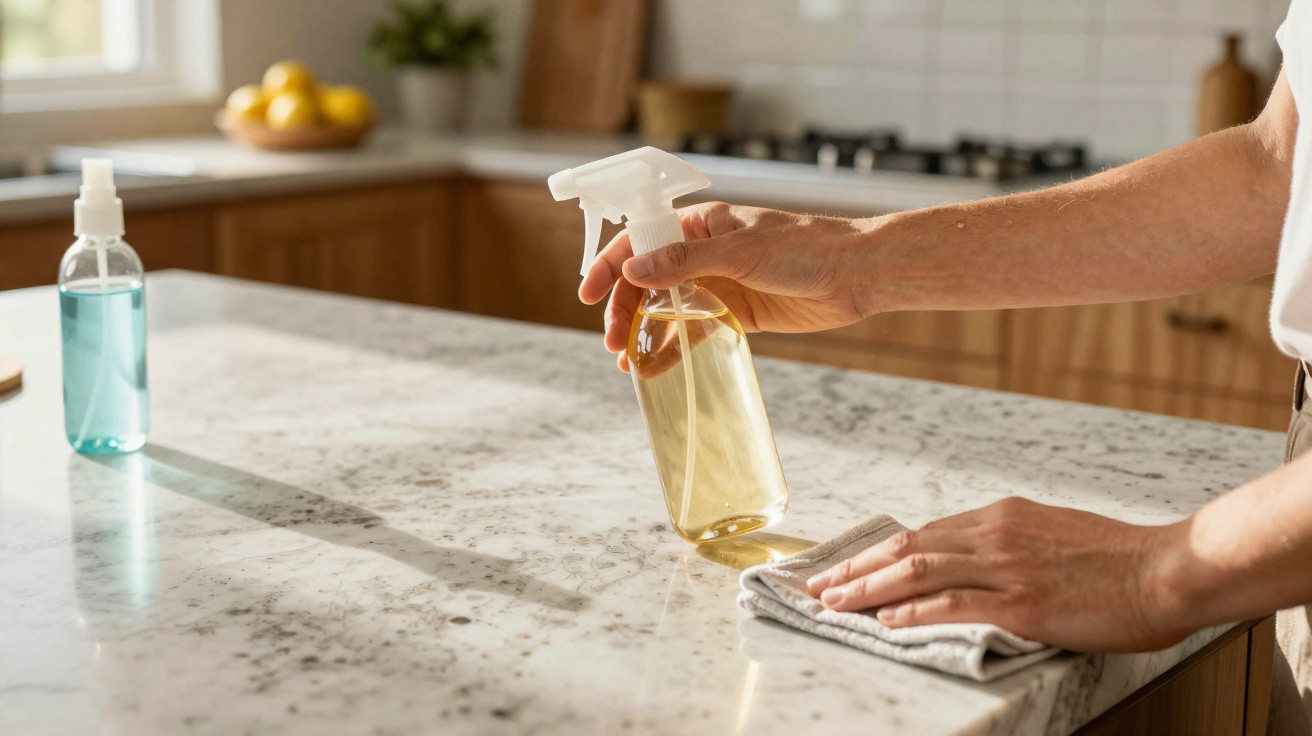
A clear spray, a faintly sharp scent and the reassuring sense that you are “cleaning naturally”. Vinegar has become the understated star of countless homes: inexpensive, environmentally friendly and approved by TikTok.
Then, one day, you wipe the wrong surface. Several days pass and, initially, there is little to see. Before long, though, the shine begins to disappear, a cloudy area develops, and a dull ring refuses to lift. You scrub more firmly, only to make it worse.
Using vinegar on this particular surface can lead to lasting damage, yet most people are completely unaware of it.
When a “natural cleaner” silently damages your home
Step into a contemporary kitchen and it is easy to spot them: gleaming stone worktops catching the morning light, a centrepiece island, the kind of finish you touch simply because it feels pleasing. Granite, marble and quartz are promoted as strong, hard-wearing and virtually indestructible.
That is why it seems perfectly safe to reach for vinegar spray and quickly wipe everything down after dinner. The scent feels fresh, grease vanishes, and avoiding aggressive chemicals can feel strangely virtuous. The worktop appears fine - perhaps even better than it did before.
What remains unseen is the gradual, quiet way in which acid begins to wear at the surface.
Speak to any stone restoration specialist and the accounts are strikingly similar. A family moves into a newly built home with glossy marble worktops. Keen to “go green”, they pour white vinegar into an attractive amber bottle and use it for every task: spills, fingerprints and water marks all disappear with a quick spray.
Three months on, the marble surrounding the sink has turned cloudy. Its veining no longer looks as defined. Close to the hob, there is a subtle but permanent ring where a vinegar-soaked cloth was left for an hour. The surface has lost its richness, much like a photograph left in sunlight for too long.
They contact a professional, anticipating a simple polish. The assessment is direct: acid has etched the stone. Part of the damage may be lessened, but some of it is permanent.
Beneath the lifestyle appeal, the explanation is chemistry. Vinegar contains acetic acid. That poses no issue for glass or stainless steel. However, with calcareous stone - marble, travertine, limestone and certain types of granite - acid reacts with the minerals responsible for the stone’s structure and lustre.
The reaction is not dramatic; it is subtle. Every wipe removes a microscopic layer from the surface. A polished finish becomes matt. Small pits reflect light differently, leaving dull patches, rings or pale splash marks that scrubbing cannot remove.
Quartz worktops, frequently advertised as “maintenance free”, are not entirely protected either. Repeated contact with acid can gradually break down the resin holding the stone particles together. The surface may then lose its even sheen and look worn well before it should.
How to clean stone worktops wisely without harming surfaces
The positive news is that you need not choose between a clean kitchen and a well-maintained worktop. The key is to use a cleaner suited to the material rather than relying on one bottle for every job. Begin with a straightforward habit: establish precisely what your surface is made from.
If you rent your home, ask the landlord or check the original property listing photographs. If you purchased the worktop yourself, look for the invoice or fitting guide. Once you know whether the surface is marble, granite, quartz, laminate or wood, there is no need to guess.
For everyday cleaning, use a pH-neutral product, preferably one marked as suitable for stone. A small amount in warm water, applied with a soft cloth, will deal with most routine messes. It need not be elaborate; it simply needs to work quietly and reliably.
On a hectic weekday evening, no one wants a ten-step cleaning routine. There may be a stack of washing-up, children doing homework at the island and a pan of pasta close to boiling over. Those are precisely the moments when shortcuts are tempting: one spray for the hob, worktops, table and fridge door.
This is how long-term damage gradually takes hold. A few drops of vinegar near the tap, a swift wipe across a marble windowsill, or leftover solution running down a stone splashback. None of these incidents looks disastrous immediately, but the damage builds slowly, layer by layer.
Let us be honest: nobody truly follows the perfect daily routine, with the correct product for every surface, the ideal cloth and precise timing. Even so, replacing vinegar where it causes genuine harm - on stone and certain sealants - is one small adjustment that safeguards the most costly areas of your kitchen.
Professionals who restore kitchens for a living are often almost evangelical about one point:
“Vinegar is brilliant - on the right surface. On the wrong one, it’s the quietest way to throw thousands of pounds down the drain.”
There is no need to become obsessive. Instead, create a small mental map of your home: vinegar-safe and vinegar-risky. Glass, tiles, certain plastics and chopping boards are generally fine. Natural stone, engineered stone, some hardwood finishes and waxed surfaces require more thought.
- Always test a new cleaner in a concealed area before applying it more widely.
- Change to pH-neutral stone cleaners for marble, granite and quartz.
- Clean acidic spills, including wine, lemon and tomato sauce, promptly with water rather than vinegar.
- Keep vinegar sprays away from grout, natural stone and waxed wood.
- If you are unsure, plain warm water and a soft microfibre cloth are the safest options.
The hidden cost of “just a little vinegar”
Once you begin to recognise it, the same pattern appears everywhere: a bathroom shelf with a cloudy marble top, a hall with dull areas on travertine tiles after years of vinegar mopping, or a quartz island that looks strangely patchy in afternoon sunlight, as though it is permanently smeared.
These surfaces have not failed in an obvious way. There are no cracks, chips or dramatic before-and-after changes. Instead, they have simply aged poorly and much sooner than expected, worn away by numerous small daily choices that seemed “natural” and “safe” at the time.
That is the understated irony: a product chosen by many people to protect their health and home can, on certain materials, gradually strip away their beauty and value with every wipe.
| Key point | Detail | Why it matters to the reader |
|---|---|---|
| Vinegar is acidic | Repeated use gradually etches natural and engineered stone | Helps you prevent hidden, long-term damage |
| Know your surface | Identify whether you have marble, granite, quartz, laminate or wood | Enables you to select the correct cleaner confidently |
| Choose pH-neutral cleaners | Particularly for stone and sealed surfaces | Prolongs the life, shine and value of your home |
FAQ:
- Can I ever use vinegar on stone if I rinse it quickly? Even brief contact can begin etching sensitive stones such as marble, so avoiding vinegar entirely on stone surfaces is safer.
- What is a simple alternative for daily kitchen cleaning? A few drops of mild, pH-neutral washing-up liquid in warm water, used with a microfibre cloth, are usually sufficient for routine wipe-downs.
- Is vinegar safe on laminate worktops? Most laminate surfaces can tolerate diluted vinegar, although repeated use can dull the finish; a gentle all-purpose cleaner presents less long-term risk.
- How can I tell whether my stone is already damaged? Check for dull rings, cloudy patches or sections that remain matt after cleaning - these are classic signs of etching rather than ordinary surface dirt.
- Can a professional repair vinegar damage on marble or quartz? Light etching can often be improved through polishing; deeper damage may be reduced rather than fully removed, and costly refinishing is sometimes required.



Comments
No comments yet. Be the first to comment!
Leave a Comment