
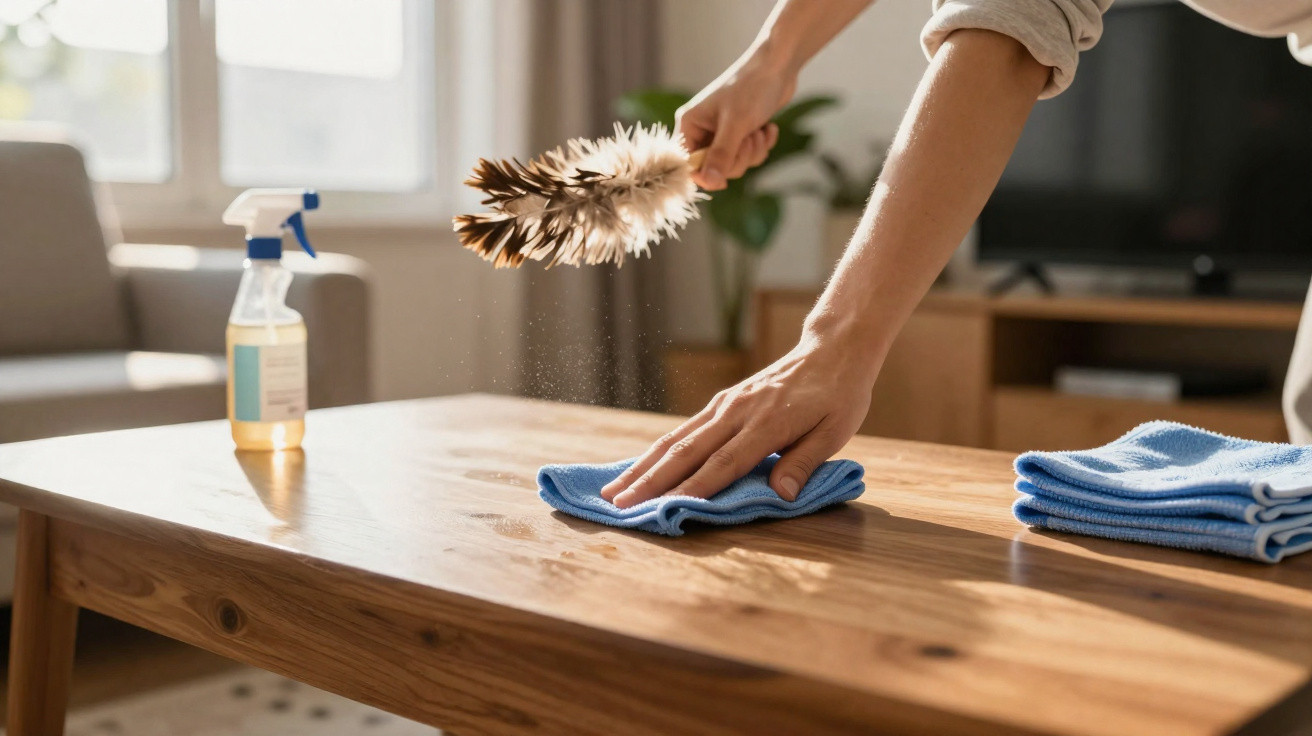
Sunlight streams through the window, revealing every speck floating in the air, and suddenly the living room you have just cleaned resembles a snow globe. The TV unit gleams, the coffee table carries the scent of lemon cleaner, yet a light grey film is already beginning to settle over everything again.
You pause, annoyed. Have you cleaned incorrectly? Is your home somehow much dirtier than it should be? Or does dust simply win every time?
Professional cleaners say you are neither cursed nor using ineffective products. In many cases, the issue comes down to one thoughtless habit. It is a habit that causes dust to return more quickly, in greater amounts, and almost as soon as the vacuum cleaner has been put away.
And nearly everyone does it.
The surprising habit that makes dust settle faster
Most cleaning professionals agree that the biggest dust-related mistake is dry dusting with either a feather duster or a dry cloth. It can seem effective, even soothing, as a few quick strokes turn a dull surface shiny. But appearances are misleading.
Rather than removing the dust, you are sending it airborne like party confetti. It drifts around the room before falling back down, often onto the same areas you have just wiped.
It is a little like sweeping a sandstorm beneath the carpet and expecting it to vanish.
On a dull Tuesday morning in London, I watched a professional cleaner carry out a “deep dust” in a townhouse. The homeowner insisted that she cleaned “all the time”, but still felt that every room was permanently coated with fine powder. It was a familiar complaint.
The cleaner entered, pulled the blinds fully open and paused. Seconds later, countless tiny particles were visible in the air. Smiling, she said quietly: “That’s last week’s dry dusting.” The homeowner’s preferred tool was a soft feather duster, used every few days on shelving and picture frames.
After several trial strokes, the cleaner demonstrated the problem: a single sweep of the feather duster raised a noticeable cloud above the bookcase. The dust had not gone anywhere; it was simply suspended, ready to settle on the sofa, television screen or window sill. The home was not “dirtier than average”. That cleaning habit was merely perpetuating the cycle.
From a simple physics perspective, dry dusting produces the most movement while capturing the least dust. Dust consists of skin cells, textile fibres, pet dander, pollen and tiny fragments of soil. These light, flaky particles become airborne easily, and a dry tool flicks them upwards rather than holding on to them.
Once airborne, particles can remain suspended for several minutes, sometimes longer. Even minor air movement from an opening door, a fan or simply walking through the room can distribute them further. Eventually, they settle on the first suitable flat surface, usually lower areas such as coffee tables and TV units, which are also the places we tend to notice most.
That is why it can feel so dispiriting to think, “I just did this.” The irony is that the more vigorously you dry dust, the more quickly the dust can seem to return.
What professionals use instead to keep dust away longer
Professional cleaners tend to follow one consistent rule: use something that is slightly damp or made to collect particles, rather than something that sends them flying. This could be a lightly moistened microfibre cloth, an electrostatic duster or a cleaning wipe with a small amount of product.
The important word is “slightly”. The cloth should not be wet enough to drip; it only needs enough moisture for dust to cling to it rather than float away. Wipe the surface, fold the cloth to expose a clean section, then continue. The dust remains in the fibres instead of ending up in your lungs or returning to the shelves.
Professionals also clean from top to bottom. They tackle high shelves, picture frames and ceiling fans first, followed by furniture at mid-height and then skirting boards. Gravity takes care of the rest, so when it is time to vacuum, you collect what has fallen rather than throwing it back into the air.
There is also a practical human element. Few people have an hour to follow a “perfect protocol” every few days. On a busy evening, using a dry cloth to quickly wipe the TV unit can feel sufficient: quick, visibly cleaner and another job ticked off.
In terms of results, however, that shortcut works against you. Dry dusting is particularly unforgiving on glossy surfaces, including black TV screens, glass tables and piano tops. Every mark and particle stands out. Frustration builds, and you may begin to believe that your home simply “collects” more dust than everyone else’s.
Let us be honest: nobody really does all of this every day. Professionals understand that and do not judge. They simply repeat the essentials: choose a damp cloth instead of dry dusting, vacuum before mopping, and remember the hidden dust producers, such as radiators and vents.
One cleaner I spoke to put it bluntly:
“If your dusting tool is lighter than the dust you’re fighting, you’re just decorating the air.”
She suggested keeping a small “dust kit” together in one place: a spray bottle filled with water and a drop of washing-up liquid, two microfibre cloths and a handheld vacuum cleaner.
Then, even when you are tired, the better approach is as convenient as the lazy one. Open the cupboard, take out the kit, give surfaces a quick wipe and keep the dust contained. There is no major mental effort or complicated method involved, just an easier routine that keeps surfaces clearer for longer.
- Choose microfibre over cotton to capture dust instead of spreading it around.
- Always work from the highest shelves down to the floor.
- Use a lightly damp cloth for awkward areas, such as window sills and headboards.
How to improve your dusting routine without changing your whole life
The aim is not to become the mythical person who deep-cleans every skirting board each Saturday. Instead, make a few sensible adjustments that settle dust rather than disturbing it. Small changes to the order, tools and timing of your cleaning can have a greater effect than another hour spent scrubbing.
Begin with the room that bothers you most, often the living room or bedroom. Replace the feather duster with damp microfibre, clean from the top down, then vacuum slowly with the lights on so you can see what you are collecting. Check how the room looks two or three days afterwards. That is often when people notice the real difference.
We have all had the experience of cleaning frantically before visitors arrive, only to spot a new layer of dust in the afternoon sunlight. Altering one habit will not create a showroom-perfect home, and that is not the aim. What it can offer is a little more calm between cleans.
Once you have noticed how rapidly dry dusting brings the dust back, it is difficult to ignore.
| Key point | Details | Why it matters to readers |
|---|---|---|
| Avoid feather dusters for everyday cleaning | Feather and fluffy dusters send dust into the air rather than trapping it, particularly on bookcases, blinds and ornaments. | Changing tools means dust is less likely to “reappear” on the same surfaces, reducing both frustration and cleaning time. |
| Use a slightly damp microfibre cloth | Lightly moistened microfibre collects particles and keeps them in its fibres. Rinse the cloth or replace it as it becomes dirty. | It stops dust resettling on TVs, sideboards and window sills, meaning the freshly cleaned appearance lasts noticeably longer. |
| Clean in the correct order: high to low, then vacuum | Begin with ceiling fans and high shelves, finish with skirting boards, then vacuum the floor slowly in good lighting. | Gravity works to your advantage: you remove fallen dust instead of redistributing it around the room. |
FAQ
- Does opening windows while I dust make it worse? It can do. Gentle airflow may help move dust outside, but a strong draught can stir it up while bringing pollen and outdoor particles indoors. If you open a window, leave only a small gap and avoid creating a “wind tunnel” between opposite sides of the home while wiping surfaces.
- How often should I actually dust to see a difference? In most occupied homes, dusting the main rooms once a week is sufficient when you use damp microfibre and vacuum properly. Higher areas, such as wardrobe tops or curtain rails, can be cleaned monthly. Technique matters more than obsessively increasing how often you clean.
- Is a robot vacuum enough to control dust? A robot vacuum can help with dust on floors and pet hair, but it cannot replace proper surface dusting. It also commonly misses corners and skirting boards, where dust accumulates. Treat it as a useful assistant rather than a complete substitute for a quick weekly clean with a cloth.
- Do certain products make dust stick less? Some polishes and sprays create a light anti-static coating on surfaces such as wood and electronics, which may slow dust accumulation. When used sparingly and wiped thoroughly, they can be useful, but they will not correct poor habits such as dry dusting or failing to vacuum.
- Why does my bedroom get dusty faster than other rooms? Bedrooms are dust-producing spaces, with bedding fibres, clothes, skin cells and frequently limited ventilation. Washing sheets weekly, vacuuming beneath the bed and wiping bedside tables and headboards with a damp cloth can produce a visible improvement within only a couple of weeks.


Comments
No comments yet. Be the first to comment!
Leave a Comment