
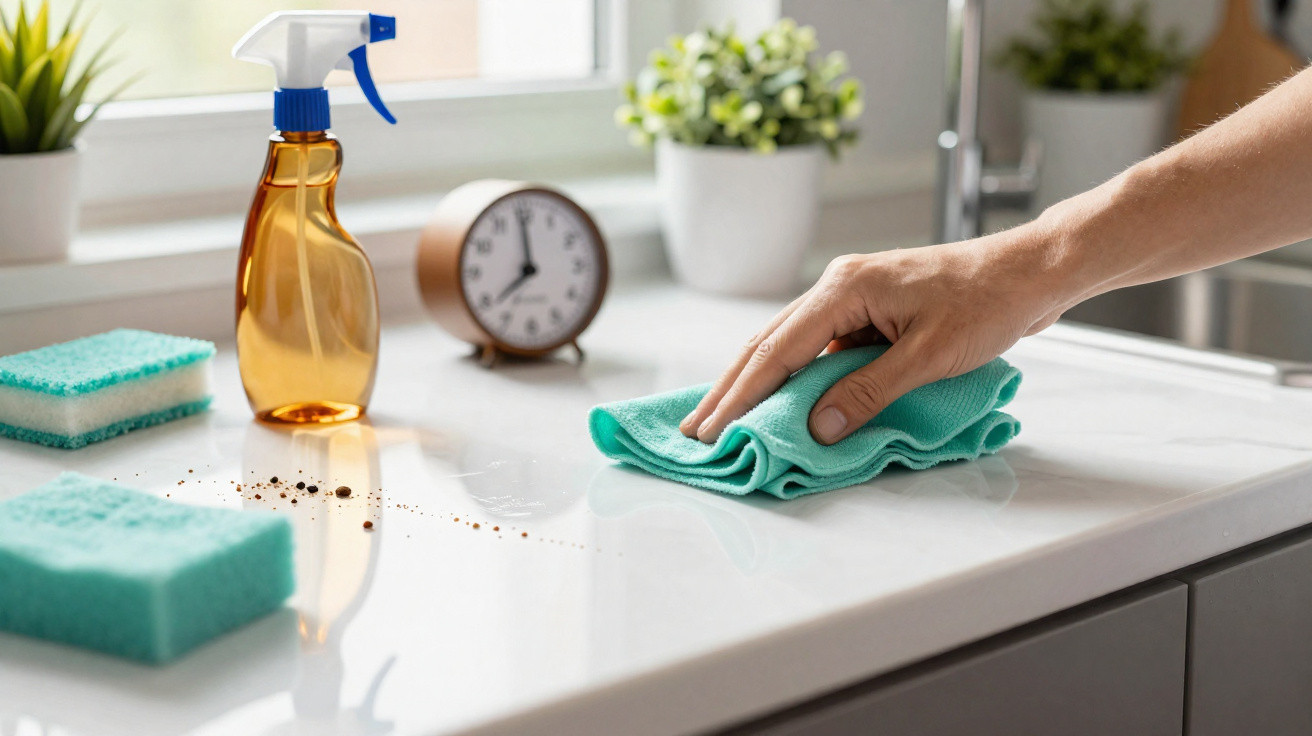
Behind the counter, a barista rubbed the same patch three times in untidy circles, while her cloth squeaked across the wood. From my seat, I could actually watch the smear grow wider rather than fade away. The table had been “wiped”, but still appeared unclean, as though the grime had merely changed location. A second barista stepped in and pulled the cloth across in one long, straight pass… and the dusty streak disappeared immediately. Identical spray, identical cloth, entirely different outcome. It was like seeing a magic trick - or a small science demonstration hiding in plain sight.
Why straight lines outperform chaotic circles
Watch somebody wipe down a kitchen worktop and a pattern soon emerges: most of us instinctively use erratic movements. Small circles, half-moons and pointless zigzags. Rubbing the surface with a cloth can seem thorough, almost creative. But the remaining marks - faint greasy rings or crumbs shoved towards the edges - reveal a different reality. The dirt has not gone; it has simply been moved. Compared with this, wiping in one direction may look dull, but it works like a snowplough clearing a winter road. Everything travels forwards, and nothing is pulled back over itself.
A hospital cleaner demonstrated this to me in a particularly stark way. She spread a narrow line of fluorescent gel - the type used for infection-control training - over a bedside table. In ordinary light, the tabletop appeared clean enough. Under a UV lamp, however, the line shone like toxic neon. She first wiped it using random circles. The gel did break apart, but it was also dispersed across nearly the entire table, glowing in uneven patches. She then repeated the test on a second table, this time drawing the cloth firmly from edge to edge in one direction. Under UV light, a distinct boundary showed where the gel had been pushed off the surface. The contrast was almost embarrassing.
The reasoning is straightforward. Moving a cloth in one direction does two jobs simultaneously: it lifts particles and provides them with a definite route out. Microfibres or paper fibres catch the dirt, while anything they cannot absorb is pushed onwards like by a miniature bulldozer. Changing direction repeatedly drags the same particles back across areas you have already “cleaned”. Random wiping also creates tiny untouched sections, much like missed tiles in a floor. One-direction wiping limits overlap and blind spots, and allows the cleaning product to work without being spread too thinly over an excessive area. Cleanliness has a direction.
The one-direction wiping method that genuinely cleans surfaces
The most dependable approach is almost absurdly simple: choose a direction and stick with it. Begin at one edge, lay the cloth flat and draw it towards yourself in one assured stroke. Overlap each previous pass slightly, as you would when mowing a lawn. If the cloth is visibly soiled or saturated with moisture, fold it to reveal a clean face before carrying on. For broad worktops, clean in long back-to-front strips. For tables, go left to right or top to bottom, but remain consistent with your chosen route. The aim is not to hunt the dirt around; it is to guide it off the surface.
Most mistakes happen right at the start. People spray cleaner as though tagging graffiti - scattered bursts everywhere - and then tackle each damp patch in its own circular motion. That destroys the logic of directional movement. Apply the product sparingly and evenly in the direction you intend to wipe, or put it directly onto the cloth in a line. Next, allow it a few seconds to sit. Give it time to soften grease, release particles and begin killing microbes. During a hectic day, that pause can feel indulgent. On the surface, it separates smearing from proper removal. Let’s be honest: nobody really does that every day.
There is a guilt element, too. We know we “should” clean more often, so we try to compensate by scrubbing with greater force rather than more effectively. Aggressive circles on a delicate screen. Angry spirals over a hob. The exertion can feel virtuous, even though it often disperses contamination rather than containing it. Slow, intentional one-direction wiping changes the perspective. You are not fighting the dirt; you are controlling it. As one cleaning specialist told me:
“I don’t want people to clean harder. I want them to clean like they’re drawing a map the germs can’t get back from.”
That may sound poetic, but it is also highly practical. With this approach in mind, a short mental checklist can make a real difference:
- Where is the dirt coming from?
- Where should it finish up?
- Which straight route will take it there without returning over the same area?
- At what point should I turn over or replace my cloth?
- What is my “final edge”, where the dirt leaves the surface?
Small changes, wider effects
On a difficult day, surface wiping can seem like a never-ending and pointless routine. Crumbs return to the kitchen island. Faint constellations of toothpaste appear on the bathroom worktop. It is easy to fall into resigned disorder: pick up a cloth, swipe until everything looks “less bad”, then move on. Cleaning in one direction disrupts that autopilot. It makes you pay attention to edges, seams where crumbs collect and corners that are routinely missed. After a week of doing this, many people notice something unexpected: surfaces remain cleaner for longer. Not immaculate - life still happens - but less grimy, less tacky and less mysterious.
At an emotional level, seeing a visible, clean route behind the cloth can be genuinely reassuring. One-direction strokes create subtle signs of progress: a dull surface becomes softly and evenly sheened, while streaks are reduced to the outer edges. It looks finished rather than merely “touched”. In terms of germs, healthcare studies have found that structured, directional wiping lowers residual microbial counts compared with random movements using exactly the same products. That does not mean your kitchen must function like an operating theatre. It simply means your effort works for you at last, instead of being undermined by your own habits.
On a busy weeknight, nobody wants another lesson on wiping a table. Yet the way you move your cloth - that unexciting, linear, almost meditative motion - quietly determines whether you are truly cleaning or merely redistributing yesterday’s mess. The same small principle applies to a restaurant table, work desk, phone screen or child’s high chair: dirt follows direction. And every time you hold a cloth, you decide that direction, whether consciously or not. One small adjustment to the movement of your hand can change the hygiene of an entire space - and no spray bottle can do that for you.
| Key point | Detail | Why it matters to the reader |
|---|---|---|
| One direction | Wipe from one edge to the other in slightly overlapping strips | Helps remove dirt properly instead of shifting it around in circles |
| Cloth management | Fold regularly, use a new side and replace the cloth once it becomes too damp or dirty | Prevents microbes from being reintroduced to areas that are already clean |
| Product contact time | Leave the product to work for a few seconds before wiping in a straight line | Maximises the effectiveness of the spray or disinfectant without additional effort |
FAQ:
- Does wiping in one direction genuinely remove more germs? Yes. Hospital studies show that directional wiping leaves fewer microbes on a surface than random movements when the same product and type of cloth are used.
- Can circular wiping ever be helpful? Circular movements may help release stubborn grime, but they are most effective as an initial step followed by straight, one-direction passes that remove the loosened material.
- Should I wipe from left to right or from front to back? Either option is suitable. Consistency is what counts: choose one direction, cover the entire surface with overlapping strokes and move dirt towards an edge where it can leave the surface.
- How often should I replace or fold my cloth? Do so whenever it appears dirty, feels very damp, or when moving from a dirtier area to a cleaner one. A typical microfibre cloth has 4–8 usable clean faces when folded regularly.
- Will this method work with disinfectant wipes as well? Yes. Use one side of the wipe in a single direction, keep the surface visibly wet for the label’s stated contact time, and do not scrub repeatedly back and forth over the same spot.




Comments
No comments yet. Be the first to comment!
Leave a Comment