
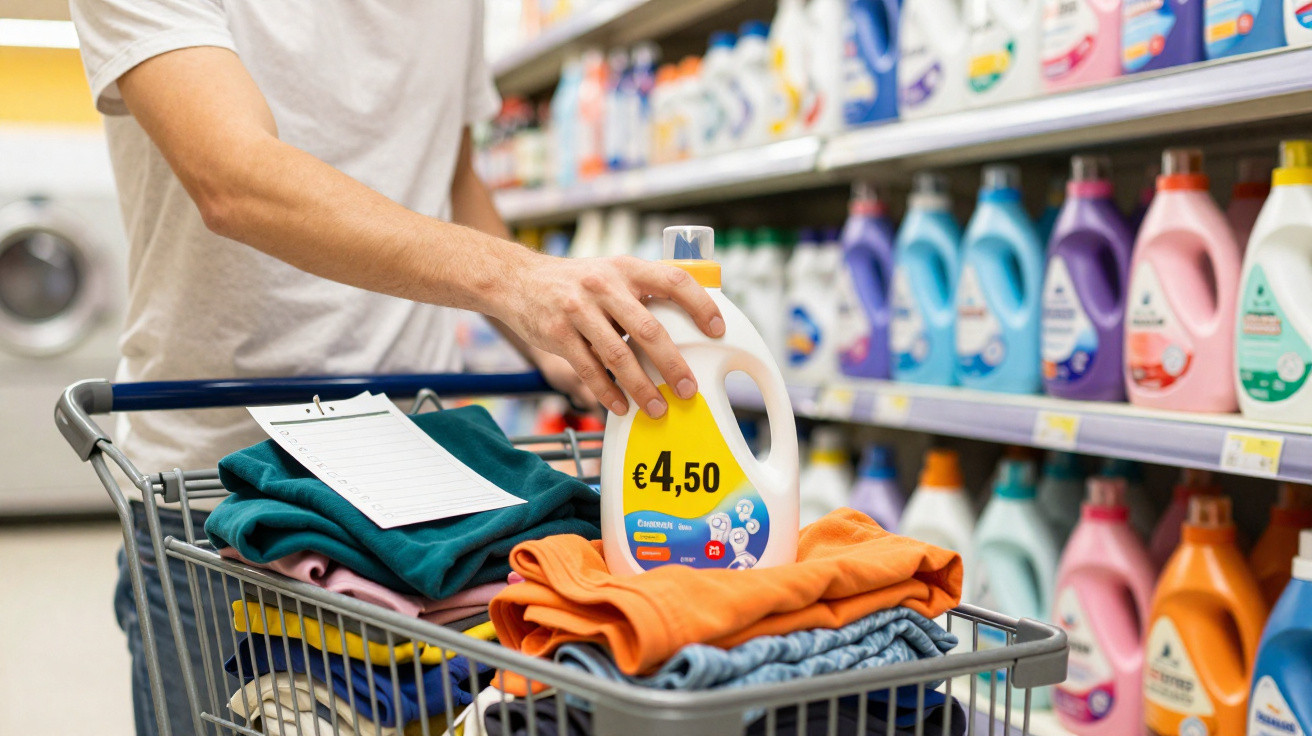
With eco-friendly claims, assertive advertising and ever-higher prices, picking a laundry detergent can feel surprisingly daunting for such an everyday household task.
French consumer organisation 60 Millions de consommateurs tested dozens of detergents under demanding conditions, with one unassuming €4.50 product taking the top spot. Its result also raises wider questions about what is actually going into your washing machine, onto your clothes and into wastewater.
Why a low-cost detergent attracted attention
Supermarket aisles are full of capsules, powders and liquids promising more thorough cleaning, brighter colours and milder ingredients. Many shoppers choose whatever is discounted or simply stick with a familiar brand. However, plenty of products contain harsh substances or fail to deliver once the perfume and foam are set aside.
To bring some clarity, 60 Millions de consommateurs carried out a 2023 comparison of a broad selection of detergents available in France. Its method resembles those used by consumer bodies in the UK and US: the group considered washing performance alongside effects on health, the environment and household spending.
The winning product was not the most expensive, nor the most aggressively advertised. It was a basic store-brand liquid priced around €4.50.
This finding challenges a widespread assumption that a higher price automatically brings stronger results and safer ingredients. The test indicates that this is no longer necessarily true.
How 60 Millions tested the detergents
The consumer body examined detergents against several practical measures. Every product was given an overall result combining technical effectiveness with its wider consequences.
The key criteria used for the rankings
- Cleaning efficiency: how effectively common marks, including grease, mud, food, sweat and make-up, were removed.
- Fabric care: treatment of delicate materials such as wool, cashmere and silk, plus colour retention for dark and brightly coloured clothing.
- Health impact: whether products contained irritating or sensitising ingredients that might cause allergies or skin reactions.
- Environmental footprint: the biodegradability of components, their potential to pollute water and the inclusion of concerning chemicals.
- Price per wash: value for money rather than the price displayed on the shelf alone.
The laboratory used identical washing machines and standardised wash programmes to eliminate bias. Products were assessed at their recommended dose, an important detail because using too much detergent can disguise a weak formula while adding to both pollution and cost.
A detergent judged “good” had to combine decent stain removal, limited health and environmental concerns and a reasonable cost per load.
Formil Colours: the €4.50 colour detergent
Among liquid detergents for routine coloured washing, one product stood out to the testers: a colour detergent from Formil, a private-label brand widely available in European discount supermarkets. It was awarded a “C” on France's Ménag’Score scale, indicating average overall performance, but 60 Millions nevertheless presents it as a sensible purchase.
Its strength is its balance of acceptable washing performance, a more controlled ingredients list than many rival products and a bottle price of about €4.50. That difference can be significant for households doing several washes each week.
| Product type | Example highlighted by 60 Millions | Approximate score | Typical price |
|---|---|---|---|
| Dark fabric detergent | Noir intense care with Marseille soap | 14 / 20 | €3–€5 |
| Delicate / wool care | Wool and delicate care from Persil | 12 / 20 | Mid-range |
| General colour detergent | Formil Colours | Ménag’Score C | About €4.50 |
For dark garments, the magazine advises choosing a detergent marketed as “Noir intense care with Marseille soap”. With a result of roughly 14/20, it ranked among the stronger products in the test. It remains reasonably priced too, costing around €3 to €5 depending on the retailer.
For fine fabrics, testers favour Persil's wool and delicate-care ranges. These products achieved about 12/20. While that is not an outstanding score, their formulas offered a balance between cleaning ability and fibre protection suited to hand-wash items and gentle washing programmes.
The pattern is clear: niche, fabric-focused products performed reasonably well, while a low-profile €4.50 colour detergent became the everyday workhorse recommendation.
The detergents that performed poorly
The investigation's other major finding involved branded capsules. Several pod detergents from Ariel and Skip, both widely available across Europe and recognised in the UK and US, appeared at the bottom of the rankings. The concern extended beyond their washing results to the environmental profile of ingredients included in certain formulas.
Budget brands using traditional branding also prompted concern. Leader Price's bi-dose capsules and an Apta liquid detergent promoted with Marseille soap were both highlighted. According to 60 Millions, they contained substances classified as irritating, which may be worrying for people with sensitive or reactive skin.
- Ariel and Skip capsules: criticised for formulations the testers considered harmful to the environment.
- Leader Price Bi-doses Power Duo: identified as containing possible irritants for users.
- Apta “Marseille soap” detergent: also noted for ingredients that could trigger skin reactions.
The contrast between traditional imagery-Marseille soap and bright white foam-and the real ingredients list shows how marketing can obscure the distinction between appearance and reality. A nostalgic-looking label is no assurance of a mild formula.
What the findings mean for UK and US shoppers
Although the test covered detergents sold in France, its broader conclusions apply beyond French borders. Many named brands operate internationally and tailor their ranges by market while relying on comparable approaches: convenient capsules, lower-cost classic liquids and “eco” products designed for environmentally conscious buyers.
British and American shoppers can use a straightforward checklist based on the French findings when choosing products in the detergent aisle.
Practical checks before choosing a bottle
- Compare the price per wash rather than only the bottle price. Capsules are often more expensive than liquid detergents.
- Choose fragrance-free or lightly fragranced formulas when someone in the household has eczema, asthma or allergies.
- Where possible, look for biodegradability claims and certified environmental standards, but also check the ingredients on the back of the bottle.
- Keep a separate detergent for dark clothing to help prevent fading and greying.
- Use a wool or delicate detergent for knitwear, lingerie and technical sportswear.
- Do not overdose: modern washing machines and detergents generally do not require a full cap.
Marketing often sells convenience and perfume. Your skin and local rivers need something more boring: clarity on ingredients, moderation on fragrance and realistic promises.
Beyond cost: health, microplastics and fabric lifespan
Today's detergents do more than lift stains. They can gradually affect the lifespan of clothing and the amount of microplastic released into waterways. Powerful surfactants and high alkalinity may damage fibres over time, particularly in stretchy materials such as leggings and underwear.
Perfumes and preservatives present another issue. Those with sensitive skin, or households with children, may favour shorter ingredient lists even when the fragrance seems less “fresh”. Some commonly used fragrances are part of groups known to cause contact allergies in a small but increasing share of the population.
Microplastics are another consideration. Synthetic clothes release tiny fibres each time they are washed. Choosing a detergent cannot prevent this completely, but cooler washes, gentler cycles and less aggressive formulas can reduce shedding. A detergent that works effectively at 30°C can cut energy use while helping to preserve fabrics.
How to test laundry detergent at home
Most consumers cannot use a laboratory, but several straightforward checks can help establish whether a detergent works for their household:
- Wash an old dark T-shirt repeatedly with your normal detergent, then look for fading or a grey film after ten cycles.
- When changing detergent, watch for itching or redness among family members; if there is any concern, use an extra rinse or move to a hypoallergenic range.
- Carry out a stain comparison: mark two matching cloths with coffee or oil, wash one with your existing detergent and the other with another brand at the same temperature.
These simple trials cost very little, but can show whether an attractive €4.50 bottle genuinely works in your machine, with your water hardness and on your fabrics.
The 60 Millions de consommateurs investigation points to a straightforward conclusion: an effective laundry routine does not depend on premium pods or attention-grabbing claims. A carefully selected basic detergent, at a price comparable with the recommended €4.50 product and supported by transparent testing, can wash well while reducing harm to your skin, clothes and the environment.


Comments
No comments yet. Be the first to comment!
Leave a Comment