
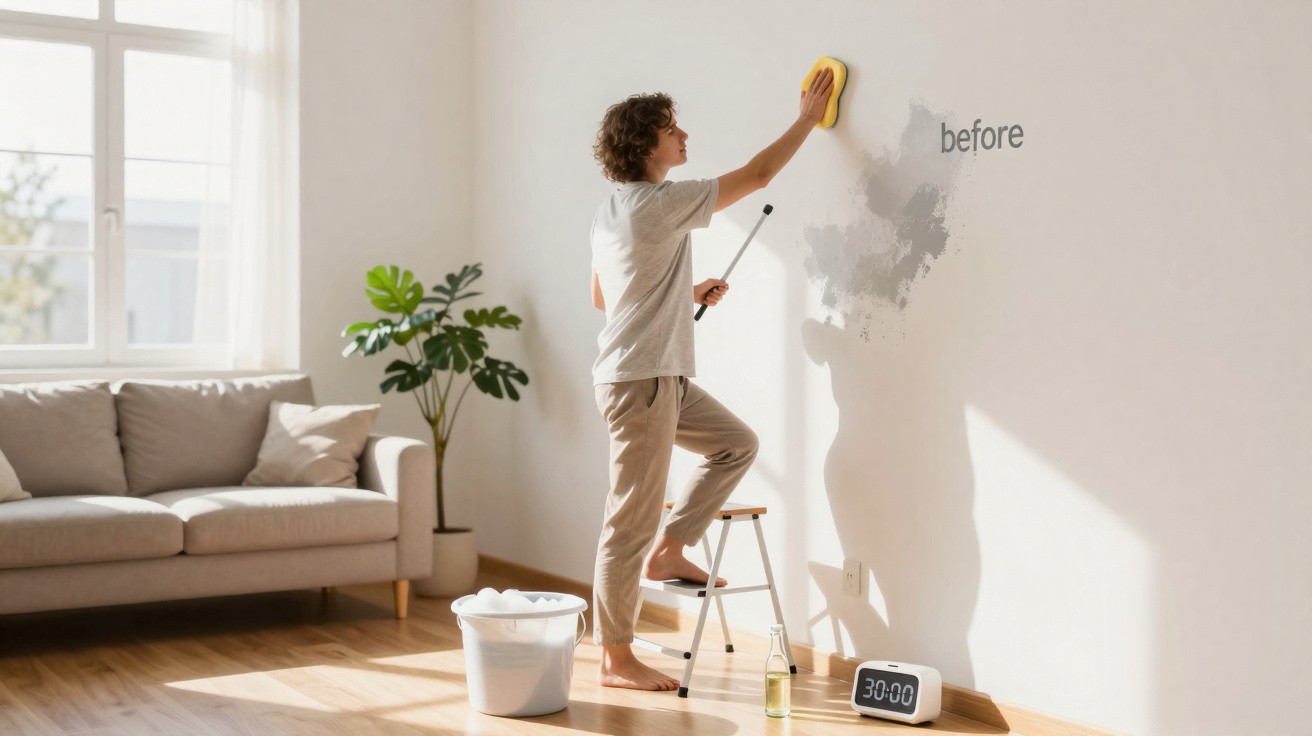
Plenty of households put off giving walls and ceilings a proper clean for months - it feels too tiring, too risky, and too dependent on harsh chemicals. A straightforward approach is now catching on: a natural cleaner made from two basic cupboard ingredients, paired with a flat mop on a telescopic handle. About half an hour later, the room can feel noticeably fresher.
Why walls and ceilings have suddenly become part of the routine
Floors and worktops tend to get wiped down as a matter of habit, while walls and ceilings are easy to overlook. Yet they collect a surprising amount of grime that is not immediately obvious: fine dust, greasy film from cooking, candle soot marks, tobacco residue, heating fumes and pollen. Much of it clings to surfaces and then finds its way back into the air you breathe.
This build-up can be particularly troublesome in homes with children, older people, allergy sufferers or anyone with limited mobility. Many families face the same dilemma every year: they want a thorough clean, but they do not want parents or someone who needs care climbing a ladder. With fear of falls - or simply not enough time - the dirt often stays put.
A simple mix of everyday ingredients and a telescopic handle is enough to clean walls and ceilings from the floor - with no acrobatics on a ladder.
The cupboard cleaning duo: what it actually is
At the heart of this method is something almost disarmingly simple: a small amount of liquid soft soap and a splash of clear household vinegar stirred into warm water. No aggressive additives, no added fragrance, and no foamy “show”.
Why this particular pairing works so well
- Soft soap helps lift grease, dusty residue and light nicotine film from the surface, without attacking most painted finishes.
- Household vinegar has a mild limescale-dissolving effect, helps neutralise odours, and reduces the chance of sticky residue being left behind.
- Warm water supports even distribution and loosens dirt gently.
What matters here is not a rare ingredient, but the combination of a mild degreaser and an acidic rinse - plus applying it with a microfibre sleeve that is almost dry.
The 30-minute method, step by step
To keep the process streak-free and stress-free - without drips running everywhere - the technique is key. Done this way, it fits neatly into everyday household routines.
Preparation: what you’ll need
- Flat mop with a telescopic pole (similar to a floor mop)
- Microfibre sleeve or pad that can be wrung out well
- Bucket of warm water
- A little liquid soft soap
- Household vinegar (clear, with no colouring)
- A dry microfibre cloth for a quick buff in problem areas
Many homes already have a telescopic mop, typically used for floors or high windows. Here, the same tool is simply redirected to walls and ceilings.
How the cleaning pass works
- Ventilate the room well, ideally with windows opened wide.
- Remove loose cobwebs and heavier dust using a dry brush or a dry microfibre pad.
- Mix the solution: add a little soft soap and a splash of vinegar to the warm water, then stir briefly.
- Dip the microfibre sleeve, then wring it out firmly - it should be only lightly damp.
- Clean the walls first, working from bottom to top so drips do not run over areas you have already cleaned.
- Use long, steady strokes and avoid pressing too hard.
- Finish with the ceiling, moving in the same direction as the light so any remaining streaks are immediately visible.
- Air the room thoroughly again afterwards so residual moisture can evaporate quickly.
With the right level of dampness, a single pass is often enough to remove dusty layers and grey film - even above the dining table or the hob.
Health and safety: why this approach is so popular
The shift towards this gentle cleaning duo has not happened by accident. Many families and carers describe the same frustrations: irritating fumes, slippery floors after cleaning, risky climbing and balancing - and still the feeling that the job is not truly finished.
This newer approach is intended to achieve several things at once:
- Lower risk of falls: cleaning is done from the floor using an extendable pole, rather than wobbling on a stool or chair.
- Milder ingredients: the air stays free of harsh cleaning fumes, which can be particularly noticeable in smaller flats.
- Less physical strain: if a room can be done in 30 minutes, it feels more realistic to keep up regular sessions.
- Cost benefit: instead of multiple specialist products, one simple concentrate does the work and lasts a long time.
Older people, those with limited mobility, or anyone with asthma can benefit from a cleaning routine that remains manageable. That, in turn, can noticeably relieve pressure on family members.
Typical mistakes that cause streaks and damage
Even though the method is straightforward, the same everyday slip-ups crop up repeatedly. The good news is they are easy to avoid.
| Mistake | Result | Better approach |
|---|---|---|
| Too much water | Drip marks, paint swelling, stains on wallpaper | Use the microfibre only damp - never dripping wet |
| Starting at the ceiling | Dirt runs back down onto the walls | Walls bottom to top, ceiling only at the end |
| Skipping dry dusting | Smears and clumps of dirt | Remove dust dry first, then clean damp |
| Keeping windows shut | Humid air, slow drying, musty smell | Cross-ventilate during and after cleaning |
How the trick changes daily life for carers
In many homes where care is provided, ceilings and the top sections of walls become “no-go” areas for years. If someone has limited strength, even scrubbing the floor is a struggle. Family members then delay the task until frustration builds - and the air quality suffers. This method makes the whole topic feel far less daunting.
Carers often say they now split the deep clean into smaller jobs: one week the bedroom, the next week the living room, followed later by the hallway and kitchen. Because each session takes only around 30 minutes, the rest of the day is still available for care, work or much-needed rest.
When the routine feels realistic, people are more likely to stick with it - creating a home where more sensitive individuals also feel more comfortable.
Which surfaces is the method suitable for - and where should you be careful?
A mix of soft soap and vinegar water is generally considered gentle, but not every surface handles moisture or acidity in the same way.
Usually unproblematic
- Painted walls with wipeable paint (common in newer homes)
- Textured plaster with a robust seal
- Plastic ceiling panels
- Tiled walls, for example in kitchens and bathrooms
Use caution and test in an inconspicuous spot first
- Wallpaper with a paper backing or delicate printed patterns
- Lime or clay plaster without a seal
- Wood panelling and veneered surfaces
If you are unsure, test the solution on a small patch in a corner behind a piece of furniture. If there is no discolouration and the paint does not lift, it is usually fine to proceed carefully across the whole room.
Practical tip: how to keep the result looking good for longer
A thorough pass is most worthwhile when the surfaces do not look grey and dusty again a few weeks later. A handful of small, everyday habits can help the effect last:
- Air rooms briefly and regularly, especially after cooking or showering.
- Avoid burning candles directly beneath the ceiling.
- Vent greasy cooking vapours using an extractor hood or an open window.
- Every few weeks, use a dry telescopic microfibre pad to lift dust from the ceiling.
In rented homes in particular, well-kept walls and ceilings can help avoid disputes at move-out. Paintwork stays looking fresher for longer, and odours are less likely to soak in.
Why the mix can also ease mental strain
Many people experience a “deep clean” as an overwhelming project. As soon as walls and ceilings are added to the list, it can feel endless. The method described here breaks the task down into clear, achievable steps - with a noticeable payoff in a short space of time.
When someone sees the difference after half an hour in the living room, it can provide momentum for the next room. The air feels lighter, colours look more vibrant, and the guilt about “neglected corners” loses its grip. For family carers, that sense of control and clarity can make day-to-day life feel a little less pressured.
Ultimately, the growing popularity of the method points to one simple idea: you do not always need expensive specialist cleaners or risky climbing. Sometimes two basic ingredients from the cupboard, a sensible process, and the willingness to include walls and ceilings in the cleaning plan are enough.



Comments
No comments yet. Be the first to comment!
Leave a Comment