
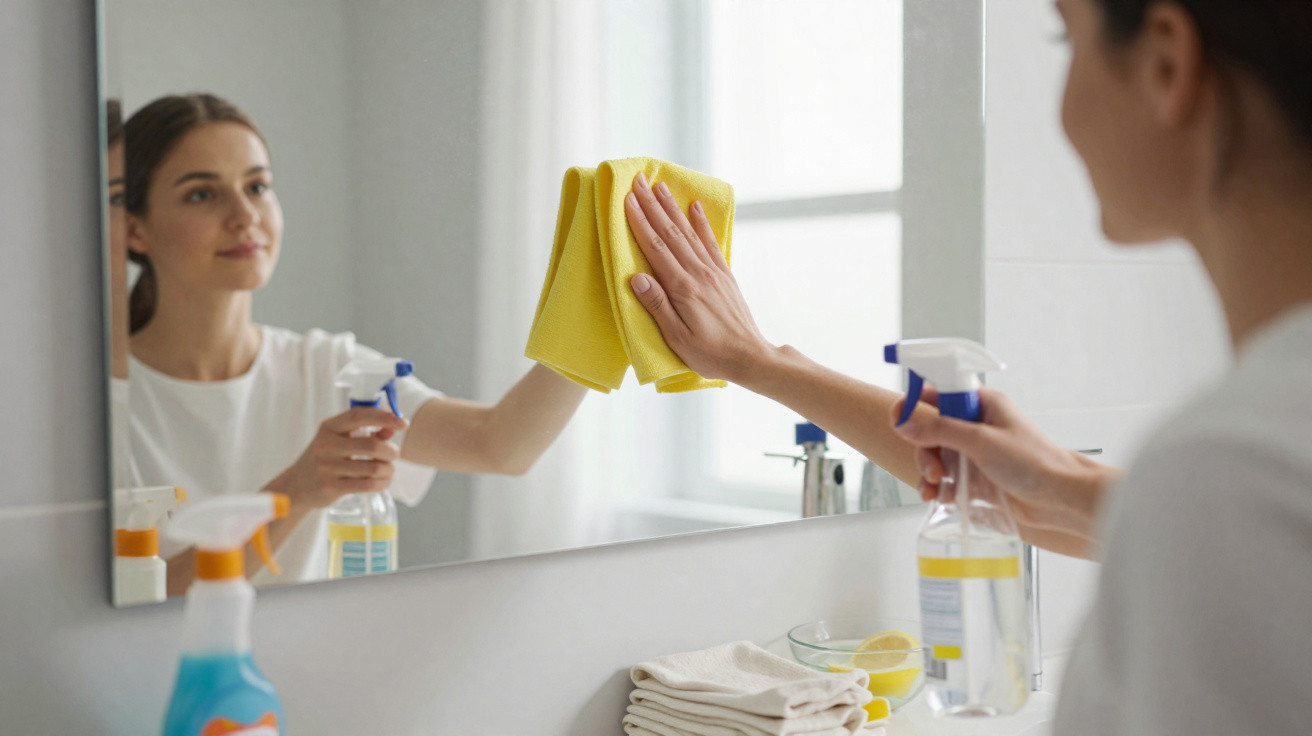
You move close to the mirror, clutching a scrunched-up paper towel in one hand and the bottle everyone recommends in the other. After a few liberal sprays and rapid wipes, you stand back feeling almost pleased with the result.
Then the light catches it: from the side, overhead or out in the hallway. All at once, the glass reveals halos, streaks and greasy curves marking every impatient movement you have just made. You tip your head, rub it with your sleeve, and make the smears worse. The cleaner smells fresh, yet the mirror does not look clean. Clearly, something is wrong.
The culprit could be the very product you rely on most.
Why all-purpose cleaner keeps ruining your mirrors
When a mirror turns dull, most people grab the usual solution: standard all-purpose cleaner. That brightly coloured bottle sits beneath the sink and works on nearly everything, so it seems natural to think, “Mirror? Same story.” Moments later, the glass is soaked, the smell is sharp and foam is trickling down the frame.
Viewed head-on under a bright ceiling light, it may seem acceptable. You are in a hurry, after all. But once the sun shifts or the bathroom light falls at a different angle, every wipe mark emerges like a ghost across the glass. That is what glass does: it exposes whatever your cleaner has left behind.
Heavy formulas do not suit glass, while most multi-surface sprays are designed to tackle grime rather than create shine. They contain surfactants, fragrances and sometimes softening agents that remain on the surface. That may be useful on a worktop, but on a mirror it becomes residue. Each added ingredient intended to make a cleaner smell pleasant or “nourish” surfaces dries into a fine layer. In angled light, that layer becomes streaking. Use the wrong cloth too - one that is rough, dusty or overly fluffy - and you are effectively drawing those streaks in high definition.
There is another easy-to-miss problem: the amount of cleaner people apply. When a mirror is hazy or speckled, the instinct is to spray more rather than less. The liquid drips and pools at the bottom, leaving you to spread diluted dirt around instead of lifting it away. As it dries, the wetter areas contract into arcs and trails, rather like watercolour on cheap paper. Later, those marks can be mistaken for “bad glass”.
At a microscopic scale, glass is smoother than a kitchen worktop and therefore reflects light with ruthless clarity. Residue that would vanish on wood or laminate shows up as bright lines on a mirror. The more ingredients a cleaner includes - dyes, brighteners and “shine boosters” - the more chances there are for streaks to form. Mirrors are not more difficult to clean; the product is simply doing too much for a straightforward job.
How to clean mirrors without a single streak
The most dependable “product” for a streak-free mirror is also the least glamorous: plain white vinegar diluted with water. Combine one part vinegar with one part warm water in an ordinary spray bottle. There is no colour, perfume or thickening agent - only a mild acid that removes toothpaste, fingerprints and the odd mist that gradually builds up.
Apply a light spray, not a downpour, just a fine mist. Next, use a flat, tightly woven microfibre cloth rather than a fluffy towel or a bundle of paper. Begin at the top corner and move steadily across the glass in S-shaped strokes. Turn the cloth over whenever an area becomes damp or dirty. For a large mirror, use a second, fully dry microfibre cloth at the end to buff away the remaining moisture. The real shine arrives during those final twenty seconds.
Let’s be honest: nobody really does this every day. Most of us clean mirrors when visitors are coming or when the streaks are too obvious to ignore. This is why the small details make a difference. Keep a clean microfibre cloth rolled up near the bathroom and you are much more likely to give the mirror a quick wipe while the kettle boils than if the cloth is buried in the laundry basket.
It is also tempting to “improve” the vinegar with a drop of washing-up liquid or a spray of that favourite all-purpose cleaner. That combination may suit greasy pans, but it creates layers on a vertical glass surface. First comes the soap film, followed by fragrance oils and then dust from the cloth. Beneath an LED vanity bar, every layer stands out. Avoid the cocktail, keep to the uncomplicated mixture, and the mirror can look like glass again rather than plastic.
Lighting is another point that nearly everyone gets wrong. Cleaning in poor light or after dark conceals streaks as you wipe, only for them to appear once daylight returns. Where possible, clean with some natural light available. Position yourself slightly to one side of the mirror and look along its surface rather than directly at it. Every streak will suddenly become visible - and you can remove it now instead of spotting it tomorrow morning when you are running late.
“The biggest game-changer wasn’t a new product,” confided Claire, who cleans hotel rooms for a living. “It was learning to use almost no product at all, and letting the cloth do the work.”
That is the understated rule used by professionals: less liquid, better fabric and more considered movement. Hotel bathroom mirrors appear flawless not because staff use magical foam, but because they follow the same routine every day. They work from top to bottom and side to side, changing the cloth regularly. Your home does not require hotel-level discipline, but you can adopt the method.
- Choose simple formulas for glass: vinegar and water, or a dedicated glass cleaner containing very few ingredients.
- Use flat microfibre cloths, washing them without fabric softener so that they remain absorbent.
- Clean in strong light and work from top to bottom to prevent drips and overlooked areas.
- Keep one cloth solely for mirrors so that it does not collect greasy residue from the kitchen.
What to change this week for clearer mirrors and a calmer mind
On a hectic weekday morning, a streaky mirror is more than a minor irritation. You are already managing time, children and notifications, then your reflection appears blurred and grimy even though you have only just washed your face. That subtle feeling that “nothing stays clean” can affect your mood without you fully noticing.
On a Saturday, three modest changes can alter that feeling. Stop using all-purpose cleaner for mirrors. Make an inexpensive clear vinegar spray, label it “glass only”, and hang a dedicated microfibre cloth behind the door. The next time you see toothpaste splashes, it becomes a 30-second task rather than a complete cleaning session. On an exhausting evening, that difference matters.
We have nearly all experienced that moment when we look in the mirror and it is the mirror that seems tired, not us. The amusing part is that the answer is not a miracle product advertised on television. It is moving away from the very bottle responsible for those ghostly lines. Tell a friend who says their bathroom never looks “truly” clean, or run a side-by-side test: clean half the mirror with your normal spray and the other half with the simple mix. The glass will decide for you.
| Key point | Details | Why it matters to readers |
|---|---|---|
| Avoid heavy all-purpose cleaners on mirrors | Multi-surface sprays frequently include surfactants, perfumes and dyes that leave a thin coating on glass. This film catches light and appears as streaks, particularly under side lighting. | Changing products immediately tackles the main source of those puzzling marks that emerge after the mirror “dries.” It means less frustration and less scrubbing. |
| Use a simple vinegar-water mix | Mix 50% white vinegar with 50% warm water in a spray bottle. Spray a light mist, then use a flat microfibre cloth in S-shaped movements from top to bottom. | This affordable solution cuts through toothpaste and fingerprints without leaving residue, allowing the mirror to dry crystal clear rather than cloudy. |
| Choose the right cloth and lighting | Select a clean, tightly woven microfibre cloth washed without fabric softener, and clean when natural light or strong side lighting makes streaks visible as you work. | The correct cloth and lighting allow you to remove streaks in one pass instead of finding them the following morning when you are already rushing. |
FAQ
- Can I still use my regular glass cleaner on mirrors? Yes, provided it is a dedicated glass cleaner with a fairly short ingredient list and no “polish” or “conditioning” claims. Spray it onto the cloth instead of straight onto the mirror, and apply it sparingly to prevent residue.
- Why does my mirror look worse after wiping with paper towels? Paper towels release tiny fibres and absorb limited liquid, so they spread dirty moisture around and leave lint behind. A flat microfibre cloth grips and holds dirt rather than smearing it across the surface.
- Is vinegar safe on all types of bathroom mirrors? Vinegar is normally safe for glass, but avoid soaking the edges or allowing liquid to seep behind the mirror, where it may damage the backing over time. A light mist on the surface is sufficient for routine cleaning.
- How often should I clean a bathroom mirror? In most homes, once a week is enough, with quick touch-ups whenever you notice splashes or fingerprints. A speedy wipe with dry microfibre between more thorough cleans can keep it fresh without becoming a chore.
- What if my mirror already has stubborn cloudy patches? If vinegar or glass cleaner does not shift the cloudiness, the backing may be damaged and no product can repair it. If the clouding gradually fades after repeated gentle cleaning, it is usually layers of old product and humidity slowly breaking down.


Comments
No comments yet. Be the first to comment!
Leave a Comment