
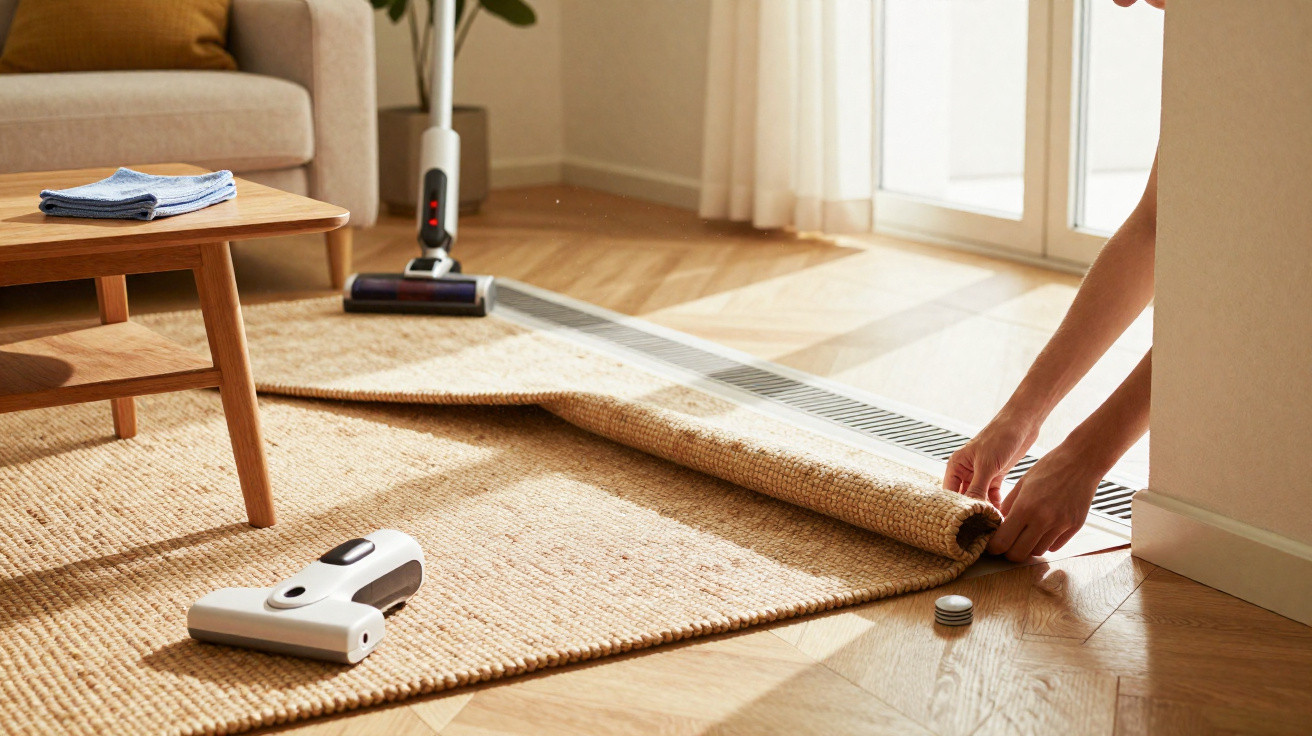
A thin, swirling haze hovers above the rug. Fine grey specks lift whenever somebody crosses the room, like an uninvited silent storm. The house appears clean and even carries the scent of laundry detergent, but the light tells a different tale.
You pause and look: your child races across the rug, the dog comes behind them, the door opens, and it happens again. A faint burst, nearly undetectable in shadow yet clear in a shaft of sunlight. You vacuumed only yesterday. You vacuum weekly. Why, then, does the house still seem dusty?
Perhaps dust is not the real issue. Perhaps the issue is the places where it likes to settle and conceal itself.
When rugs quietly become dust machines
Most people assume that rugs capture dust and prevent it from circulating through the air. That is only partly correct. The less reassuring reality is that, in unsuitable locations, rugs can work like oversized dust pumps. A footstep, a slammed door or a chair dragged backwards can each send a small plume into the room. Most of it remains unseen, but your nose, throat and allergies notice it.
Dust builds up where air changes pace: by doors, beneath windows and along lengthy corridors. Put a rug in one of these spots and it effectively becomes a dust filter that is continually trodden on, shaken and disturbed. Its fibres hold particles, before feet and moving air propel them upwards again. It may look inviting, but it harbours dirt.
On an otherwise peaceful evening, the comfortable hallway runner becomes a miniature storm beneath your shoes. Step on it, and it responds with dust.
Consider a long corridor in a block of flats. Many people lay a narrow runner along its centre, leading from the entrance to the sitting room. It feels pleasant underfoot, reduces echoes and makes the space feel like “home”. Within a week, its edges can begin to curl and a pale grey track may emerge down the middle. You vacuum it and it appears improved. Yet a vacuum cannot always penetrate deep enough into the fibres to remove the finest particles, particularly where there is no underlay or it is too thin.
Whenever the front door is opened, incoming air strikes the rug before anything else. Shoes deposit outdoor debris, pet hair drifts onto it and tiny flakes of skin fall from clothing. All of this settles on that narrow piece of fabric. The next person to pass through physically compresses, squeezes and sends that mixture back into the air at a child’s chest level. You are unlikely to see much of it unless sunlight cuts across the hall at precisely the right angle. Then it resembles glitter - the sort you would rather never have bought.
The same effect can happen beneath a dining table, where chairs scrape and move, or at the end of a bed, where there is movement every morning and evening. Poorly positioned rugs can turn ordinary routines into dust-triggering activity.
The basic physics behind this household problem is straightforward. Dust is not simply “dirt”; it consists of fibres, pollen, skin flakes, mites, soot and minute mineral particles. These materials respond to airflow and pressure. A rug positioned in a busy route or a draught path lies in an area of constant pressure changes. Every footstep squeezes the fibres and then lets them rebound like a spring. That rebound sends dust back into the room.
Without a firm underlay, air can circulate freely beneath the rug. Each step then works like a set of bellows, drawing air in and forcing it out with particles in tow. Put the same rug away from draughts and primary walking routes, and it will still gather dust, but it will not be “pumped” so regularly. The dust can settle further down and remain there until it is intentionally cleaned. Rug placement can either settle the dust or create a daily haze.
How to position rugs so they settle dust rather than stir it
One straightforward principle can make a major difference: rugs should interrupt traffic routes rather than lie directly beneath them. Move entrance rugs slightly away from the arc of an opening door, so the first strong rush of air and shoes meets the hard floor instead of the fibres. Put a washable mat immediately inside the door for heavy dirt, then position a thicker decorative rug slightly further into the home, where steps are gentler and slower.
In hallways, avoid the traditional long runner running centrally from one wall to the other. Use shorter rugs instead, with visible sections of floor between them. This interrupts the pattern of pressure and limits the pumping effect. Beneath a coffee table, allow the table to absorb most of the impact: the area where people rest their feet should have less cushioning, or be left uncovered where the room permits. A rug that outlines movement is quieter than one placed squarely in its path.
In a bedroom, slide the rug partly beneath the bed rather than placing it centrally in front of it. The section beneath the bed retains dust where air movement is slower. The exposed edge still provides a soft surface when you get up, while the most particle-heavy section stays away from repeated footsteps. In a child’s bedroom, choose smaller rugs marked out as “play zones”, leaving the main route clearer and easier to deep-clean.
People often arrange rugs simply to fill bare areas: one large rug in the sitting room, another in the hall and another beneath the table. What tends to be overlooked is the actual path of airflow. Daily-opened windows, radiators, air vents and even the gap beneath the front door produce small currents. When a rug sits directly in one of these routes, dust is never given the opportunity to settle properly. It rises, falls and rises again.
Many homes also create layers: a rug on a slippery floor, no underlay and furniture resting partly on and partly off it. Every shift produces extra movement, friction and dust forced upwards. Let’s be honest: nobody really carries out that full deep clean every day, turning over the rug and cleaning it methodically. As a result, unsuitable placement quietly increases the dust burden week after week.
We have all rolled up a rug “just to clean underneath” only to start coughing because of an unseen cloud. That cloud did not form overnight. It developed through months of small choices about where and how the rug sat in the room.
“The way a rug sits in a room decides whether it becomes a soft filter or a dusty trampoline.”
- Avoid: putting thick rugs directly at entrances, beneath swinging doors or across main walking routes.
- Prefer: positioning rugs partly beneath stable furniture, which anchors the fibres and limits movement.
- Upgrade: choose dense underlays to prevent air pumping from underneath and stop rugs flexing excessively.
Living with less dust without making your home look like a catalogue
There is something surprisingly satisfying about reconsidering a room from the perspective of dust. It is not about making your home resemble a sterile hotel; it is about deciding where the daily storm takes place. Move a hallway rug thirty centimetres away from the door. Reposition the sitting-room rug so the main walking route runs beside it rather than across it. The home can suddenly seem calmer, even if nobody can identify the reason.
For anyone living with allergies, asthma or a child with a constantly runny nose, rug placement becomes part of the health discussion rather than merely a decorating choice. Even minor adjustments can literally make the air feel lighter. On a bright afternoon, observe your rooms in strong daylight. Notice where dust swirls when someone walks and where a sunbeam exposes a concealed mist. That is your guide. From then on, rugs are no longer just decorative items: they become quiet partners in how your home breathes.
| Key point | Detail | Benefit for the reader |
|---|---|---|
| Rugs in traffic routes pump dust | Every step compresses fibres and forces particles into the air | Helps explain why a “clean” home can still seem dusty |
| Airflow matters as much as cleaning | Doors, windows and vents create currents that disturb dust in rugs | Provides practical guidance on where rugs can be moved or made smaller |
| Placement can settle or amplify dust | Rugs that frame movement rather than sit beneath main routes trap more dust safely | Offers simple layout changes without purchasing new décor |
FAQ:
- Does removing all rugs reduce dust completely? Removing them reduces one significant dust reservoir, but dust still settles on floors, furniture and textiles. Well-positioned rugs that are easy to clean can help keep dust out of the air.
- How often should I really clean my rugs? In high-traffic spaces, aim to vacuum weekly with a powerful vacuum fitted with a brush, alongside a deeper wash or professional clean once or twice yearly.
- Are some rug materials less dusty than others? Short-pile, closely woven wool or synthetic rugs usually hold less fluffy dust on their surface than long-pile or shag rugs, and vacuuming releases dirt from them more easily.
- Do rug pads really make a difference for dust? Yes. A dense rug pad limits air pumping from below and keeps the rug stable, reducing dust clouds caused by footsteps while making vacuuming more efficient.
- Where should I avoid putting rugs completely? Avoid placing them immediately behind external doors, directly in front of often-opened windows, over vents and in narrow pinch points where everyone steps in the very same place.


Comments
No comments yet. Be the first to comment!
Leave a Comment