

The disagreement began with a mug of tea and a rumpled duvet.
One flatmate insisted that sheets needed changing every three days “for hygiene”. Another casually confessed that he sometimes left them for a month, “if they still smell fine”. Nobody was keen to reveal their own real routine. In the background, the washing machine whirred away like a lie detector.
If you have ever taken the bedding off at 11pm only to realise you never washed it, you will recognise the combination of guilt and exhausted acceptance. Do you haul yourself to the laundry basket, or slip back under the slightly questionable sheets and act as though you noticed nothing? The reality of how often fresh bedding is genuinely needed lies somewhere between those options.
And it is probably not what most people assume.
How dirty is your bed really?
A bed can appear clean well after it has ceased to be truly clean. The cotton may still feel soft, its colour may look unchanged, and there may be no visible warning signs. But every night, it collects sweat, shed skin, hair, remnants of skincare products and anything a pet happens to add.
Researchers who tested used bedding have found bacteria levels similar to those on a frequently touched door handle. It is not a hazardous waste site, but it is hardly a spa either. If you regularly wake with a blocked nose, itchy skin or an unexpected breakout on your cheeks, your pillowcase may be playing a part. In a way, your bed records your body in invisible writing.
When it comes to surveys, there is a sizeable difference between what people report and what they actually do. One UK poll found that most participants said they washed their sheets “about once a week”. Yet another study following real behaviour found that many waited 2–3 weeks, while others went considerably longer. That is the nature of laundry routines: our answers describe aspirations, while daily life demands compromise.
At a university campus in Leeds, a small research project asked participants when they had last changed their sheets. At first, the replies sounded reasonably respectable. Then one person quietly said “three months”, prompting guilty laughter across the room. Nobody seemed surprised. Everyone understood how it happens: exam pressure, late shifts, a broken tumble dryer and life accumulating more quickly than washing.
From a health perspective, the question of timing depends on what shares the bed with you. Dust mites thrive in warm, slightly humid conditions and feed on the skin flakes lost overnight. Their droppings may trigger allergies and asthma. Meanwhile, body oils build up on pillowcases, holding on to dirt and make-up, so your face spends hours against what is effectively a highly efficient grime trap.
Dermatologists generally reach the same conclusion: for most people, once a week is the ideal frequency. It is neither excessive nor neglectful. For those with allergies, eczema, acne, or who sleep without clothes, they tend to recommend changing pillowcases every 3–4 days. Skipping one week is unlikely to damage your health, but allowing “I’ll do it next weekend” to become a pattern can gradually influence both sleep quality and skin behaviour.
The real-life washing schedule that actually works
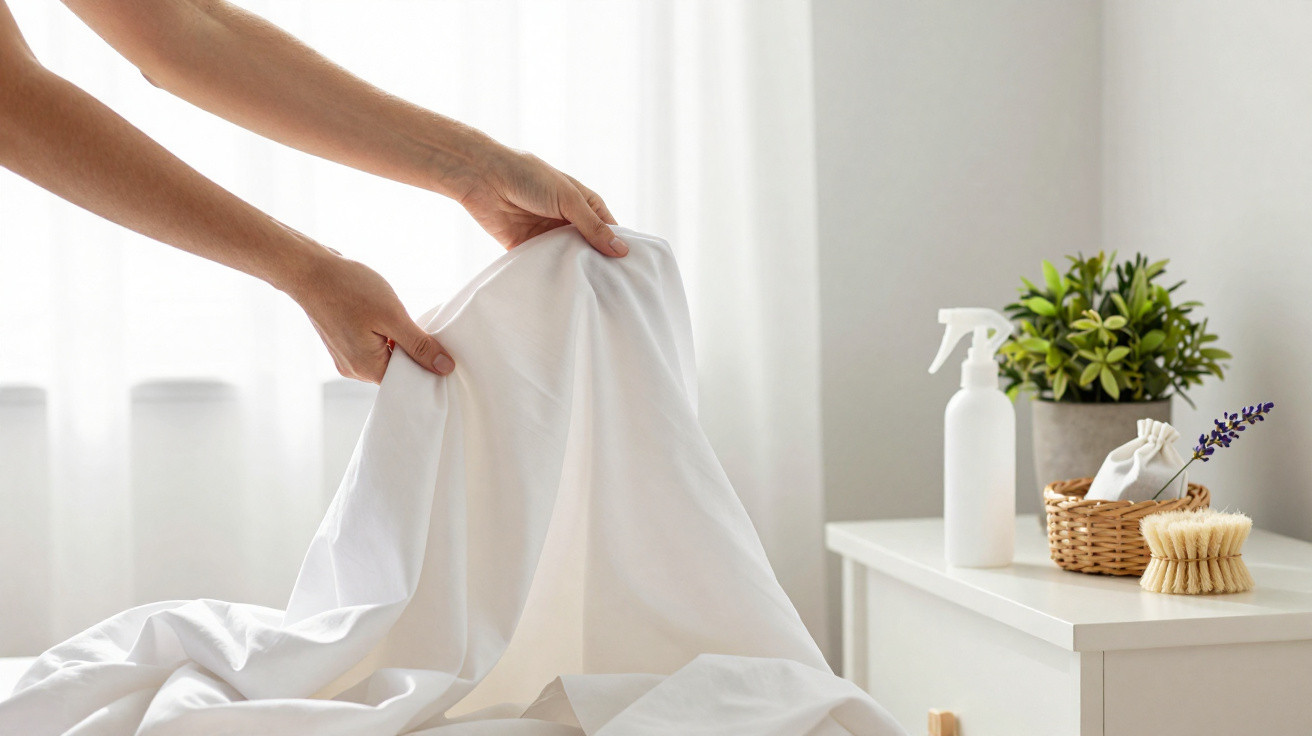
The most straightforward approach is also rather unexciting: choose a regular sheet day and treat it as a fixed commitment. It could be Sunday morning, Thursday evening or any time that suits your routine. Take the bedding off, put the sheets and pillowcases into the wash immediately, and leave it there. Do not deliberate or bargain with yourself. Simply follow the routine.
Those who keep up the habit usually make the entire process less difficult. Having two or three bedding sets in rotation means there is no need to wait for the dryer. A dedicated basket or shelf for clean bedding also helps. Some people even put a fresh set straight on the mattress as soon as the old one comes off, then wash the used bedding later. It makes a midnight encounter with a bare duvet and a bad temper far less likely.
For most of us, the problem is not actually washing the sheets; it is the spiral of saying, “I’ll do it tomorrow”. You remove the bedding, discover there is no detergent left, then notice somebody else is already using the machine. The plan gets postponed. Life carries on, and before long you are sleeping on a fitted sheet without a top sheet, cuddling a pillow in a partly washed pillowcase. We have all been that person.
Old bedding can carry emotional clutter, too. One therapist told me that clients often slept less well in untidy bedrooms that felt slightly stale. This is not about achieving perfection, but about the messages your surroundings send. Clean sheets tell your brain that the day has been taken care of and that it is safe to rest. Sliding into crisp bedding after a difficult week is not solely about softness; it can offer a small sense of control in a world that rarely feels controllable.
It is useful to understand when the “rules” can be flexible. If you shower before bed, wear pyjamas and rarely sweat, changing your sheets every 10 days is unlikely to transform your life for the worse. But if you share a bed with a partner, children or pets who charge in barefoot, a weekly wash becomes more than a pleasant idea. The same applies if you have allergies, experience night sweats or live in a hot top-floor flat. In those circumstances, both your sheets and duvet cover require more frequent care.
Let’s be honest: nobody really does this every day. Doctors who recommend changing pillowcases daily for acne know that most patients will not follow the advice literally. What they are really trying to do is reset the baseline. You may not manage seven changes in a week, but you might manage two. That is often where practical improvement begins.
As one sleep physician put it to me:
“Perfect hygiene routines look great on paper, but your brain doesn’t live on paper. Aim for the schedule you’ll actually keep, not the one that impresses your doctor for five minutes.”
To make this more manageable, build a small “sheet system” rather than depending on motivation alone.
- Standard rhythm: Change sheets and pillowcases every 7 days, duvet cover every 2–4 weeks.
- Higher-need rhythm: If you have allergies, sweat heavily or allow pets on the bed, change pillowcases every 3–4 days and sheets every 5–7 days.
- Low-friction trick: Store one clean, folded set at the foot of the bed, so changing it takes 90 seconds.
Why this tiny habit touches so many parts of your life
When people begin washing their sheets more regularly, germs are rarely the first thing they mention. Instead, they describe how it feels: the small mood boost of getting into a bed carrying a faint scent of detergent and daylight, the way their shoulders relax, or the brief pause before reaching for their phone. It may be almost imperceptible, but it still matters.
Changing bedding routinely can also alter the way you view yourself in your own home. A cluttered room with stale sheets can quietly suggest that you are always behind and do not quite merit the gentler version of rest. Fresh bedding is a modest domestic act of self-respect. It says that you are allowed to come home to something comforting, even if the rest of your day has been anything but.
There is also a social element that few of us acknowledge. When a date unexpectedly turns into a sleepover, or a friend stays after missing the last train, your bed is no longer simply a private retreat. Suddenly, you spot the faint mark on the pillow, the slightly musty area at the end of the bed and the duvet cover that has lost its brightness. That flash of embarrassment reminds us that private routines do not always remain private.
The health implications vary from person to person. For some, washing sheets weekly is mainly about comfort and appearance. For others, it may be closely connected to fewer asthma attacks, less severe eczema flare-ups or acne settling sufficiently for them to feel comfortable appearing bare-faced on camera. It is neither magic nor a cure-all, but it is a mundane, repeatable action that can make other problems less uncomfortable.
This subject can also bring us back to the stories we inherited. Perhaps your mum boiled sheets and hung them out until they dried so crisply they snapped in the wind, making anything less feel like a failure. Or perhaps you grew up in a household where laundry was done only when there was absolutely nothing else left to wear, and you are still learning how to maintain any sort of routine as an adult. Washing sheets may look like an ordinary household task, but it is intertwined with class, culture, upbringing and the pace of your life now.
There is no universal award for getting it “right”. There is only your own reality: your body, your bus timetable and your energy this week. The unexpected truth is that washing your sheets is not about meeting a moral benchmark. It is about creating a workable truce between health, comfort and effort. That could mean a weekly phone reminder, extra pillowcases for a midweek change or a quiet personal agreement: untidy flat, perhaps; stale bed, no.
Once you notice how much cleaner bedding affects your sleep, skin and mood, the question changes. It becomes less about “What’s the minimum I can get away with?” and more about “What version of this makes my life feel 5% kinder?” That is a far more interesting starting point.
| Key point | Detail | Why it matters to the reader |
|---|---|---|
| Realistic frequency | Aim to wash sheets once a week, and change pillowcases more often if you have sensitive skin | Know what to do without becoming obsessive or neglecting the task |
| Adapt it to your life | Adjust the frequency for allergies, sweating, pets and showering habits | Turn a generic “rule” into a routine that fits your reality |
| Make it easy | Set a fixed sheet day, rotate several sets and make small steps automatic | Reduce mental load and avoid spending whole weeks in tired bedding |
FAQ:
- How often should I really wash my sheets? For most healthy adults, once a week is a sensible target. If you have allergies, night sweats, acne or pets in bed, aim for every 5–7 days for sheets and every 3–4 days for pillowcases.
- Is it bad to go longer than two weeks? It is not immediately dangerous, but dust mites, bacteria and body oils accumulate. You may notice itchier skin, more congested sinuses or a musty smell. In time, this may affect your sleep and the way your skin behaves.
- Do I really need to wash the duvet and pillows too? Pillow protectors and duvet covers are useful, but the fillings still need attention. Washing pillows twice yearly and duvets once or twice yearly is normally sufficient, unless there has been a spill or illness.
- What if I don’t have time for full washes that often? Focus on pillowcases and the top sheet, as these have the most contact with your face and body. A fast midweek pillowcase change alongside a weekly full bedding change can be a realistic compromise.
- Are there signs my sheets need changing right now? Yes: visible marks, a musty or sour odour, itchiness when you get into bed, or having recently been ill, sweated heavily, or had pets or children in the bed more than usual. On a very human level, the moment the bed simply feels “off” is your sign.



Comments
No comments yet. Be the first to comment!
Leave a Comment