
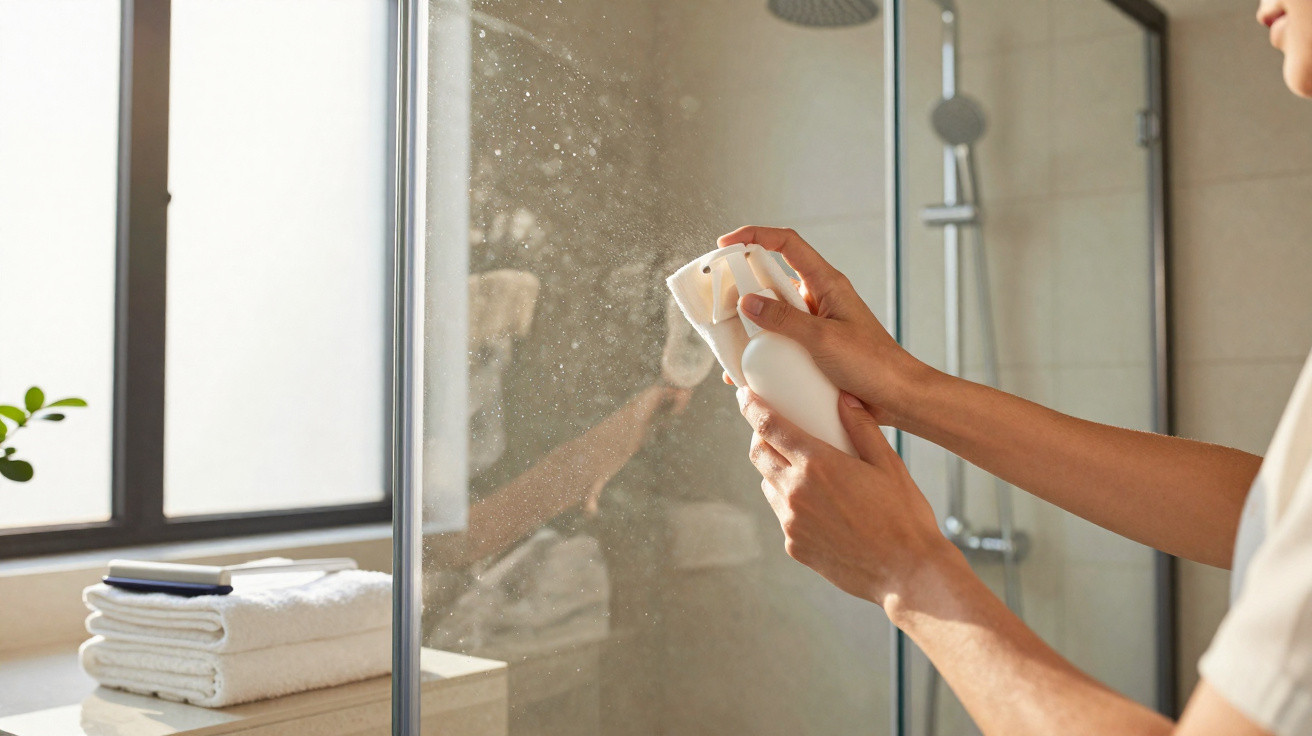
The glass appears almost invisible: no streaks, specks or ghostly white film. A new guest can enter, set down their suitcase and think, “Wow, this is clean.” What they will not realise is that, two days earlier, that very same glass was marked with limescale shadows and rings of soap scum.
In five-star hotels, this consistently pristine appearance is not achieved through hard work alone. It relies on one small additional stage that most of us leave out at home – a step that subtly alters the way water sits on the glass for weeks.
Once you understand it, you will notice the difference everywhere.
The invisible enemy on your shower screen
Take a proper look at your own shower screen. You may spot drip marks reflecting the light, a cloudy band around shoulder level, or a faint shape where water regularly lands. It may not seem dirty, exactly, but it looks… worn. This is the sort of dullness that remains after every quick weekend clean, gradually becoming the accepted normal.
That coating is made up of several things: hard-water minerals, soap deposits, body oils and remnants of shampoo. These particles stick to tiny flaws in the glass before accumulating layer by microscopic layer. Each shower adds another coating. Before long, the glass installed in your flat three years ago no longer appears transparent. It seems aged instead.
Hotels cannot allow this to happen. Guests form an opinion about cleanliness the moment they look into the bathroom. Even an impeccably made bed will not compensate for shower glass that appears misty and streaked. Hotel teams have therefore learnt to tackle a particular type of problem: one that returns daily, one drop at a time.
One London head housekeeper admitted she could predict the volume of guest complaints simply by inspecting the shower screens on a floor. Rooms with mildly dull glass attracted more remarks, lower ratings and more notes saying “not as clean as expected”. It was not a matter of germs. It was about what the eye interprets as “fresh”.
Her team attempted every solution: stronger limescale removers, scrubbing every day and softened water. Although these methods worked, they demanded time the team did not have. Then she noticed the approach used by a Scandinavian boutique hotel group. Their shower screens remained crystal clear with half the work. The answer was not a more aggressive cleaner, but a transparent, virtually unseen coating left on the glass after cleaning.
She adopted the technique. Within a month, the team had reduced repeated descaling sessions, while comments about “foggy shower” screens had almost vanished. Guests did not specifically celebrate the improvement in reviews. Instead, they began using terms such as “sparkling” and “spotless” again – the sort of feedback every hotel quietly hopes for.
The reasoning is straightforward: glass is not as smooth as it appears. Viewed under a microscope, it consists of peaks and hollows. Minerals from hard water and soap residue settle readily in those hollows. Conventional cleaning removes existing deposits but does not change the surface itself. The following shower then restarts the process. The hotel method does more than clean the hollows; it fills them. Water cannot cling on and instead runs away.
That is where the real difference begins.
The hotel secret: clean once, then “seal” the glass
The technique used in high-end hotels has two stages. First comes a thorough clean that returns the surface to bare glass. Next comes a protective treatment that preserves the freshly cleaned appearance for weeks. It is this second stage that nearly everyone overlooks at home.
The deep clean is straightforward, though it requires more care than an ordinary weekend wipe. Use a non-scratch sponge with a limescale remover or a white vinegar solution, working slowly from top to bottom in overlapping strokes. Rinse thoroughly, then dry the glass with a microfibre cloth until it squeaks. This is your “reset”. Missing out the drying stage ruins the effect, because avoiding water spots is the whole point.
Then comes the hotel step: they continue rather than stopping there. A water-repellent coating, similar to products made for car windscreens, is applied. Spread on a very fine layer, buff it in circular motions and wipe it away until the glass again looks completely ordinary. There is no visible shine or coating. Yet, when the next shower is used, water forms beads and rolls down instead of lingering. With less for soap and minerals to attach to, deposits develop far more slowly.
At home, many people attempt to make up for this with daily squeegeeing, detailed cleaning routines or costly sprays. Let’s be honest: no one really does that every day. Hotels understand this as well. That is why they use a barrier instead of relying on guest behaviour or extraordinary housekeeping hours. At home, you can use precisely the same approach with one additional product and five minutes of attention once or twice each month.
At first, the change is subtle – and then it becomes impossible to miss. After a week, your shower screen will still look much as it did on cleaning day. After two weeks, there may be a few marks around the edges. A single light wipe restores it to perfection. There is no scraping or struggle with stubborn chalky stains: just maintenance rather than a battle.
“We stopped trying to win a daily war against water marks,” says Laura, a head housekeeper who oversees 180 rooms. “We changed the rules of the game. Once the glass is sealed, it works with us, not against us.”
The most frequent mistake at home is making the routine unnecessarily complicated. People combine too many products, apply vinegar over strong chemicals and then wonder why the glass is streaky or the seals begin cracking. The most effective sequence is simple: clean, dry, protect. Nothing more is required. There is no need to scrub more forcefully; simply clean more intelligently.
Another common oversight is neglecting the edges and lower third of the glass. These are precisely the areas where limescale tends to settle. Spend an additional minute treating these sections. Choose soft cloths instead of old towels that leave lint behind. Think like hotel housekeeping: small, regular actions rather than frantic weekend marathons.
There is an emotional aspect that rarely gets mentioned, too. On a dull Monday morning, entering a shower that resembles a boutique spa can lift your mood slightly. After a busy evening, cleaning feels less punishing when a five-minute refresh genuinely lasts. On a very human level, clean glass creates mental space.
- For the deep clean, use a dedicated glass cleaner or vinegar solution, then rinse well.
- Ensure the screen is completely dry before using any water-repellent product.
- Renew the protective coating every 3–4 weeks, or when the water beading begins to disappear.
Living with a shower screen that truly stays clear
When the glass has been sealed properly, the way you approach bathroom cleaning changes. You are no longer confronted with a discouraging “before and after” each weekend. Instead, the shower screen maintains an almost-new appearance. It becomes one less surface demanding attention when you are already exhausted.
In practical terms, the weekly clean turns into a wipe rather than a full-scale attack. All you need is a soft cloth, a mild cleaner and a few minutes. The glass will not resist with white marks and gritty areas. The hotel technique simply makes the surface less inviting to dirt, meaning you are not beginning from scratch every time.
At a deeper level, this modest adjustment often encourages other changes. A clear shower screen makes the entire bathroom appear a little better. You may pay more attention to the grout or choose to keep the basin slightly tidier. Reading this on a phone at midnight, it may sound insignificant. In everyday life, however, these small shifts create a space that quietly supports you rather than depleting you.
This is why the hotel secret stays with people after they try it: it is not only about glass, but about the feeling of your mornings and evenings.
| Key point | Detail | Benefit for the reader |
|---|---|---|
| “Reset” clean | Completely remove limescale and soap before applying any protection | Lets you begin again with genuinely transparent glass |
| Water-repellent layer | A car windscreen-type product or glass protectant, applied in a thin layer | Keeps the shower screen clear for weeks |
| Light maintenance | A simple weekly wipe and monthly reapplication | Saves time and reduces everyday cleaning effort |
FAQ:
- How often should I apply the water-repellent layer? You can normally reapply it every 3 to 4 weeks. When water stops beading and running off, it is time to apply a new layer.
- Can I simply use vinegar rather than a specialist product? Vinegar is excellent for deep cleaning and removing limescale, but it does not create a long-lasting protective coating. To achieve the “hotel effect”, you need a product that causes water to bead.
- Will this work on old, heavily cloudy glass? Yes, although you might first need two or three deep-clean sessions. Once the glass has been restored as much as possible, the sealant will slow down fresh build-up.
- Isn’t a daily squeegee enough? It is helpful, but most people do not maintain the habit long term. This hotel-style technique offers protection even on days when you forget or lack the energy.
- Are car glass water-repellent products safe for shower screens? Many are, provided they are designed for glass and used in a ventilated area. Always check the label, and keep them away from plastic seals and painted surfaces.


Comments
No comments yet. Be the first to comment!
Leave a Comment