
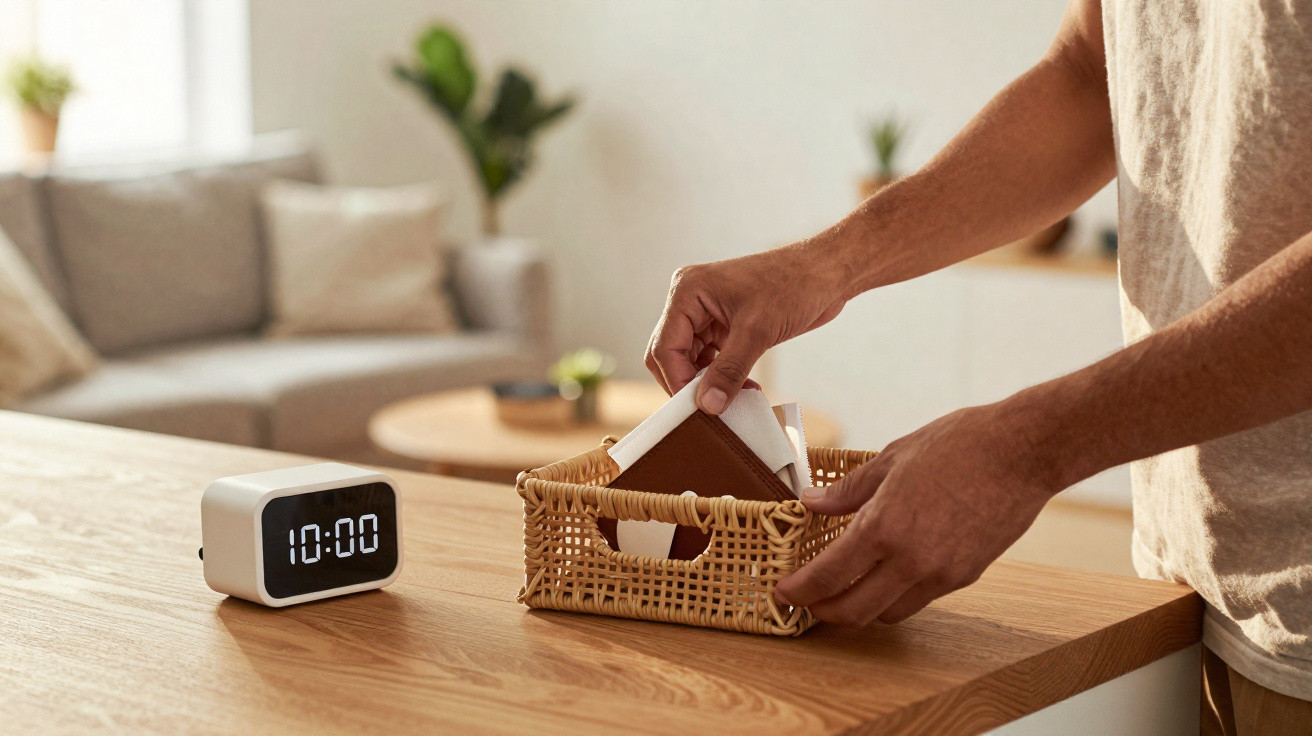
The kitchen worktop gleamed on Sunday evening.
By Wednesday morning, it had disappeared beneath an avalanche of post, lunchboxes, receipts and one abandoned sock that nobody would own up to. Do you know that peculiar transformation when a home goes from “magazine” to “disaster zone” in three days? It is not a major clean that is lacking. It is the small routine that never quite became a habit. Between work, children, notifications and late-night snacks, clutter steadily returns like weeds pushing through a crack in the pavement. Yet some people follow an almost absurdly straightforward ritual that prevents the mess from starting again every week. They do not have extra time; they simply act differently.
Why clutter keeps returning
Most households do not become untidy in one dramatic moment. Instead, they come apart through tiny, barely noticed actions: a bag put down “just for now”, a delivery box abandoned in the hall, a mug placed beside the sink instead of in it. On their own, none of these looks like chaos, so we allow them to remain. Then, one morning, it feels like the house turned against you overnight. It has not. The small messes have simply, quietly, won the week.
One wet Tuesday in a London suburb, I saw a mother of three arrive home after work and the school run. Shoes were kicked off, backpacks hit the floor, and the hallway resembled an exploded airport baggage carousel. Two hours later, she was still moving around the same stacks of things, feeling beaten. She insisted that she “cleaned constantly”, but by Sunday the dining table would once again be covered with paperwork and miscellaneous toys. Her experience is far from unusual. Surveys by professional organisers suggest that people are not worn out by deep cleaning itself. They are exhausted by the feeling that, regardless of what they do, the mess resets every week.
The reasoning is harshly simple. A major Saturday clean is a sprint, while clutter is a marathon runner. One weekly effort is competing against six days of tiny daily additions. Any surface without a defined “job” turns into storage space. Every item without a regular home becomes a wanderer. The house therefore returns to its default setting: visual noise. The answer is not putting in more effort on Sunday or scrubbing harder. It is replacing heroic cleaning sessions with one easy habit that tackles daily build-up before it turns into chaos.
The 10-minute “Reset Loop” that tackles clutter at its source
This straightforward routine can quietly alter everything: a daily 10-minute “Reset Loop”. Choose the same time each day, follow the same brief sequence and set the same modest expectation. It is not a complete tidy-up or a “deep clean”. It is simply a purposeful circuit through three essential zones: the entrance hall, kitchen surfaces and living area. Set a timer for 10 minutes, keep moving, avoid overthinking and stop when it sounds, even if you are halfway through a pile. The goal is consistency, not perfection.
Begin with what I call “clutter attractors”: level surfaces that collect random belongings as though they were magnets. Think of the hall table, kitchen worktop and coffee table. Pick something up, make a quick decision and continue. Put post in one tray, hang up bags, load dishes into the dishwasher or place them in the sink, and put toys in a single basket. In these 10 minutes, do not sort, reminisce or try to optimise anything. Simply return items to their most straightforward possible home. It is almost mechanical, which is precisely why it succeeds.
Let us be honest: nobody genuinely does this every day with a huge smile. On some evenings, you will want to miss it. You will tell yourself the house is “not that bad”. That is often the evening when the slow avalanche begins. A frequent mistake is making the Reset Loop into a marathon by stretching it to 30 minutes “just this once”, then dreading it the following day. Another trap is using it to declutter sentimental possessions. Keep the Loop ridiculously simple: deal with visible mess only, make no emotional decisions and use your phone timer as a firm finish point. You are creating a reflex, not sitting an exam.
“My home used to swing from disaster to spotless and back again. The 10-minute reset is the first thing that made the clean feeling actually last.”
To make it feel lighter, approach the Reset Loop as a game rather than a chore. Play the same playlist so your brain begins to associate the music with “reset mode”. Take a quick before-and-after photograph of one surface each day; that visible victory counts. If you miss a day, do not attempt to “catch up” by punishing yourself with an hour-long session.
- Stick to 10 minutes, even if you have fallen behind.
- Concentrate on three zones rather than the entire home.
- Stop in the middle of the mess when the timer sounds, proving that the task really is limited.
How this small habit changes the feel of your home
The value of the Reset Loop is not that 10 minutes can tidy a whole house. Its strength is that 10 minutes is brief enough to stop you endlessly bargaining with yourself. You sit on the sofa, sigh, start the timer and begin. No fuss. Across a week, that gives you 70 minutes of concentrated effort directed exactly where clutter tends to accumulate. Over a month, it amounts to nearly five worthwhile hours that previously vanished into doomscrolling or staring at the mess in overwhelm.
At a deeper level, a daily loop changes the story you tell yourself about your house. It is no longer an untamed creature that is occasionally brought under control on Sundays. Instead, it becomes a living space with which you have a quiet 10-minute conversation each evening. That feeling of control matters more than the number of objects you put away. Those who maintain this ritual report less “background guilt” about their homes and fewer exhausting, all-out cleaning weekends. The house no longer feels as if it is shouting at them.
There is another, stranger effect: when weekly clutter no longer completely reappears, the genuine problems become visible. You notice the corner that never functions, the shelf that is too high or the shoe rack that is too small. Once surfaces are not buried, you can make smarter adjustments rather than constantly tackling urgent tidying. Add a hook by the door, a basket beside the sofa or a tray for keys and headphones. The routine clears the visual fog so you can design your space on purpose rather than by accident. It is less about being “tidy” than allowing your mind space to breathe.
Living with less weekly chaos
There is a quiet strength in finishing the day with your home a little better than when you found it. Not flawless, simply improved. On a Thursday evening, when the week already seems like a marathon, those 10 minutes may appear pointless. Then Saturday arrives and you realise that a full-scale rescue mission is unnecessary. Your surfaces can be seen, your entrance hall is not a tripping risk, and you can invite someone round on impulse without panicking.
At a human level, this habit is more about dignity than organisation. It means returning to a space that is not silently judging you, and waking to a kitchen that does not begin the day with an argument. During a difficult week, that can feel like a small luxury. Even in weeks when everything goes wrong and you skip three days in succession, you know exactly how to begin again: the same 10 minutes, the same three zones and the same timer. No guilt, just restarting the loop where you left it.
We have all looked around and wondered, “How did it get this bad again?” The answer is rarely a weekend clear-out or an expensive storage system. It lies in the quiet, almost dull, daily actions that nobody shares on Instagram. The 10-minute Reset Loop is one such action: unseen from outside, but deeply experienced within. It is a small ritual that stops weekly clutter winning by default and returns a home that feels as though it is on your side, even when life is messy.
| Key point | Detail | Benefit for the reader |
|---|---|---|
| 10-minute routine | A daily “Reset Loop” across three key zones using a timer | Helps keep a home under control without giving up weekends |
| Clutter attractors | Target surfaces that naturally gather objects | Reduces the visual and mental “avalanche” effect during the week |
| Simple, repeatable ritual | The same steps at the same time, without perfectionism | Turns a chore into an automatic habit that is easier to sustain |
FAQ:
- How long does it take for the Reset Loop to feel natural? Most people notice a difference after one week and find it nearly automatic after three to four weeks of practising on most days.
- What if I genuinely don’t have 10 minutes every evening? Use a 5-minute version that covers only one or two surfaces; consistency matters more than duration.
- Should I include deep cleaning tasks in the Reset Loop? No. Save deep cleaning for separate sessions; the Loop is exclusively for visible clutter and quick resets.
- How do I get my partner or kids involved? Make it a “house reset race”: give each person a zone, use the same timer and stop together when it rings.
- What if my home is already very cluttered? Start the Loop regardless, in the clearest area available, and use a separate, slower decluttering process for the larger backlog.




Comments
No comments yet. Be the first to comment!
Leave a Comment