
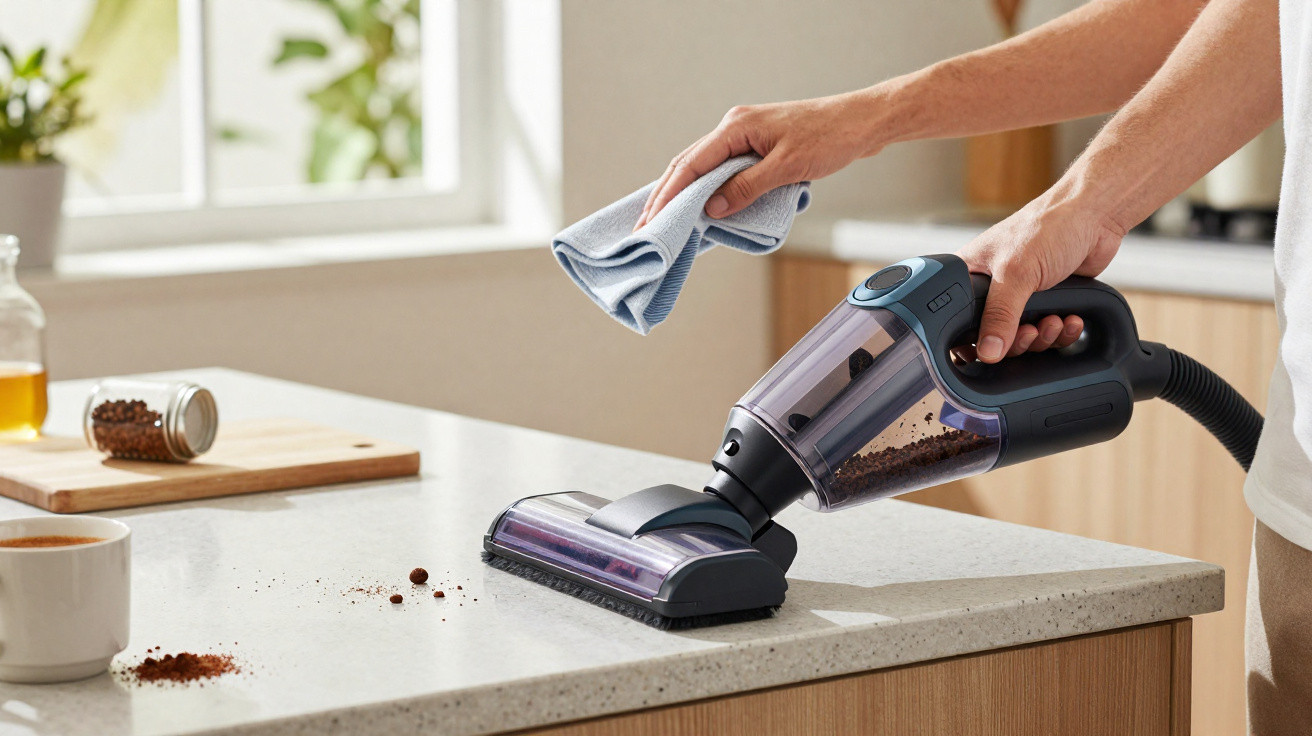
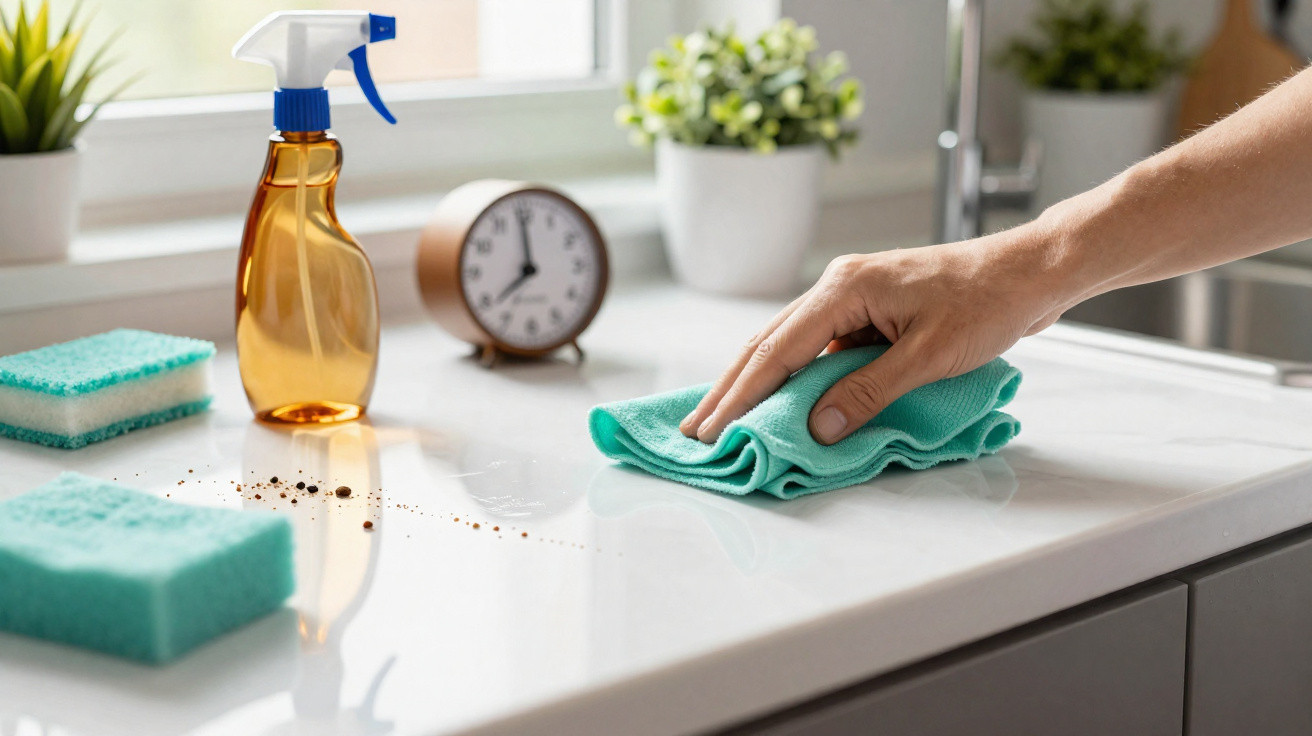
Sunlight reveals every tiny grain of dust across the worktop. Automatically, you reach for a cloth, spray on something lemon-scented and wipe in broad, gratifying sweeps. Crumbs tumble to the floor. A puff of flour rises, lingers briefly in the air, then gradually settles somewhere out of view.
Only then do you pull the vacuum cleaner from the cupboard, mildly irritated by the tangled lead you still have not sorted out. You run it over the floor quickly, assuring yourself that it is “good enough for today”. The room looks clean, smells clean and feels clean. Yet by tomorrow morning, those familiar little particles will be beneath your socks again.
It is an ordinary scene, but it could be why your cleaning never seems to last.
Why wiping first quietly undermines your cleaning
For most of us, wiping the worktops feels like the proper beginning of cleaning. It appears purposeful, smells like progress and gives instant visual results. As the marks disappear, your brain registers productivity. Vacuuming happens afterwards, as though it were simply the final formality.
But wiping before vacuuming sends dirt precisely where you do not want it. Crumbs drop into grout lines, dust is swept from the edge into corners, and greasy particles rise into the air before quietly settling again on the floor you plan to “finish”.
You may not see every particle moving, but none of that dust has disappeared. It has merely changed location. That is why you can spend 30 minutes cleaning yet still feel that a room never remains clean for longer than a day.
Picture a busy Sunday evening in a family kitchen. One person clears the table, someone else rinses plates, and children circle nearby in search of snacks. The worktops are covered in breadcrumbs, coffee grounds and rings of dried juice. Someone takes a sponge and quickly pushes everything towards the edge because it seems faster.
The crumbs spill over in small avalanches. Coffee grounds scatter across the floor mat. A swift spray of cleaner releases a fine mist of particles into the air. The vacuum cleaner does not appear until the table looks “presentable”. By that point, the floor has collected both the day’s mess and the dirt that was previously sitting on the worktops.
Later, when everyone passes through to make tea, their footsteps push those fresh crumbs deeper into the rug fibres. In the gentle evening light, you cannot really see them. Instead, you notice a slight roughness under bare feet and that nagging feeling that the kitchen is never properly fresh.
There is straightforward reasoning behind this. Dust and crumbs follow gravity and movement rather than our preferred routines. Wiping creates motion: sideways when you push debris across a worktop, and downwards when it falls or is disturbed into the air. The particles do not vanish; they simply travel along the route you have created.
Vacuuming is among the few cleaning jobs that genuinely removes dirt from the space. It draws particles from surfaces and contains them. If you vacuum last, you are tackling mess that has already been prompted to spread. It settles beneath plinths, along skirting board edges, between floorboards and inside tiny scratches in the flooring that your eyes overlook.
So the order that seems sensible – wipe, then vacuum – is quietly working against you. Your worktops become launchpads for debris, and you then use a machine to pursue the fallout that could have been collected much earlier.
Vacuum before wiping: the simple change
The most useful adjustment is almost brutally simple: vacuum before wiping anything above floor level. Enter the room, leave the worktops alone and go directly to the floor. Make one deliberate pass, travelling slowly enough for the vacuum cleaner to do its work properly.
Pay attention to skirting boards, corners, beneath the front edges of cupboards and around table legs. This is where yesterday’s wiped-off crumbs tend to be hiding. Once the floor is as clean as the vacuum can make it, turn your attention upwards. When you begin wiping, any fresh debris that drops will land on a floor already cleaned once, where it can be dealt with quickly in specific spots.
For the first few days, it can feel like the wrong way round. Then you begin to notice less dust suspended in the air, less unexpected grit beneath your socks, and a room that still looks respectable the following afternoon even when nobody has used a spray bottle.
Another helpful mental shift is to think in “top-down zones” rather than “task lists”. Instead of telling yourself, “I vacuum, I wipe, I mop”, view cleaning as controlling the way dirt moves through a space. Remove the debris already on the floor first, so old dirt is not mixed with newly fallen particles.
Many people admit to frantically wiping just minutes before guests arrive because it looks impressive. That is how cracker dust ends up on a floor you vacuumed only an hour earlier. Let’s be honest: nobody really does this every day. Most of us rush about, make it look as though we have everything under control, then wonder why the home does not stay clean.
If you have already wiped first, you can still put things right. Make a brief, targeted “second pass” with a handheld vacuum cleaner, or sweep quickly beneath worktop edges and around the dining area. It is not about being perfect; it is about catching the debris your cloth has sent downwards.
“The moment I started vacuuming before touching a cloth, my kitchen stopped feeling like a sandpit,” laughs Emma, a mother of three who runs a home baking side hustle from her tiny flat. She noticed that the more she wiped, the more flour dust seemed to appear. Reversing the order cut her maintenance time in half. Her floors stopped feeling like a bakery at closing time.
There is a subtle emotional comfort in making this change. You are not working harder; you are simply cleaning in the order dirt actually travels. The room feels more peaceful, the air less heavy and the task less never-ending. On an exhausting weekday evening, when you have only ten minutes available, that makes a difference.
- Vacuum first, wipe second – collect settled debris before fresh crumbs can fall.
- Move slowly with the vacuum cleaner – allow it time to draw dust from corners and gaps.
- Finish with quick floor touch-ups – pick up anything that fell during the wipe-down.
Rethinking what “clean” means at home
Once you recognise how much debris wiping can send flying, it changes how you view “clean rooms” more broadly. A perfectly polished worktop means very little if the floor beneath it feels gritty as you walk across it. The scent of citrus cleaner does not remove the evidence your socks can detect.
This is not about setting impossible standards or pursuing a magazine-perfect version of housework. It is about making your routine match reality: gravity, air currents, footsteps, pets, children and meals. When your cleaning sequence respects those forces, your effort lasts longer. You stop silently repeating the same task day after day.
At a deeper level, there is a modest pleasure in understanding how your own home works. You start to spot where dust gathers, how quickly crumbs return and which areas seem permanently cursed. You experiment with small changes, share them and borrow other people’s methods. On a quiet evening, with the vacuum cleaner still humming in the hallway, you may pause and think: perhaps the issue was never laziness. Perhaps it was simply the order.
| Key point | Detail | Why it matters to the reader |
|---|---|---|
| Vacuum before wiping | Remove settled dirt from floors first, then clean surfaces | Cleaning lasts longer and feels less repetitive |
| Understand how dirt moves | Wiping sends particles downwards and into the air | Makes it easier to choose smarter, shorter routines |
| Use short second passes | Make quick post-wipe touch-ups beneath worktops and tables | Creates a “deep clean” feeling without extra heavy work |
FAQ:
- Should I always vacuum before any kind of wiping? For most everyday cleaning sessions, yes: begin with the floors, then move up to worktops, shelves and tables so fresh dirt does not fall onto areas you have already cleaned.
- What about mopping, where does that fit in? The ideal order is to vacuum or sweep first, then mop, then wipe worktops last, followed by a quick check for any newly fallen crumbs.
- Does this apply if I have a robot vacuum? Yes. Let the robot tackle the floors early in your routine, wipe surfaces while it finishes, then spot-clean any areas that caught fallout.
- Is wiping really that bad for spreading germs and dust? Wiping is not inherently bad; it simply shifts particles around. When it is done before vacuuming, more of that debris ends up on the floor and remains there.
- How often should I vacuum if I change my routine? Many people find that vacuuming a little more slowly, rather than necessarily more frequently, produces better results, particularly in kitchens, hallways and around dining tables.

Comments
No comments yet. Be the first to comment!
Leave a Comment