
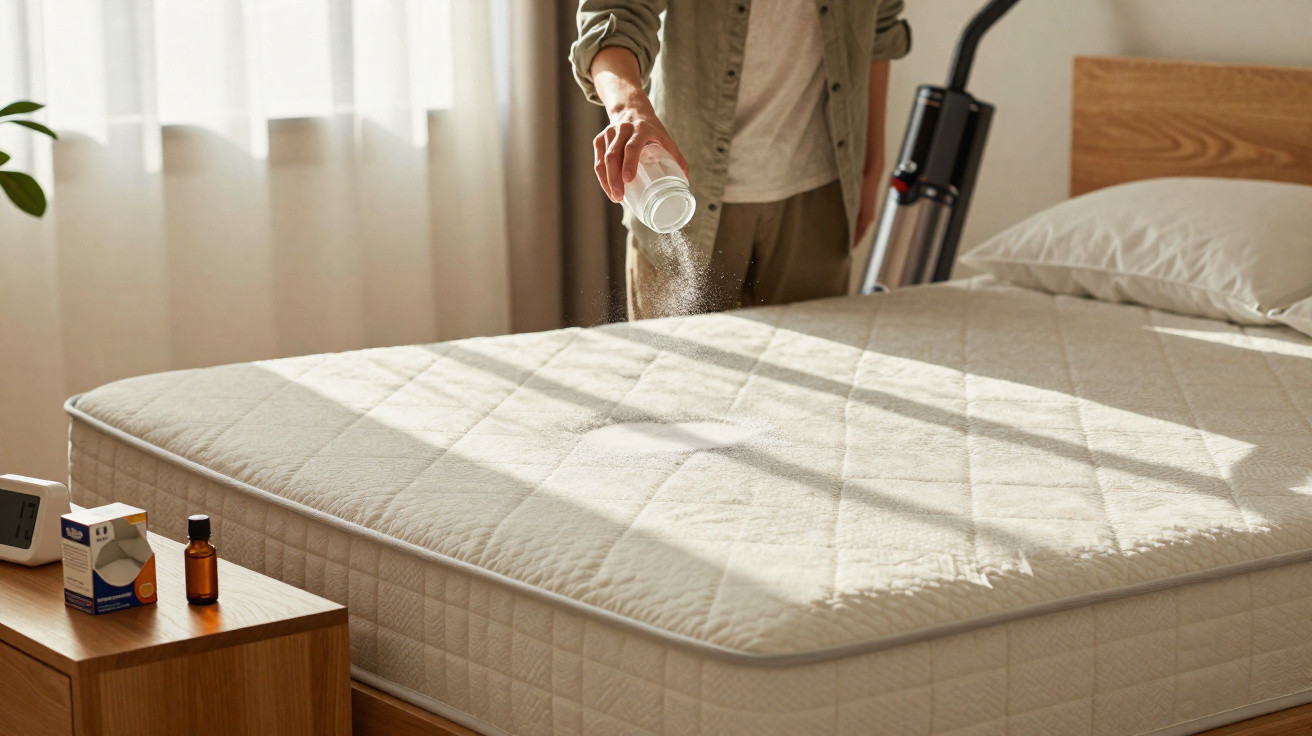
Sunlight cut through the curtains and fell, unfiltered, across the rumpled mattress. There were no sheets, only an exposed slab of fabric marked by pale yellow rings and a few unexplained darker patches you reassure yourself are “old tea stains”. The room smelled reasonably clean, yet the mattress looked worn out – as though it had absorbed years of Netflix, perspiration, crumbs, children’s feet and the odd late-night snack mishap. You replace the bedding, turn the pillows, mist the room with linen spray and act as though nothing underneath matters.
Then a person you trust offers an odd piece of advice: scatter baking soda across it, leave it for an hour, then vacuum it away. That is all. No costly cleaning product, steam cleaner or laborious Sunday spent scrubbing. Just white powder and a hoover.
Suddenly, you start asking yourself: what, exactly, have you been sleeping on for all these years?
Why your mattress needs more than clean sheets
For most of us, a neatly made bed with freshly laundered sheets means it is “clean”. The mattress underneath becomes the behind-the-scenes area: unseen and forgotten. But it is the bedroom item that retains everything – sweat, natural body oils, dust and tiny flakes of skin you would rather not think about. With time, it develops a subtle but persistent smell, often noticed only when you return from a break and open the bedroom door.
The strange thing is that we spend roughly a third of our lives directly on this enormous sponge. We breathe into it and warm it every night. Then we wake feeling sluggish, blame the coffee and never consider that the surface below us may be worn out too. A mattress never asks to be rescued. It simply becomes flat, heavy and quietly grubby.
In a recent survey by a major bedding brand, over half of participants said they had never given their mattress a deep clean. Not even once. Plenty believed a quick spray of Febreze qualified as a proper clean. One woman who was interviewed said she spotted a circular stain only when removal workers lifted the bed frame after she had lived in the same flat for ten years. “I just screamed,” she laughed, sounding partly appalled.
We all recognise the moment when the bedding comes off and the mattress instantly appears older than it should. There is the faint outline of past spills and the slightly deeper-toned patch where you sleep each night. It may not be dirty, exactly, but neither does it feel truly fresh. We fret over the sofa, oven and shower grout, while the thing we lie on for hours is postponed until “someday”.
Looking at it more practically, a mattress provides an ideal environment for moisture and smells. Its foam and textile layers retain humidity from both your body and the room. That dampness does not simply disappear; it gradually evaporates, leaving mineral salts and organic traces behind. Such residue is a feast for dust mites and attracts odours. Washing the sheets certainly helps, but it is like washing the plates without ever wiping the table.
The outcome is a gradual accumulation that remains largely invisible, although your nose and skin encounter it nightly. When you wake congested or feel that the bedroom never quite smells “hotel fresh”, the mattress can often be the overlooked cause. This is where baking soda comes in: quietly, without an advertising campaign, doing what many expensive sprays merely claim to achieve.
The baking soda mattress trick that really works
The straightforward method is this: remove all the bedding, take a box of baking soda and distribute a thick layer over the whole mattress. Leave it for an hour, then vacuum it up using a clean upholstery attachment. That is the essential step. The more evenly the powder is spread, the more effectively it can reach fibres and small indentations where odour and moisture tend to linger.
For a slightly more thorough approach, gently work the powder into the surface with your hand or a soft brush, focusing particularly on stained or more heavily used areas. There is no need to scrub; simply massage it lightly so that the baking soda settles into the fabric weave. Then leave the room, open a window and allow it to work while you get on with life elsewhere.
This is one of those habits we all know we “should” practise more frequently. Let’s be honest: nobody truly does it every day. That is perfectly fine. The important thing is to make it part of a realistic routine. A slow weekend morning is often ideal. Get up, strip the bed, put the sheets in the wash, dust the mattress with baking soda and make a coffee. By the time the washing machine beeps and you have checked your messages, the powder will already be absorbing odours you had not realised were present.
Using too little is a frequent mistake. A light, hesitant sprinkling will achieve very little. Think of icing a cake: most of the surface should turn white. Vacuuming too hastily is another error. If you make one quick pass across the middle while ignoring the edges and seams, the most heavily used areas remain untreated. Those are precisely the places where perspiration, oils and crumbs usually build up.
There is also a temptation to add every possible fragrance. Mixing a few drops of essential oil into the powder may smell pleasant, but it can irritate sensitive skin or noses. If the vacuum does not remove every trace, the fragrance will remain embedded for a long time. A smell that feels lovely on the first day may become cloyingly sweet by day ten. Baking soda alone is already a discreetly powerful option.
“I’ve tried sprays, steamers, even those expensive ‘mattress mists’,” confided Claire, a young mum who now swears by the powder method. “Nothing felt as immediately fresh as just vacuuming off that layer of baking soda. It’s like the bed breathes again.”
For those who prefer a simple checklist, the essentials of a baking soda deep clean are as follows:
- Remove all bedding and ventilate the room as you work.
- Scatter a thick, even layer of baking soda over the entire mattress.
- Leave it for at least one hour; two to four hours is better still.
- Vacuum carefully and slowly with a clean upholstery or mattress attachment.
- Allow the mattress to air for a few more minutes before making the bed again.
It is a modest, almost traditional task, but the change in how the bed feels and smells can seem surprisingly contemporary.
What happens after the first deep clean
After doing it once, it is difficult to view your mattress in quite the same way. The fabric appears brighter, while the room smells less “slept in” and more neutral. When you get into bed that evening, many people report a similar sensation: it is slightly like sleeping in a guest room, except it is your own. The reassurance of knowing the surface beneath you has been refreshed has a genuine effect, even when it is not always visible.
Some people find they sleep a little more coolly, particularly if they previously used layers of protectors and covers to conceal lingering odours. Others say they wake with less of that mild, stuffy-headed feeling. It is not a miracle solution for allergies, but reducing the build-up on your main sleeping surface is like lowering your body’s background noise. It gives your system less to contend with every night.
There is something quietly satisfying, too, about using an inexpensive, straightforward product for a job often wrapped up in jargon and gadgets. Baking soda has no polished packaging and makes no promises of a lavender dreamscape. It simply absorbs. Neutralises. Helps remove some of what time has left behind. That can change how you view the supposedly miraculous cleaning products filling your feed. All at once, the modest box at the back of the cupboard becomes the main character.
| Key point | Detail | Benefit for the reader |
|---|---|---|
| Deep cleaning made simple | Baking soda takes in odours and moisture held within mattress fibres. | Provides an affordable, accessible way to freshen a bed without specialist equipment. |
| One hour that changes the feel | Leaving the powder in place for at least 60 minutes improves its effectiveness. | Delivers better results with minimal added effort or time. |
| A better sleep environment | Vacuuming after the treatment removes residue, dust and fine particles. | Produces a cleaner, calmer place to rest and may improve comfort. |
FAQ:
- How often should I sprinkle baking soda on my mattress? Most experts recommend doing this every three to six months, with an additional treatment after spills, illness or hot summer nights.
- Can I use baking powder instead of baking soda? No. Baking powder includes other ingredients and is less effective at absorbing moisture or neutralising odours.
- Is one hour really enough for a deep clean? One hour can work, but leaving the baking soda for two to four hours gives it longer to absorb humidity and smells.
- Will this remove old, dark stains completely? Baking soda can help with odours and slight discolouration, but very old or deeply set stains will often require spot treatment first.
- Can I try this on any type of mattress? It is usually suitable for most spring and foam mattresses, provided the powder stays dry and is thoroughly vacuumed away afterwards.


Comments
No comments yet. Be the first to comment!
Leave a Comment