
The story need not finish there.
Each winter, many people open the washing machine feeling anxious, hoping their favourite knits have come through unharmed. If they have not, the usual response is to sigh, swear, then banish the damaged jumper to the back of the wardrobe or add it to the charity bag. But that reaction may be too hasty. One straightforward, seemingly counterintuitive technique can ease constricted wool fibres and help a shrunken sweater recover some of its softness and size. The approach has gradually gained traction among laundry specialists, repair groups and online communities determined to keep clothing out of the bin.
Why wool shrinks: the hidden trap in your washing routine
Wool reacts very differently to cotton and polyester. Every strand is a naturally occurring microscopic spring, coated in minute scales. These scales help wool keep you warm by trapping air, managing temperature and drawing moisture away from the skin.
However, in unsuitable conditions, the same scales create the problem. Heat, vigorous movement and harsh detergents cause fibres to rub together, twist and become interlocked. This process is known as felting. As it occurs, the knit contracts, the material becomes stiffer and the item shrinks in every direction.
When wool felts, the fibres tangle and clamp together, turning a flexible knit into a dense, smaller fabric.
Using a machine setting labelled “wool” does not necessarily guarantee protection. A number of common risks can combine:
- Water hotter than 30°C (86°F)
- Rapid drum movement or extended cycles
- Standard detergent rather than wool detergent or a delicate soap
- An overfilled drum, which creates additional friction
- Tumble drying, including on a low heat setting
Once this happens, it is easy to assume the garment is beyond saving. Yet, in many instances, particularly where the wool has not heavily felted, the fibres may still be relaxed and stretched to regain some of their original dimensions.
The softening bath: the unlikely “rescue” for a shrunken sweater
Textile conservators and knitwear professionals have used carefully managed soaking for years to work with natural fibres. The idea is straightforward: softening the fibres makes it possible to encourage them into a roomier form.
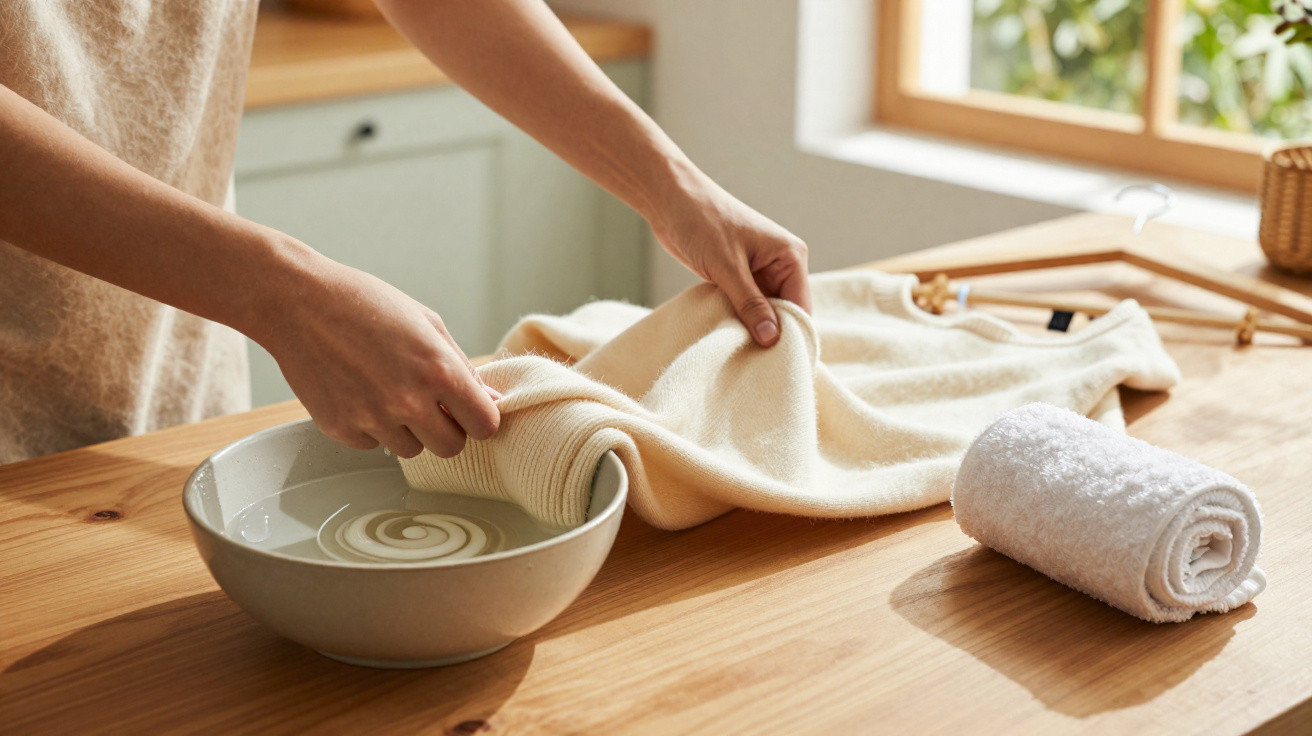
At home, this means using a lukewarm bath containing a gentle softening product, allowing the wool to relax instead of puffing up and matting. It will not fully “reverse” felting, which is seldom achievable, but it may restore enough size and comfort to make the garment wearable again.
A carefully prepared soak can loosen the grip between wool fibres, giving you a window of time to reshape the sweater by hand.
What you need for the rescue soak
Most households already contain everything needed for this treatment. Laundry professionals commonly suggest the following:
- A large bowl or sink containing roughly 2 litres of lukewarm water (around 30°C / 86°F)
- 4 tablespoons of white vinegar or hair conditioner, or 2 tablespoons of vegetable glycerine
- 1 clean bath towel for drying and reshaping
Vinegar can help restore the pH balance and maintain wool’s flexibility. Silicone-free conditioner may coat and lubricate the fibres, while glycerine draws in moisture and makes the knit easier to manipulate. Do not overuse any of them: the purpose is light, controlled softening rather than creating a slippery mess.
Step-by-step: stretch without tearing
After preparing the bath, both the timing and the handling are important. Trying to hurry the job is more likely to damage the fibres than ease them apart.
1. Soak, don’t scrub
Set the sweater flat on the water’s surface, then gently press it down until it is evenly saturated. Allow it to sit for at least 30 minutes. Thick or closely knitted wool may benefit from 45 minutes.
While it soaks, avoid rubbing or wringing it. The water and softening product need time to reach the centre of every fibre. Agitation at this point simply adds strain when the aim is to relieve it.
2. Remove excess water with care
Once soaking is complete, lift the sweater with both hands so that its weight is supported. Let it drain for several seconds before placing it flat on the towel. Roll and press the towel gently to draw out most of the water.
Never twist or wring a wet wool sweater; rolling it in a towel keeps the fibres aligned and protects the knit.
The sweater should be moist rather than dripping wet. Excess water makes it more difficult to reshape and can cause particular areas to stretch unevenly.
3. Reshape while the fibres are relaxed
Place the damp sweater flat on a dry work surface or a clean towel. Begin by positioning the shoulders and neckline correctly. Next, use both hands to draw the fabric gently outwards:
- Pull from the side seams to restore width across the chest
- Pull from the hem to bring back length in the body
- Pull from the wrist towards the shoulder to ease the sleeves
Use small adjustments of only a few millimetres, repeating them as needed instead of tugging sharply in a single motion. If helpful, compare it with a similar sweater that fits properly. You can lay that “good” sweater beneath it as an approximate guide.
For areas that remain resistant, such as cuffs or the waistband, stretch the section, wait for a minute and then repeat. Wool reacts more favourably to gradual, repeated encouragement than to one forceful pull.
4. Fix the new shape during drying
Dry the sweater flat, keeping it away from radiators, heated floors and direct sunlight. Intense heat can stiffen the fibres once more and undo the progress you have made. As it dries, which can take up to 24 hours, check it a few times and readjust areas that begin to contract.
| Stage | What to do | What to avoid |
|---|---|---|
| Soaking | Use lukewarm water and a mild softener | Hot water or vigorous agitation |
| Water removal | Press in a towel, keep it flat | Twisting or wringing the knit |
| Reshaping | Stretch slowly in small increments | Pulling hard in one direction |
| Drying | Dry flat, adjust occasionally | Hanging or using direct heat |
How to stop your wool shrinking next time
Although this rescue method can be remarkably effective, prevention remains the better way to save time, money and frustration. Most laundry mishaps result from minor shortcuts in the routine, rather than a complete lack of knowledge.
Set up a wool-safe routine
A few easy changes can lower the chance of another disaster:
- Turn sweaters inside out before washing to limit friction on the outer surface.
- Put each knit in a mesh laundry bag so it has less contact with other fabrics.
- Select a cold wash or 30°C (86°F) maximum setting with a very slow spin.
- Choose detergents made for wool, or use only a very small amount of mild soap.
- Avoid fabric softener containing synthetic fragrances, as it can coat fibres in an unsuitable way.
Many wool garments do not require regular washing. Letting them air on a hanger or laid flat for several hours will often remove moisture and odours. Treat stains locally with a damp cloth and a little gentle soap, rather than running a complete wash for one small mark.
Handle drying and storage like a pro
After washing, wool keeps its shape better when it is properly supported. Dry sweaters flat, either on a rack or a towel. Suspending them while wet can pull at the shoulders and neckline. When the knit is nearly dry, use your hands to neaten its shape again: straighten the hems, line up sleeve seams and ease the neckline back into position.
For storage, fold wool rather than hanging it, particularly heavy jumpers. Where moths are a worry, keep wool clothing in breathable bags with cedar blocks or lavender sachets. Freshly cleaned sweaters are less appealing to insects than items stored with food residue or traces of perspiration.
When to accept defeat – and when to get creative
Certain garments cannot be restored. If a sweater has become a rigid, dense item with almost no stretch left, the felting may be too severe. In these circumstances, a softening soak might deliver only limited improvement.
Still, the garment need not be useless. Heavily felted wool can be made into:
- Cushion covers or hot-water-bottle sleeves
- Pot holders and trivets
- Slippers or insoles cut from the dense material
- Pet blankets or stuffing for toys
Repair cafés and visible mending groups frequently share straightforward patterns for repurposing felted sweaters. Rather than becoming a guilt-inducing addition to landfill, a failed wash can provide material for creative projects.
Wool labels, blends and risk levels: what to look for before washing
This rescue technique will not produce identical results with every knit. The fibre composition is important. A care label reading “100% merino wool” will behave differently from one stating “wool 30%, acrylic 70%”. As a general guide, greater wool content brings a higher felting risk, but it also offers a better chance of reshaping when you act quickly.
Check the care label before any wash: it tells you not only how to clean, but also how the fabric might react to heat and movement.
Cashmere, alpaca and other premium fibres respond in a similar way to wool, although they can be more fragile. They often react well to the same softening bath, but require additional caution during stretching because the fibres may break if pulled too firmly. Synthetic blends can sometimes shrink less, yet may lose their original drape if they are stretched excessively while drying.
Knowing these distinctions can help you decide whether to hand-wash, use a machine wool programme or choose dry cleaning. It also gives you a more realistic sense of what can be recovered after a shrinking mishap. Rather than panicking, you can take out a basin, some vinegar or conditioner and a towel, then give the sweater a reasonable second chance.


Comments
No comments yet. Be the first to comment!
Leave a Comment