
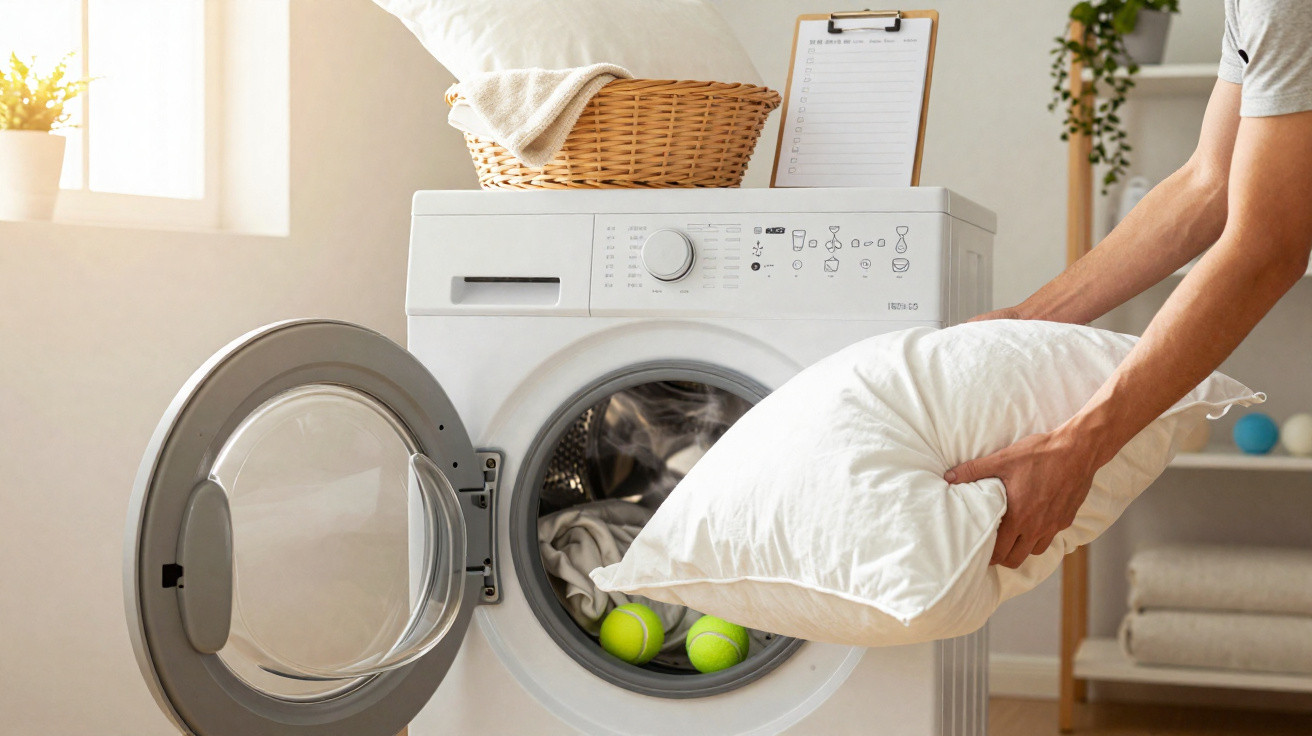
Emma opened the door and took out what had once been her favourite pillow. It resembled a collapsed soufflé that had lost the will to live: one bulging corner, an oddly flat section in the centre, and a cold dampness that made it clear it was not fully dry.
For a moment, she stood with her thumb pushed into the pillow, watching it rise only halfway back into shape. Not ideal. She had bought it six months before, after reading three blog posts and a dozen reviews that promised “hotel-level fluff.” Now it was more like a miserable pancake inside a cotton cover.
Then she spotted something unusual in a video on her phone: someone putting bright yellow tennis balls into a tumble dryer full of pillows. It looked absurd, but it also seemed to make a peculiar amount of sense.
Why tennis balls in the dryer actually make sense
Anyone who has removed a pillow from the tumble dryer and felt a dense lump move around inside will recognise that small, deflating disappointment. The cover may look perfectly fine, yet the filling inside has shifted into compact clumps. Although the pillow weighs no less, it has lost the soft, cloud-like fullness you paid for.
Heat by itself will not fix that problem. The pillow dries while flattened, the filling clings together, and you end up sleeping with your neck at an awkward angle, wondering why you woke up more exhausted than when you went to bed. This is where tennis balls make their entrance - quite literally.
Across TikTok, Instagram and traditional cleaning forums, the same surprisingly excited observation keeps appearing: “The tennis ball trick actually works.” Some users post before-and-after images of pillows that appear to have become a few years younger. Others share late-night laundry stories: they tested the hack at 11:30 p.m. and then remade the entire bed because the difference was so noticeable. There is an almost relieved feeling in these posts, as though people have discovered how to save something they assumed they would need to bin.
Naturally, it is not magic; it is simple mechanics. Putting a couple of tennis balls in the tumble dryer with pillows turns them into small, persistent masseurs. As the drum spins, the balls strike, compress and rebound against the pillows, repeatedly breaking up the clumps in the filling. Polyester fibres are pulled apart, feather clusters loosen, and down is redistributed throughout the pillow. This movement also forms extra air pockets, allowing warm air to circulate more evenly. That’s why pillows come out not just drier, but visibly puffier. You are not creating more volume - you are releasing the volume already present but trapped in tangled knots.
How to use tennis balls to fluff your pillows the right way
The technique is straightforward: two tennis balls, one tumble dryer and a few forlorn pillows. Begin with pillows that have been washed or are at least slightly damp, as this is when the method is most effective. Put the pillows into the dryer, add the tennis balls, then select a low- or medium-heat setting. From the first turn of the drum, the balls will bounce around and tap against the pillows like a miniature marching band.
For synthetic or polyester-filled pillows, 30–40 minutes will often do the job. Feather or down pillows generally need 40–60 minutes; pause halfway through to shake them by hand and check for damp patches deep in the filling. If your dryer includes an “air dry” or “no heat” programme, use it for the final 10–15 minutes to avoid overheating the filling. The aim is agitation, not roasting.
Many people miss one small but inconvenient step: removing the pillows halfway through the cycle. Let’s be honest: hardly anyone really does that every day. Yet if you are trying to restore a favourite pillow properly, it makes a difference. Open the door, give each pillow a vigorous shake from both ends, and return them to the dryer. This gives the tennis balls another opportunity to reach different areas. In particularly noise-sensitive homes or neighbourhoods, some people replace tennis balls with wool dryer balls, or even clean trainers wrapped in socks. There is less clattering, with the same general result.
A few mistakes can quietly ruin pillows. The main culprit is high heat. On a hurried Sunday, it can be tempting to switch the dryer to “hot” and leave it running, but doing so may distort fibres, scorch feathers or melt synthetic filling from within. Drying a single pillow on its own is another frequent error: it is likely to settle in the same position and remain there. Include at least two pillows, or add a few extra towels alongside the tennis balls, so that everything can tumble without restriction.
Fabric-softener sheets may also make pillows heavier by leaving behind a coating that causes fibres to stick together again. If a pillow has ever felt strangely slippery and flat at once, this could be the reason. Here is an understanding truth: most people are simply doing their best with the laundry, choosing settings half by instinct while their attention is elsewhere. Lumpy pillows are not usually the result of carelessness - they are just part of real life at 9 p.m. on a weekday.
One home organiser I interviewed described it in a way that stayed with me:
“Good sleep doesn’t always mean buying new things. Sometimes it’s just using what you have a little differently - like a couple of tennis balls and ten more minutes of patience.”
That is the understated appeal of this trick. You’re not investing in a gadget; instead, you are reusing something that may already be sitting in a sports bag or at the back of a cupboard. Once you have seen the effect on pillows, you may start considering other soft items too: duvets, winter coats and even stuffed toys that have become limp after too many washes.
- Use 2–3 clean tennis balls per load for best impact.
- Keep to low or medium heat to safeguard the filling.
- Stop the cycle once to shake and turn the pillows by hand.
- Avoid fabric-softener sheets and depend on airflow instead.
- Repeat every few weeks to prevent pillows from becoming flat again.
The small laundry ritual that can quietly upgrade your nights
In practical terms, this hack is about restoring fluff. At a deeper level, though, it is about the quiet pleasure of repairing rather than replacing. We live in a world where pressing “add to cart” is often easier than working out what went wrong with a pillow. In that sense, putting tennis balls in the dryer feels almost old-fashioned - a low-tech, slightly silly action that can genuinely alter how your bed feels that night.
You feel the difference the first time you rest your head on a revived pillow. The gentle support beneath your neck returns, along with the soft give as you sink into it. For a brief instant, it recalls the feeling from the week you first brought it home. On a day full of emails, alerts and minor emergencies, this little household win can feel disproportionately satisfying. We have all known the moment when one tiny comfort detail transforms the mood of an entire evening.
It is also the sort of advice people pass on. You might hear it in the office kitchen between colleagues, see it forwarded through family WhatsApp groups, or catch it during a late-night call between friends discussing how little sleep they got the previous week. “You know that thing where you throw tennis balls in the dryer with your pillows? It actually works.” It sounds too simple to make a difference, until someone tries it and sends back a photo of a bed that suddenly looks like a hotel bed again.
| Key point | Detail | Benefit for the reader |
|---|---|---|
| Tennis balls break up clumps | Their repeated impact separates fibres and redistributes filling | Helps old pillows recover volume and comfort without needing replacement |
| Low/medium heat cycle | Gentler drying protects synthetic, feather and down fillings | Prolongs pillow lifespan and prevents concealed damage |
| Pause and shake mid-cycle | Turning pillows manually allows balls to reach fresh areas | Maximises the fluffing result and prevents damp, heavy patches |
FAQ:
- Can I really use any tennis ball in the dryer? Ideally, choose clean, unused or lightly used tennis balls. If they are dusty or scuffed, wipe them first or place them inside clean socks to prevent dirt transferring to pale-coloured pillows.
- Will the tennis balls damage my dryer or pillows? The sound can be unexpected, but tennis balls are safe for most household tumble dryers. Use 2–3 balls, select low to medium heat, and do not overload the drum so that everything has space to move.
- Does this work on all types of pillows? It is most effective for synthetic, feather and down pillows. Some solid memory foam pillows should never go into a tumble dryer, so check the care label before attempting this method.
- How often should I fluff pillows with tennis balls? For most people, every few weeks is sufficient, or whenever a pillow begins to feel flat and heavy. Pair this with washing every few months, in line with the label instructions.
- What if I don’t have tennis balls at home? Wool dryer balls or clean trainers wrapped in thick socks can work as alternatives. What matters is using something firm that can bounce and gently “beat” the pillow as it tumbles.
Comments
No comments yet. Be the first to comment!
Leave a Comment