
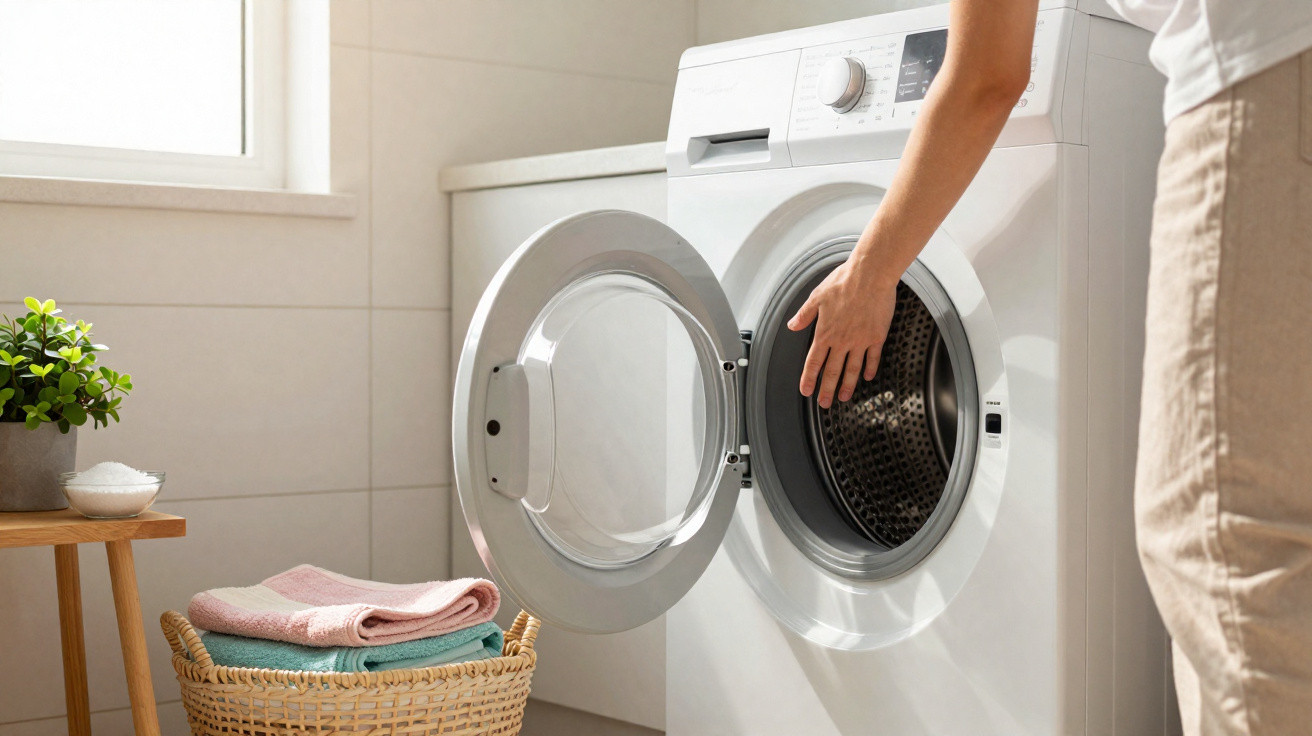
You open the washing machine, about to put on a quick load, and notice it: a faint sour, changing-room smell drifting from a drum that should represent “clean”. You hesitate. The rubber seal feels slightly slimy. Tiny marks have misted up the glass door, though you do not remember seeing them before. Irritated, you shut it again, as though postponing the issue will make it disappear.
A week later, the towels emerge with the same musty smell. You switch detergents. You run a 60°C wash “just to reset things”. You even burn a scented candle in the utility room, as though it could solve the cause. Still, every time you open the door, that smell is there. Subtle. Persistent.
Then somebody offers a suggestion: “Just stop closing the door completely.” It seems almost absurdly straightforward.
Why your washing machine becomes a mould factory
A modern washing machine is much like a compact, warm cave. Once a cycle ends, the drum remains wet, droplets sit in the rubber gasket, and small fibres and detergent deposits stick to every surface. Closing the door fully traps all of this inside a humid pocket with no incoming fresh air.
Those enclosed conditions are precisely what mould needs: darkness, moisture and limited ventilation. Within days, unseen colonies can begin to develop in the gasket folds and the detergent drawer. At first, there may be no visible sign. Instead, you notice a vague “old basement” odour as you lean down to load the laundry.
One mildly unpleasant-smelling wash may not seem especially serious. Everyday life carries on. The problem is the gradual accumulation. Every night spent with the door shut gives mould more time to spread. Every damp interval between washes allows bacteria to settle in the residue collecting behind the gasket. Since the machine still “works”, it is easy to overlook it - until the odour transfers from the drum to your clothes.
In ordinary households, the pattern is familiar. Towels tend to reveal the problem first because they stay damp for longer and absorb the musty smell more quickly. Then sportswear begins to smell wrong after only one use. A 2022 consumer survey in Europe found that roughly 60% of households with front-loading machines reported a persistent “funky” odor at least once a year. Most people blamed the detergent, while very few considered how they left their machine after using it.
You may recognise the habits that follow: running a “maintenance cycle” at 90°C with little real improvement; purchasing costly washing-machine cleaners “with active oxygen”; changing from liquid detergent to powder and then switching back. Some people even replace their machine sooner than necessary, believing there is an internal fault. Meanwhile, they continue to shut the door tightly after every load, unknowingly sealing in the problem.
The explanation is fairly straightforward. Mould spores are present throughout the air, so a washing machine does not have to be “dirty” for them to settle there. They simply require suitable conditions: moisture, organic deposits from sweat and skin cells, detergent residue, a consistent temperature and still air. A closed washing-machine door provides all four, particularly in compact bathrooms or utility cupboards with already limited airflow.
Keeping the door slightly ajar changes those conditions. Moisture can evaporate, air circulates around the drum, and the rubber seal dries more quickly, making it less welcoming to mould. This is not a matter of “deep cleaning”; it simply disrupts the ideal environment in which mould and bacteria quietly flourish in darkness.
The simple washing machine habit that keeps clothes fresher
The action itself is remarkably small. Once the cycle has finished and you have emptied the drum, do not push the door until it clicks shut. Instead, gently bring it back so that it remains ajar. A gap of two centimetres is often enough to encourage airflow and allow the drum to dry between loads.
If children or pets make you concerned about safety, you can still manage the situation. Some people place a small rubber door stop or folded cloth between the door and frame, keeping it only slightly open rather than allowing it to swing wide. The aim is not to display your laundry to everyone; it is simply to prevent the machine becoming a sealed, steamy space that never properly dries.
This modest adjustment is most effective when it forms part of your usual laundry routine, much like pressing “start” or clearing the lint filter in a tumble dryer. Finish the wash, remove the clothes, quickly wipe the gasket with the corner of a towel when possible, and leave the door open a little. Nothing more is needed: no apps or expensive products, just fresh air doing what it does.
Many people assume prevention requires complicated timetables and rigid routines. Real life is less orderly. You put on a quick wash before work, completely forget it, remember at midnight, tip everything into a basket and head straight to bed. With its door firmly closed, the machine then stays wet all night. Nobody has the energy to run a cleaning cycle every week. No one. The habit therefore needs to be practical.
Leaving the door open suits untidy, everyday life. It does not involve setting reminders or relying on being in the right mood. Even if you neglect the seal or detergent drawer for a month, that small opening continues to work quietly in your favour. Let’s be honest: nobody really does all of that every day.
Several common mistakes quietly worsen mould growth. Many people leave wet washing in the drum for hours before drying it. Others overfill the machine, preventing water from draining as it should. Some use far too much liquid detergent, leaving a sticky coating inside the drum. None of these practices help, but shutting the door between loads makes their effect far worse. When it stays ajar, at least every small oversight does not become an ideal breeding ground.
“What shocked me,” says a technician who services washing machines in small apartments, “is that in nine out of ten moldy machines I see, the owners tell me the same thing: ‘I always close the door so it doesn’t look messy.’ They’re literally locking the smell inside.”
That idea of keeping things “locked-in” has a strong hold. We are accustomed to closing doors - on bathrooms, wardrobes and dishwashers. A partly open washing-machine door can feel unfinished, as if the home is not truly tidy. If a mental prompt helps, treat that small gap as part of cleaning the machine, rather than evidence that you are behind with household jobs.
For anyone who prefers a straightforward checklist, this door-open habit works particularly well alongside the following steps:
- Leave the door slightly open between loads so the drum can dry.
- Once a week, pull back the rubber gasket and wipe away any visible grime.
- Use the correct detergent quantity - not “a bit extra, just in case”.
- Every month or two, run an empty hot cycle with a cleaner or vinegar.
- Take out wet loads as soon as you can, particularly towels.
A small gap that changes how your home smells
There is something unexpectedly pleasing about opening a washing machine and smelling nothing at all. No cloud of perfume and no sourness - only a neutral smell. It can alter how the entire bathroom or utility room feels. You no longer feel slightly awkward when guests ask, “Where’s your machine?” and you open the door hoping they will not notice the odour.
More fundamentally, this small practice quietly challenges the notion that domestic problems can only be “fixed” with products. Shop shelves are filled with bottles promising “deep hygiene” and “odor elimination”. Yet sometimes the solution is not adding something, but removing a condition - in this case, a closed door. Your washing machine does not require another chemical in order to breathe; it needs room.
We have all experienced a simple piece of advice from a friend that makes us reconsider something done the same way for years. Leaving the washing-machine door slightly open is one of those suggestions. You do it once, stop thinking about it, then a few weeks later notice that your towels no longer smell as though they are older than your building. It is a small, barely noticeable change - the sort that spreads quietly between homes in coffee chats and group messages, perhaps accompanied by a photo of a door left just a little ajar.
| Key point | Detail | Benefit for the reader |
|---|---|---|
| Door slightly open between loads | Allows moisture to evaporate and air to circulate inside the drum | Reduces mould growth and unpleasant smells with almost no effort |
| Quick gasket and drawer checks | Occasionally wipe the rubber seal and detergent drawer | Prevents visible residue and bacteria from building up |
| Correct detergent and loading habits | Avoid overloading the machine and using too much detergent | Improves washing results and protects both clothing and the machine |
FAQ:
- Why does my washing machine smell even after using cleaner? Because the conditions that caused the smell are still there. If the door stays closed and the drum stays damp, mould can return quickly, even after a deep clean.
- Is it safe to leave the washing machine door open with kids or pets? Yes, if you keep it just slightly ajar and teach kids not to climb inside. Some parents use a small stopper to limit how wide it opens.
- How long should I leave the door open after a wash? Ideally, all the time between cycles. If that’s not possible, a few hours after each wash already helps the drum and seal dry more completely.
- Does this apply to top-loading machines too? Yes, although top-loaders often ventilate a bit better. Leaving the lid up helps air circulate and reduces moisture build-up.
- Will this stop odors completely, or do I still need maintenance cycles? Leaving the door open dramatically cuts odors, but occasional hot maintenance cycles and light cleaning of the gasket and drawer still keep the machine at its best.


Comments
No comments yet. Be the first to comment!
Leave a Comment