
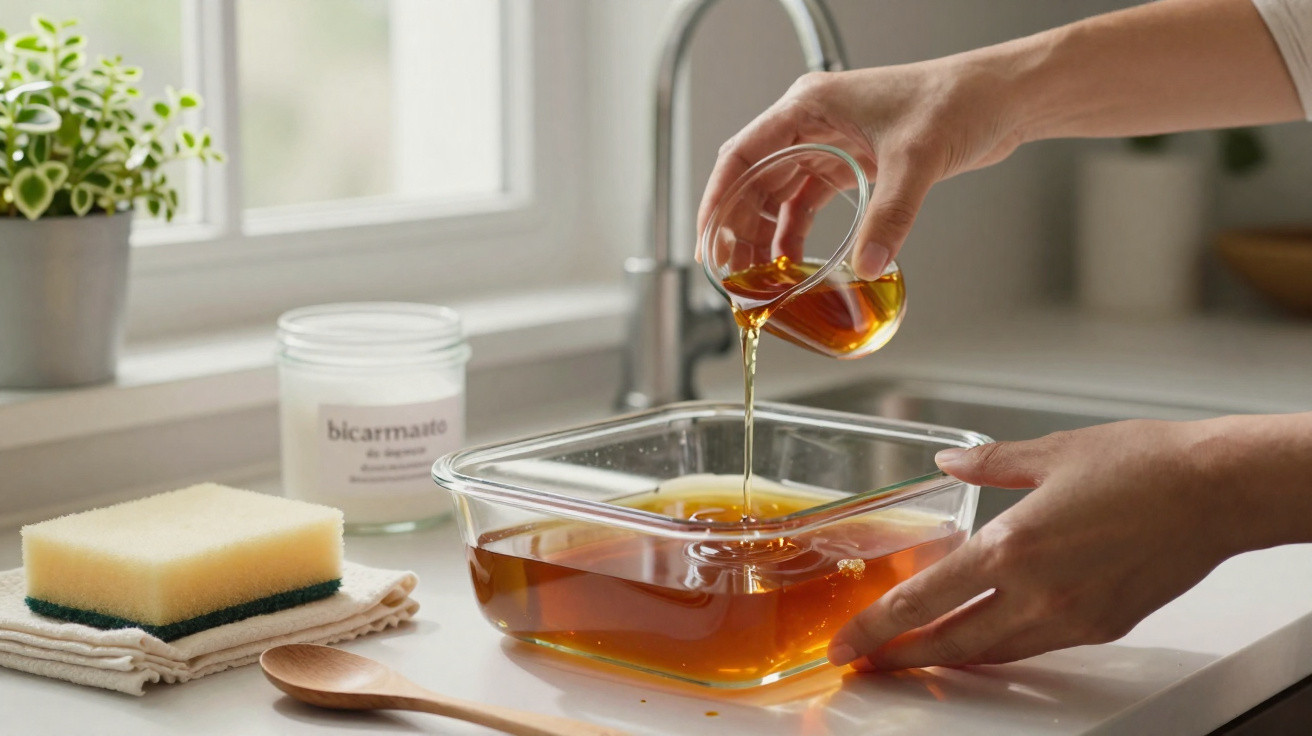
She had tested the expensive orange-fragranced spray. She had tested the blue gel that claimed it would “erase residue.” Each made the room smell like a showroom, yet neither achieved much. Then she picked up something from outside the cleaning cupboard entirely. Two drops, an unhurried swirl and a paper towel were all it took. The adhesive came away as though it had decided it no longer wanted to stick.
The experts I had spoken to earlier had dismissed the suggestion. It was too basic. Too oily. Too… domestic. The label on the jar read extra-virgin. The outcome delivered immediate relief.
It did the job in seconds.
The sticky truth, without the hype
There is a reason label residue clings on like a foul mood. Adhesives are made to hold fast under heat and pressure, then stubbornly stay put. Many shop-bought removers tackle that hold with fragrance, solvents and an ever-higher price.
Ordinary kitchen oil works more discreetly. It gets between the adhesive and the surface, weakens their connection and makes the gummy residue wipeable. It may not look or smell like a cleaner, but it can work far faster than you might expect.
On one grey Tuesday, I carried out my own kitchen trial. I chose five sticky offenders: a postage-label mark on a mason jar, a duct-tape stain on a plastic storage box, the syrupy outline left by a candle label, tree sap on the arm of a patio chair and a persistent length of clear parcel tape on stainless steel. I timed every one.
I put two drops of rapeseed oil on each mark, left them for 45 seconds, then rubbed gently using a paper towel. Four of the five surfaces were clear in under two minutes. The stainless steel needed another application and a soft nylon card. Adhesive remover took longer on two items. Vinegar did not shift any of the tape, although it did make the steel brighter.
The chemistry behind it is straightforward enough to explain without a lab coat. Most label adhesives are pressure-sensitive and non-polar, which is a technical way of saying they mix readily with oily substances. Oil softens and breaks down those chains, allowing the residue to release its hold. You are not dissolving the surface; you are persuading the adhesive to come free. A small plastic scraper can help because this is not about applying force. It is about removing the glue’s reason to remain attached.
It is not about elbow grease; it is about finding the right companion for the particular mess.
The 60-second kitchen oil method
The approach is simple. Apply one or two drops of cooking oil-vegetable, rapeseed or light olive oil-straight onto the sticky area. Use a finger, cotton pad or the edge of a paper towel to spread it into a light coating. Leave it for 30 to 90 seconds. Next, wipe in small circular motions and allow the softened adhesive to collect like crumbs.
If a faint mark is still visible, place a plastic card beneath an edge, lift it and repeat with a little more oil. Complete the process with hot water and washing-up liquid, or quickly wipe hard surfaces with glass cleaner. That final degreasing step separates “clean” from “why does this still feel slippery?”.
People tend to make the same mistakes. They soak the whole area and then complain about residue, even though two drops would have been enough. Or they scrub until plastic becomes cloudy, overlooking the fact that the glue is already releasing if they simply wait a moment. Give the oil time to act. Then handle tools carefully-avoid metal blades on stainless steel, abrasive products on shiny plastic and soaking untreated wood. Honestly, no one manages that perfectly every day.
With electronics, do not let oil reach ports or seams. On painted walls, try it first on a small concealed patch-not because oil strips paint, but because certain paints can become thin or glossy when rubbed. For fabric, avoid oil altogether and use rubbing alcohol, applying it from the reverse side with a dabbing and blotting motion.
I contacted a janitorial trainer with experience in stadiums and schools. He initially laughed, then reconsidered.
“If it breaks the bond and you rinse after, it’s not wrong. It’s just not sold in a spray bottle with a mascot,” he said.
Treat it as understated chemistry rather than a clever trick. The principle is the same one behind using make-up remover on waterproof mascara.
Here is a quick reference guide:
- Begin with 1–2 drops of neutral oil.
- Allow 30–90 seconds for the adhesive to soften.
- Wipe lightly, using a plastic card to scrape if necessary.
- Use washing-up liquid and warm water afterwards to remove the oily layer.
- Test delicate materials first; do not use it on untreated wood or touchscreens.
A small amount of patience works more quickly than excessive scrubbing.
Why cooking oil works, and what else it suggests
There is a familiar idea that proper cleaning must smell of citrus, cost more than lunch and come in an attractive bottle. Oil sits at the opposite end of that performance. It has no mascot. It is probably already in your kitchen cupboard. And it can slip beneath many sticky deposits and clear them away with less time spent at the task.
We have all experienced the moment when a marked surface feels like a personal defeat. Then a plain, almost unremarkable product resolves it, leaving you slightly misled by the world of specialist cleaners. This is not an argument for throwing out every bottle beneath the sink. It is about using the quickest available option and getting on with the rest of your afternoon.
After watching a label outline disappear in less than a minute, you begin to spot other uncomplicated solutions. Peanut butter for chewing gum in hair. A warm hair dryer for price labels on cardboard. A baking-soda paste for mugs with tea rings. The science remains reliable, the cost stays modest and the result is immediate. The experts may scoff, but your hands and one kitchen liquid can still finish the task.
| Key point | Detail | Benefit for the reader |
|---|---|---|
| Use light cooking oil | Vegetable, rapeseed or light olive oil break down most sticker adhesives | Inexpensive, easy to find and gentle on everyday surfaces |
| Wait 30–90 seconds | Let the oil work between the glue and the surface before wiping | Quicker results, with less scrubbing and reduced risk of damage |
| Finish with washing-up liquid | Removes the slippery coating and leaves glass, metal and plastic clean | No oily texture-only a clear, properly finished surface |
FAQ:
- Which oils work best? Neutral cooking oils, including rapeseed, vegetable, sunflower and light olive oil, work fast. Do not use flavoured or dark oils on porous materials.
- Will oil stain wood or fabric? Untreated wood and fabric may darken when exposed to oil. Instead, put rubbing alcohol on a cloth and dab from the outside towards the centre.
- Is vinegar better for sticky residue? Vinegar is effective for mineral deposits and cloudy glass. Oil usually loosens pressure-sensitive adhesives more quickly.
- Can I use this on car paint? Yes, carefully, for sap and sticker outlines. Apply only a small amount, use light pressure and wash immediately afterwards with car shampoo. Test a hidden area first.
- What if the residue still won’t budge? Heat the area with a hair dryer for 10–15 seconds, add another drop of oil, lift it with a plastic card and then wash it. Stubborn industrial adhesives may require a dedicated adhesive remover.

Comments
No comments yet. Be the first to comment!
Leave a Comment