
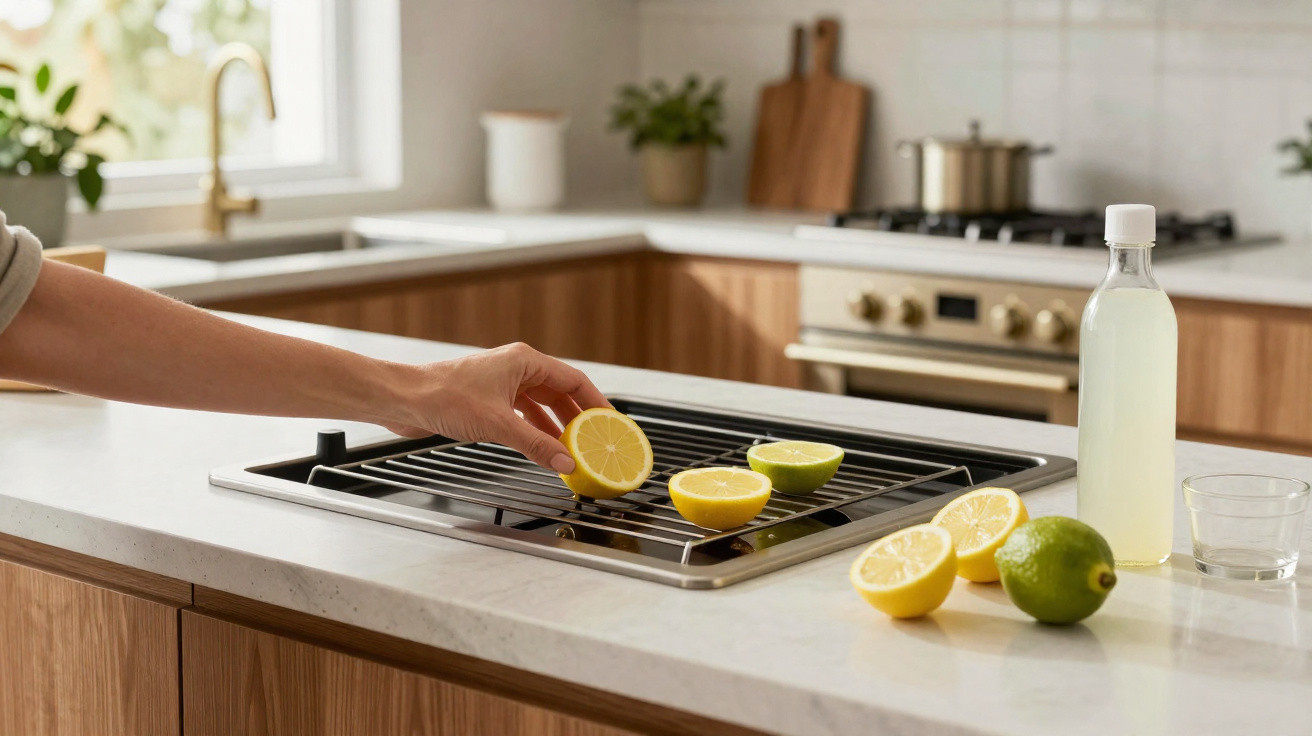
Brown streaks marked the glass, along with baked-on splashes that seemed to chart every hurried evening meal from the past six months. Yet a tray still went in, because getting on with life often takes priority over cleaning. Later, while scrolling on the sofa, a short video appeared: someone placed a single lemon slice in a cold oven, shut the door and turned the dial. No gloves, chemical sprays or desperate scrubbing. Only citrus and heat. The comments ranged from “This changed my life” to “No way this works.” The idea lingered, resurfacing whenever the oven light exposed the built-up grime.
Why a single lemon slice has become everyone’s favourite cleaning hack
An oven door can reveal plenty about a home. Some gleam as though they belong in a showroom, while others bear the understated evidence of weekday lasagnes and midnight pizzas. Most of us fall somewhere between the two, cleaning the outside before visitors arrive and overlooking what is inside. This small lemon trick speaks directly to that familiar situation. It offers a tempting promise: less effort, less guilt and a fresher-feeling kitchen without giving up an entire Sunday to scrubbing with a scourer.
The lemon-in-the-oven hack repeatedly reappears on social media, much like a tune you cannot shake. One creator records her greasy oven, places a slice on a tray, turns up the heat and returns to steamed-up glass with loosened dirt. Another posts a before-and-after image that looks rather like a professional deep clean. In Facebook groups, people share their own results: some insist it revived an oven they had written off, while others show partial results and sheepishly concede that they may have overcooked the lemon. It combines ordinary household mess with the appeal of a small miracle.
There is, however, a genuine process behind the viral appeal. Lemon is naturally acidic and, once heated, its juice and oils disperse into the air alongside the steam created in the oven. This warm citrus vapour helps soften the greasy coating and dried food particles that usually stick stubbornly to glass and metal. Once that residue has loosened, wiping it away requires far less work. There is no overpowering odour or unexplained foam, only a gentle, almost nostalgic fresh scent in a place more commonly associated with burnt cheese and chips.
How to do the lemon-in-the-oven trick step by step
Begin with a cold oven, as this matters more than you might expect. Cut a fresh lemon into a thick slice roughly 1 cm wide. Put it on a heatproof dish or small baking tray rather than directly on the oven shelf. Place it on the middle shelf, close the door and set the oven to a low or medium temperature of around 120–150°C. The aim is to produce steam from the lemon, not to bake it until crisp.
Allow the oven to heat with the lemon inside for around 20–30 minutes. A mild citrus fragrance should develop, and the glass may acquire a light mist. Switch off the oven, then keep the door shut for a further 10 minutes to let the steam continue its work. Open it carefully because the air will remain hot, and wait for it to cool slightly before wiping. By then, a damp cloth or sponge should move over stains that previously felt solid as stone. The benefit is not the wiping itself, but how unexpectedly effortless that wiping becomes.
This is also where everyday reality intervenes. Some people lose patience, raise the temperature or add three lemons “just in case”. That can leave them with dried-out slices, sticky residue or even a faint burnt-citrus smell. Let’s be honest: nobody really does this every day. The method is most effective as a gentle refresh rather than a penalty for months of ignored oven dirt. If the glass is nearly opaque with grime, lemon steam can still make a difference, although you may need to repeat it or follow it with a mild homemade paste.
“I used to dread opening my oven,” admits Claire, a busy mum of three from Leeds. “The lemon thing didn’t give me a showroom, but it took me from ‘impossible’ to ‘I can handle this in ten minutes’ - and that changed how I feel about my own kitchen.”
- Choose one fresh lemon slice rather than dried leftovers.
- Keep the heat moderate so the lemon steams instead of burns.
- For the simplest clean, wipe the oven while it is still slightly warm.
Beyond the trick: what a lemon in the oven really changes
Opening an oven that no longer feels like a guilty secret brings a quiet sense of satisfaction. A small cleaning success can spill over into the wider kitchen. You may open the oven door more readily while cooking and stop concealing baking trays when friends visit. The lemon slice becomes less of a hack and more of a ritual: something to do every few weeks after a large roast, much as some people light a candle after tidying the living room.
In practical terms, this use of lemon reduces reliance on heavy-duty cleaning products and the strong synthetic odours that can remain long after the task is complete. That can be important for households with pets, children or simply little tolerance for chemical fumes in compact kitchens. A straightforward piece of fruit quietly takes on the first stage of the difficult job. You still need to finish with a cloth, but the relationship changes: rather than battling the oven, you are simply completing what the steam started.
There is something unexpectedly grounding about the approach, too. It has an almost traditional quality, like advice exchanged between neighbours over a garden fence. Online, the hack is presented as a route to effortless perfection. In a real flat on a cold evening, with leftovers reheating and lemon mist hanging in the air, it means something quite different: a small act of kindness towards yourself in a room where life is always spilling over. Putting that lemon slice into a cold oven is less about cleaning than it is about making the mess feel manageable once more.
| Key point | Detail | Benefit for the reader |
|---|---|---|
| Lemon steam loosens grime | Acidic vapour softens baked-on grease and stains | Reduces or removes the need for vigorous scrubbing |
| Low heat, cold start | Put a lemon slice in a cold oven and heat gently for 20–30 minutes | Keeps the method safe, straightforward and easy to repeat |
| Natural alternative | Uses an everyday kitchen ingredient instead of harsh chemicals | Gentler for families, pets and small kitchens |
FAQ
- Does one lemon slice really make a difference? Yes, particularly with light to moderate grease. The steam will not remove years of burnt-on dirt in one attempt, but it noticeably softens residue and makes wiping much easier.
- Can I use bottled lemon juice instead of a fresh slice? You can add a small amount of lemon juice and water to an oven-safe dish. It will still produce acidic steam, although the natural oils in a fresh slice provide a stronger result and a more pleasant scent.
- Is this method safe for all oven types? It is generally suitable for standard electric and gas ovens. Do not use extreme temperatures or try it during a self-cleaning cycle. Check the manual first if your oven has specialist coatings.
- How often should I do the lemon-in-the-oven clean? For most people, once every few weeks is enough, or after an especially messy roast or bake. Treat it as a regular refresh rather than an annual rescue operation.
- Will this completely replace chemical oven cleaners? It can do so for light upkeep. For severe, long-term build-up, a stronger cleaner may still occasionally be necessary, but the lemon trick can substantially reduce how often you need one.





Comments
No comments yet. Be the first to comment!
Leave a Comment