
The rain began shortly after lunch: the sort that lingers in the air without ever properly coming down.
Inside the small flat, the drying rack was already disappearing beneath a grey thicket of damp T-shirts and jeans. The room carried that “nearly dry” laundry smell, mingled with yesterday’s coffee. A woman sat on the sofa scrolling through energy prices on her phone, looking at the tumble dryer switch as though it were a fruit machine. One press could swallow half the week’s budget. With a sigh, she fetched a large bath towel from the bathroom and tried something so simple it seemed unlikely to help. Ten minutes later, the washing felt noticeably different between her fingers: lighter and less waterlogged. The towel, meanwhile, was a sorry sight. She smiled. No app, no gadget - only an old towel and a little physics. The sort of thing our grandparents understood without making a fuss.
Why laundry remains wet on the drying rack for hours
In theory, drying clothes indoors is straightforward: hang them up, wait, fold them away. In practice, T-shirts can stay chilly and clammy for half the day, jeans weigh like bricks, and towels appear to cling to every drop of water out of spite. The room becomes a humid cave, windows steam up, and you begin to question whether that faint scent is clean washing or the first hint of mould. The clothes may be “clean”, but they are hardly appealing.
Part of the issue lies beneath the surface. Water does not simply run off clothing; it remains deep within the fibres, particularly in heavy cotton and denim. On an overloaded rack, garments lie over one another, air struggles to move between them, and moisture has no fast route out. Radiators roar and fans whirr, yet the middle of the fabric remains wet. That is when people surrender and press the tumble dryer button, even if they promised themselves they would not this month. It is a quiet defeat, one cycle at a time.
Modern routines make matters worse, too. You put on a wash before work and assume it will be dry by the evening - then reality proves otherwise. Without a tumble dryer, an ordinary cotton load may need 24 hours or more to dry fully indoors, especially during winter or in a compact flat. Heavy hoodies and jeans can take almost two days. It is hardly surprising that chairs and door handles become makeshift drying stations. Oddly, you do not need a machine to make the process faster. You only need something that absorbs more water than the clothes do.
The towel trick: a genuinely effective low-tech shortcut
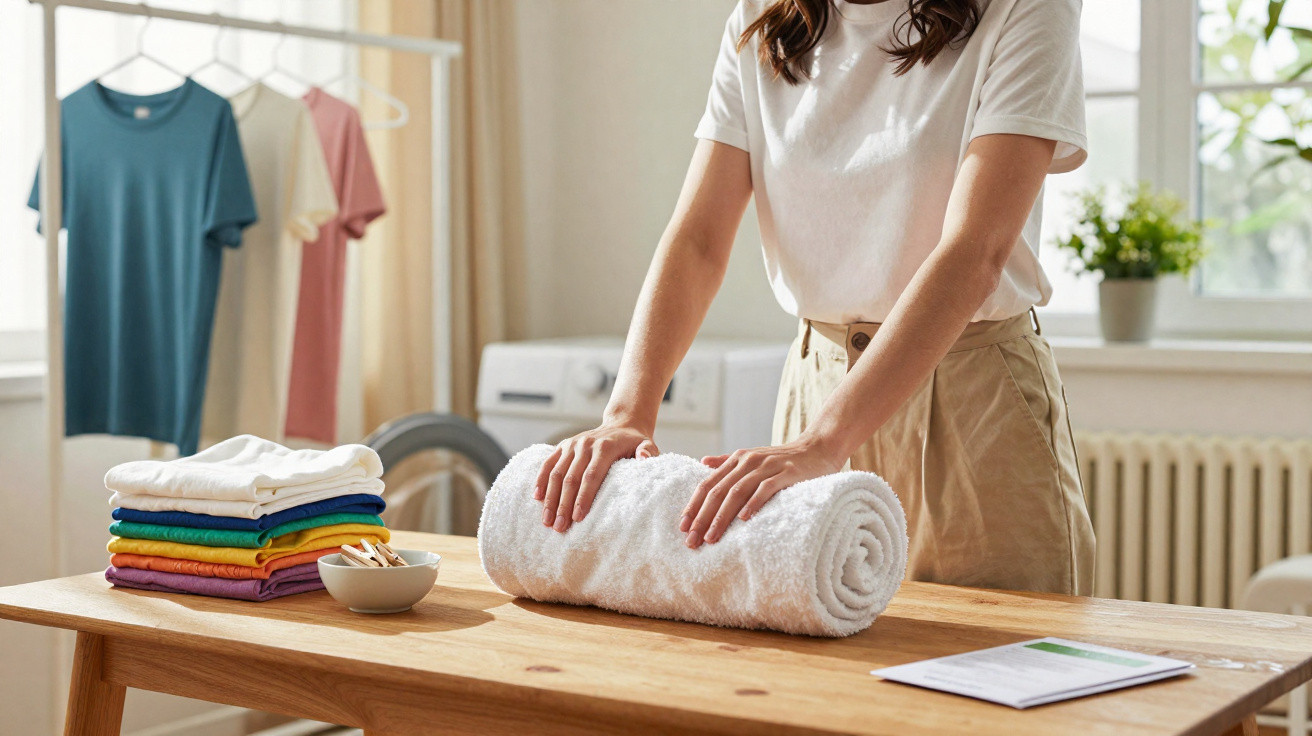
The idea could hardly be simpler: before clothes go anywhere near the drying rack, use a dry towel as a sponge. As soon as the washing machine has finished, select the dampest pieces - jeans, sweatshirts and thick T-shirts. Place a large, clean bath towel flat on a bed, sofa or even the floor. Put one or two garments on top and smooth them out roughly, then roll the lot together like a burrito. It does not need to look neat; a secure roll is enough.
When it is rolled up, apply pressure. You can use your hands, forearms or even your knees if you wish. Press gently but firmly along the towel’s length. The aim is not to wring or twist the clothes, but to compress them. The dry towel absorbs water that the spin cycle left behind. After 30 to 60 seconds, unroll it. The garments should feel distinctly lighter, while the towel will feel as though it has just been washed. That is how you know it has done its job.
For particularly stubborn fabrics, some people go further. They repeat the process using a second dry towel, rolling slightly more tightly and pressing at a slower pace. This additional pass can have a remarkably noticeable effect on thick denim and hoodies. The clothes can then be hung on the rack as normal - except the air has far less work left to do. Drying time drops, and the room is less likely to feel like a swamp. It is almost absurd how much difference such a minor step can make.
How a simple towel reduces drying time and energy use
To see why the towel trick works, think of the towel as a magnet for water. A washing machine spin cycle removes moisture through force, throwing it through holes in the drum. A towel works more quietly: through direct contact, it draws water away. Cotton terry contains countless loops - tiny hooks that hold moisture. When a wet item is pressed against this surface, water naturally transfers towards the drier, more absorbent material.
A simple rule explains the result: the drier and more absorbent the towel is in comparison with the garment, the quicker the water transfer will be. Rolling the two together increases the contact area, bringing sleeve to loop, seam to loop and pocket to loop. Every part touching the towel gains a quick way for excess moisture to escape. The clothes are not being dried completely; they are being taken from “soaked” to “damp” before they ever reach the rack.
That change matters in everyday life. Less water held in the fibres means less time spent in humid air. Less time means fewer musty odours, a lower mould risk and less need to wash again items that never quite smelled fresh. For anyone trying to reduce tumble dryer use, the calculation is stark: each cycle avoided can save around 2 to 4 kWh of electricity, depending on the appliance and programme. If the towel trick helps you miss even one or two cycles each week, it will show up on the monthly bill. And there is no need to purchase a “smart” drying gadget.
Getting the towel trick right: little details that matter
Choosing the right towel comes first. Pick a large, thick cotton bath towel - the sort you would be pleased to use after a shower. Microfibre may also work, but traditional terry cotton has a reassuring weight and grip that makes the technique feel intuitive. It is fine to use a light towel with dark clothing; modern dyes seldom run at this stage, particularly on already-clean laundry. Above all, make sure the towel is completely dry before you begin.
Avoid stuffing too much into one roll. One or two garments per towel works best; otherwise, the clothes are pressed mainly against each other rather than the towel. Spread each item as flat as reasonably possible, since large creases hold onto water. Keep the roll close-fitting but not excessively tight, then press slowly along its full length. Think of a firm handshake rather than a wrestling match. You will notice the weight changing as you work. Once the towel feels cool and heavy, it has finished its task. Replace it if you want to continue with more laundry.
A common concern is whether the method harms fabrics. When done carefully, it does not. There is no twisting, pulling or stretching of seams: only even pressure. Problems arise when someone tries to speed things up by wringing the whole roll like a rope. That can damage elastic, particularly in leggings and underwear. So leave out the drama. Let pressure and contact do their quiet work. The cleverest tricks often look slightly dull from the outside.
There is a human factor as well: routine. In truth, the towel trick takes three to five minutes for each load. On a hectic day, even that can seem like too much. Let’s be honest: nobody really does it every day. Still, for many people it becomes a modest ritual on heavy-laundry days, involving jeans, towels and bed linen. You will probably settle into a rhythm that suits you.
As one young father living in a damp London flat told me:
“The first winter with the baby, our place smelled like a wet dog mixed with fabric softener. The towel trick saved our living room – and we barely use the dryer now.”
For an easy reminder, this quick checklist is useful:
- Choose a large, dry cotton towel - not the one already hanging in the bathroom.
- Roll only one or two items at a time to ensure proper contact and results.
- Press rather than twist - the aim is compression, not wringing.
- Start with the slowest-drying items: jeans, hoodies, thick T-shirts and towels.
- Hang clothes immediately after unrolling, leaving space between every item.
A small household hack that reflects how we live today
There is something quietly pleasing about solving a modern problem with an old household item. There is no subscription, no app and no new appliance taking over the hallway. It is simply a towel, perhaps already frayed around the edges, given another purpose your grandmother would immediately recognise. The action is modest, but it changes the timetable of your day. Clothes that might otherwise have dripped on the rack all night can be dry by evening.
On a wider level, ideas like this offer a gentle response to a noisier world. Energy prices climb, climate anxiety remains in the background, and people can feel caught between convenience and conscience. Missing one tumble dryer cycle will not save the planet on its own, of course. Yet it changes the atmosphere in the room. It creates the sense that you are taking part rather than merely putting up with things. You handle the fabric, notice it becoming lighter and feel a different kind of control.
Everyone has faced a heap of wet washing, a weather app full of rain clouds and a bank balance that is not keen on another appliance running. That is precisely where this towel trick fits in quietly. It is neither heroic nor perfect, and there will be days when you do not bother. But after seeing how quickly those jeans dry afterwards, it is difficult to return to hanging everything straight out of the drum. Next time your home becomes a jungle of damp cotton, you may well reach for that old bath towel with a knowing little smile.
| Key point | Detail | Why it matters to the reader |
|---|---|---|
| Pre-spin with a towel | Roll wet clothes in a large dry bath towel and press them | Significantly reduces drying time without using a tumble dryer |
| Focus on thick fabrics | Use the method mainly for jeans, sweatshirts, towels and bed linen | Saves hours on items that stay damp the longest |
| Gentle but consistent action | Compress without twisting, spending 3 to 5 minutes per wash load | Protects fibres while saving energy, money and drying space |
FAQ:
- Doesn’t the towel just get soaked and stay wet forever? The towel does become very wet, but that is exactly the aim: it takes in water that would otherwise remain in the clothes. Hang it separately somewhere well ventilated; on its own, it will normally dry quicker than when it is wrapped around garments.
- Can I put the towel and clothes back in the washer for another spin? You can, although it is seldom needed. Manual compression already achieves what a second spin would do. If you decide to try it, make sure the load is balanced and select a gentle spin speed.
- Is this safe for delicate fabrics like wool or silk? Yes, provided you take care. For delicate items, lay them flat on the towel, roll it loosely and press extremely lightly. Do not twist or squeeze hard. Many people already “block” wool jumpers this way after washing them by hand.
- How much drying time can this realistically save? With thick garments, drying time is often reduced by a third and occasionally by half. A hoodie that previously needed 24 hours indoors may be dry enough after 10 to 14 hours, depending on the room and airflow.
- Do I still need a dryer if I use the towel trick? That depends on your space and routines. Some households nearly stop using the tumble dryer except for emergencies or bedding. Others combine the methods: the towel trick for everyday loads, with short tumble dryer cycles only when time is especially limited.



Comments
No comments yet. Be the first to comment!
Leave a Comment