
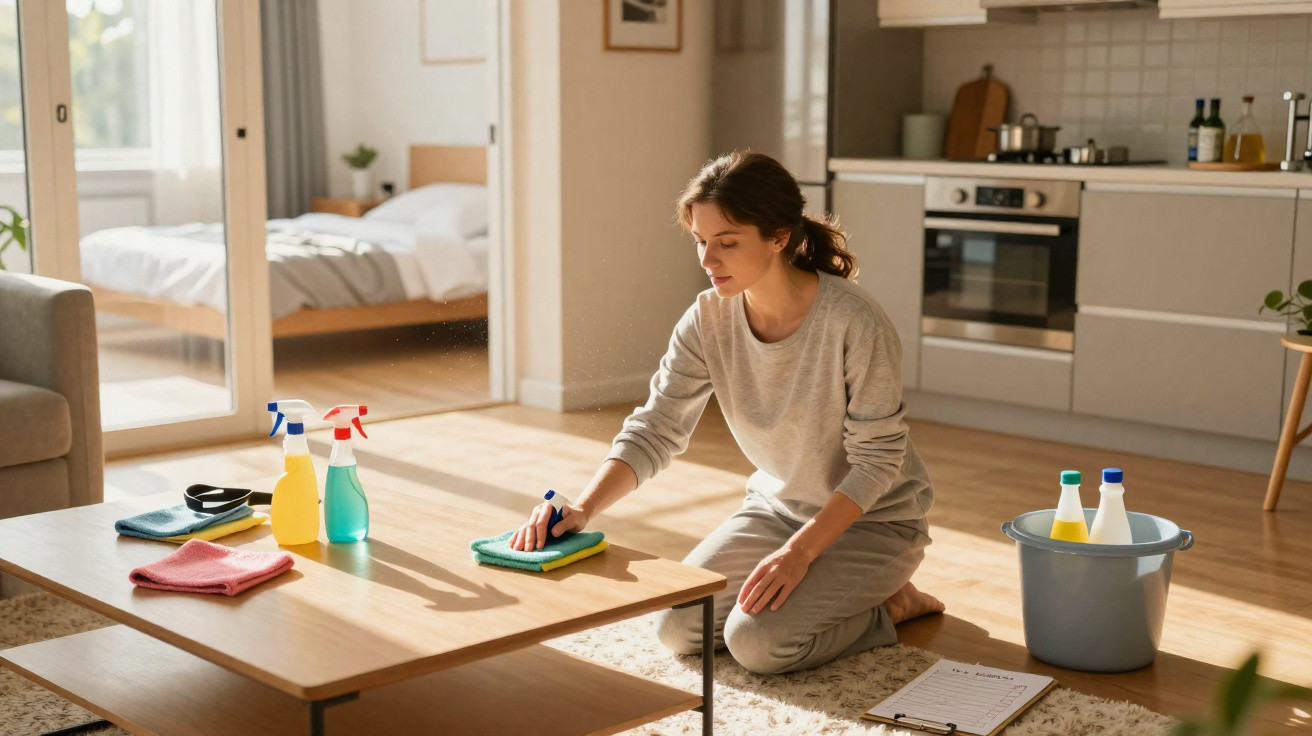
Fifteen minutes in, your back is aching, a heap of socks is getting on your nerves for no clear reason, and you are already asking yourself whether you can call it a day. The home does not even look tidier, yet your energy has already vanished.
Cleaning is not meant to resemble a marathon played out in slow motion. Yet that is precisely how it unfolds in homes up and down the country each weekend. It is not because we are lazy; it is because the way we move around our homes quietly works against us. We drift from place to place, repeat jobs and retrace our steps.
There is a better approach, one that will not leave you exhausted before lunchtime. It begins with the sequence, rather than the cleaning products.
Why cleaning feels so much harder than it “should”
Watch somebody clean on an ordinary Saturday and the same routine soon becomes apparent. They begin in the kitchen, remember the bathroom mirror, head there, then notice a bedroom chair hidden beneath clothes. After ten tiny jobs, nothing has properly been completed, while their mind is worn out from constantly changing direction.
Our bodies are usually capable of the physical work. What drains us is the mental zigzag. You are not merely wiping down a worktop: you are making dozens of small choices about where to begin, what to put away, which product to pick and what to do afterwards. That unseen burden is why a straightforward clean can feel like an endless list of jobs.
One Monday morning in London, a professional cleaner called Laura timed herself in a two-bedroom flat. She used the same products, cleaned the same rooms and faced the same amount of mess. On the first attempt, she worked in the “usual” manner: dealing with whatever caught her attention, moving between rooms and tackling dirt as she noticed it. It took 2 hours 10 minutes.
A week later, she tried again using a firm sequence: completing one type of job at a time, travelling in one direction around the flat and never doubling back. She was done in 1 hour 32 minutes. That is nearly 40 minutes saved, while feeling less effort was involved. Her final observation was straightforward: “I felt less scattered. My body did more, my head did less.” Those 40 minutes are often exactly where your weekend goes.
Cleaning becomes tiring when your mind is carrying most of the load. Going from scouring the sink to folding washing to sorting paperwork repeatedly makes your brain reset its focus. Every switch uses energy, much as having ten apps open at once runs down a phone battery.
There is an emotional element too. Clutter is seldom emotionally neutral. That stack of unopened post may bring money concerns to mind. Toys spread across the floor may trigger guilt. Whenever you handle such items, your brain takes a small emotional knock. It is no surprise you feel depleted before finishing the bathroom. A more considered order limits these emotional “checkpoints”, allowing you to travel through the home as though following a route rather than navigating a maze.
The smarter cleaning order that saves your energy
A low-energy cleaning session begins well before you pick up the mop. Treat it as you would planning a walk: aim for a loop instead of wandering at random. Make one decision first: What’s my route? In most homes, it works well to begin at the entrance and in shared areas, then work towards the bedrooms. Keep travelling in one direction, without going back and forth.
Then choose your task sequence and keep to it. Professionals often follow this order: clear surfaces, dust from high to low, clean bathrooms, clean the kitchen, vacuum, then mop. Rather than making a fresh choice every five minutes, you simply follow a plan. That plan is where the energy saving comes from.
In a busy family flat on an ordinary Sunday, the plan could work like this. Come in, set a 20-minute timer and carry out a quick left-to-right tidy in every room: remove rubbish, place obvious clutter in a basket and avoid making big decisions. Next, take one microfibre cloth on a “dust tour”, continuing in the same direction.
Only after the whole home has had this light initial pass should you move to wet jobs: bathrooms first, followed by the kitchen. Do the floors in one session at the end, rather than hauling the vacuum cleaner back and forth. Do not enter a room “just to do one thing”. Finish each job category throughout the home before beginning the next. The flat may not be flawless, but you will feel calmer and less irritated.
The reasoning behind this sequence is simple. Tidy first so you are not cleaning around stray objects. Go from dry work to wet work so dust does not become mud. Work from high to low so gravity does not reverse your progress. Leave floors until last because every other job sends crumbs, hair and dust downwards. Following this pattern means every action supports the next instead of undoing it.
Energy is often lost in the pauses: looking for a product, trying to find a cloth or repeatedly returning to the cupboard. A simple caddy stocked with the tools you use most often eliminates those unnecessary steps. Rather than stopping to ask, “Where did I leave the glass cleaner?”, you can carry on. There is less friction, less annoyance and less mental resistance. The work itself is unchanged - but your relationship with it is not.
Practical shortcuts that make cleaning feel lighter
A sensible sequence is valuable, but it will not help if every cleaning session becomes an all-or-nothing marathon. Make the task smaller. Rather than deciding to “clean the house”, set yourself a route and a time cap: one loop in 45 minutes. Once the timer ends, stop.
During that loop, work in layers instead of striving for perfection. The first pass is a visual reset: plump cushions, clear tables and gather dishes. The second covers hygiene hotspots: bathroom surfaces, kitchen worktops and handles. If you still have energy, make floors the third pass. Your home will look and feel cleaner even if it never becomes “Pinterest spotless”. Your effort is directed towards what matters most for everyday comfort.
Many people use up their energy in the opening 10 minutes. They start with the worst and most emotionally charged spot - the clothes-covered chair, the chaotic drawer or the mountain of toys - then become stuck. The answer is to delay decisions. Throw away clear rubbish, gather “I’ll deal with this later” objects in a single basket and continue onwards.
Be kind to yourself about what you expect. On a difficult day, your version of “clean” may simply mean clearing the sink, wiping the bathroom basin and vacuuming the hallway. It still counts. Let us be honest: nobody really does all of this every day. The aim is a system you can maintain, not an Instagram transformation.
“The trick isn’t to clean harder,” says Laura, the cleaner. “It’s to stop cleaning the same square meter five times because your plan is messy. Once your route is set, your brain stops arguing with you.”
To turn the route into a habit, it is useful to see it written down. Put it inside a cupboard or save it on your phone, then use it as a checklist that you can adjust.
- Step 1: Complete a quick tidy loop (take out rubbish, bring dishes to the kitchen and place random items in one basket).
- Step 2: Dust high to low in every room, moving through the home in one direction.
- Step 3: Wet clean: bathrooms first, followed by kitchen surfaces and the sink.
- Step 4: Vacuum every floor in one pass, beginning in the room farthest from the entrance.
- Step 5: Mop hard floors, shut doors behind you and allow them to dry.
A different way to think about effort at home
We often regard cleaning as a measure of character. When we feel tired or put it off, we tell ourselves we are lazy, untidy or “not a clean person”. That belief lingers and can feel heavier than the vacuum cleaner itself. But what if the issue is not you, but the order you have copied without questioning it?
On a peaceful evening, view your home as a route rather than a set of separate rooms. Where do you naturally begin walking? At which point do you always stall? That is where your sequence is wasting energy. A minor adjustment - changing the order of jobs, storing supplies on one floor rather than two or doing a 10-minute “visual reset” each evening - can change how burdensome the next major clean feels. In a difficult week, your system should still support you a little.
On a good day, this smarter sequence becomes almost automatic. Put on a podcast, go from room to room in the same direction, complete the same kind of work everywhere and finish before your patience wears thin. You are not hunting down dust; you are following a plan that respects your attention span. On a bad day, completing only Step 1 and Step 2 of that plan is still a success.
We have all had the experience of sitting on the sofa, looking around and feeling immediately overwhelmed by the mess. That response does not mean you are failing. It means your brain is attempting to take in the entire scene at once. A route turns that scene into manageable portions for both mind and body. It is not heroic or perfect, only achievable - and over time, that is what changes how home feels.
| Key point | Details | Why it matters to readers |
|---|---|---|
| Use a fixed cleaning route | Choose a starting point, usually the entrance, and always travel through the home in the same direction, ending in the room farthest away. | It cuts decision fatigue and backtracking, meaning you waste less energy wandering and finish more quickly with less frustration. |
| Group tasks by category | Tidy everything first, then dust throughout, followed by bathrooms, the kitchen and floors, rather than completely “finishing” each room individually. | Your brain remains in one mode at a time, which feels more peaceful and noticeably less exhausting than constantly changing tasks. |
| Set a time cap, not a perfection goal | Choose a 30–60 minute period and follow your route until the timer goes off, accepting that some areas will wait until the next session. | This guards against burnout, makes cleaning feel limited and still delivers visible results that work for everyday life. |
FAQ
- Why do I feel tired after just 20 minutes of cleaning? Your body is active, but much of the tiredness comes from mental overload. You are making many small decisions, moving between very different jobs and encountering emotionally loaded clutter. A straightforward route and set task sequence reduce those choices, so your mind is not working overtime.
- Is it better to clean one room fully or do the whole home by task? For speed and energy, completing each task throughout the home usually comes out ahead. Cleaning room by room can feel satisfying, but it requires more changes of products and mental gears. When you dust everywhere at once, then clean bathrooms and then floors, you settle into a rhythm that is smoother and less tiring.
- What if I never have a full hour to clean? Use the time available. Set a 10- or 15-minute timer and complete only part of your route: a quick tidy and dishes one day, bathroom surfaces the next and floors on another day. A regular mini-route is better than a huge clean that is continually put off.
- How can I stop getting stuck on clutter piles? Give clutter a session of its own. While carrying out your usual cleaning, do only two things with it: bin obvious rubbish and put “decide later” items into one basket or box. Set aside a separate 20–30 minutes during the week for that box, so your main clean remains manageable and does not drain your energy.



Comments
No comments yet. Be the first to comment!
Leave a Comment