
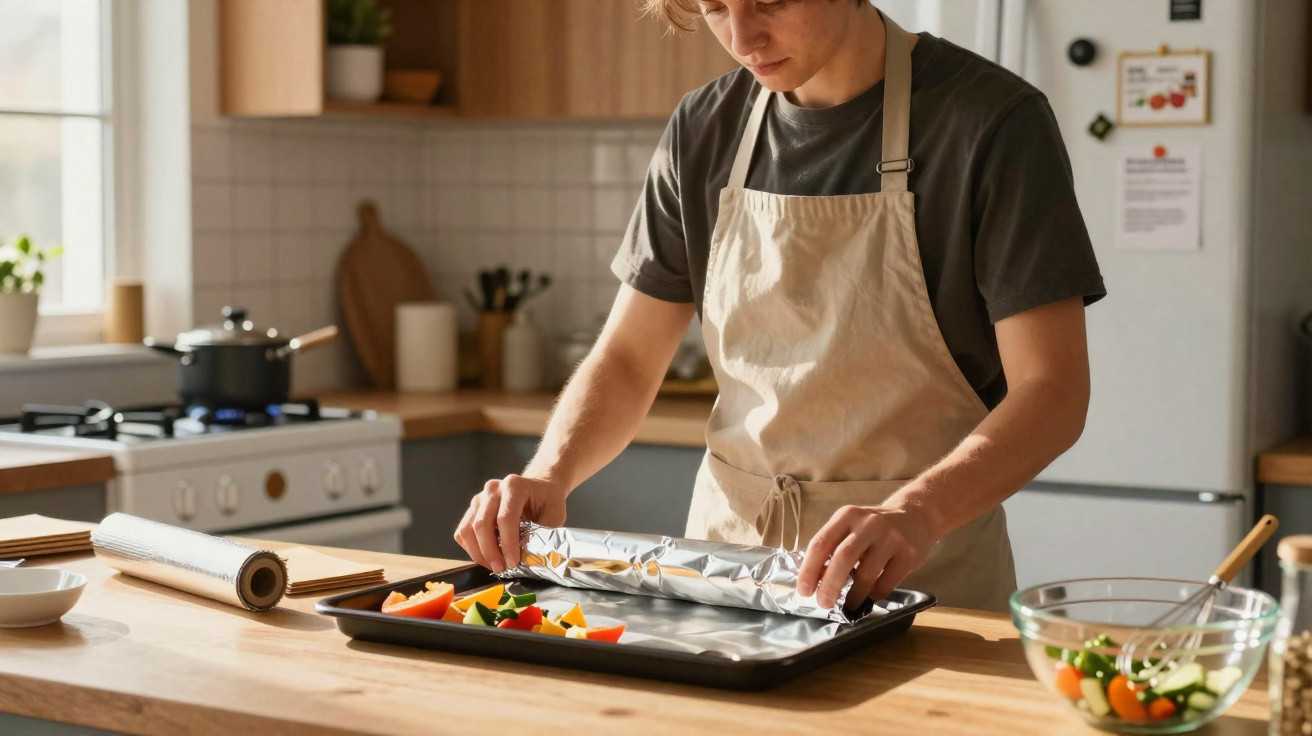
Almost every kitchen has a roll of aluminium foil within easy reach. You tear off a sheet in seconds, cover a casserole, wrap a packed lunch, or seal up a fish parcel for the oven. Then the same irritating question comes up again: should the shiny side face inwards or outwards so food cooks “properly” or stays warm?
Shiny or dull: the manufacturers’ clear answer
Anyone hunting for the “correct” side quickly ends up in forums, comment threads, and spirited dinner-table debates. In reality, the answer is far more straightforward than most tips passed around by friends.
Brands such as Albal, and the company behind Reynolds Wrap, have been repeating the same message for years: on standard household aluminium foil, both sides are made from exactly the same material and conduct heat equally well. Foil is not a high-tech mirror; it is a thin layer of metal whose main job is to conduct heat rather than reflect it.
Materials researchers back this up. What matters for heat transfer is aluminium itself, not whether the surface looks shiny or matte. Whether the reflective-looking side faces inwards or outwards changes the temperature inside a roast only marginally-so little that you would not notice it in a normal home kitchen.
"For everyday use at home, it makes hardly any difference for cooking and keeping food warm which side of the aluminium foil is against the food."
Why aluminium foil has two different-looking sides at all
The two-tone appearance exists for manufacturing reasons, not because one side “cooks better”. It is simply a by-product of industrial production. Right at the end, two sheets are rolled at the same time to make them extremely thin. The sides that press directly against the rollers are smoothed more strongly and come out looking glossy. The two inner faces rub against each other, remain slightly rougher, and therefore look duller.
Once the foil is wound onto a roll, the two sides differ only in appearance. Thickness, composition, and heat conduction remain identical. In a typical domestic oven-usually running between 160 and 220 °C-the influence of a slightly more reflective surface is so small that it effectively disappears in day-to-day cooking.
What physics has to say about it
When you cook with aluminium foil, three effects are relevant:
- Heat conduction through the metal itself
- Thermal radiation from the oven and heating elements
- Air exchange and moisture loss
Foil conducts heat very efficiently-regardless of which side faces in. It also acts as a barrier: it traps steam and hot air inside a parcel and helps prevent food drying out. That barrier effect is far more significant than the minor difference in reflectivity between the shiny and dull sides.
That is why a chicken covered in the oven with the shiny side facing out turns out virtually the same as one covered with the dull side on the outside. Any difference would, at best, show up on specialist measuring equipment-not to the naked eye or on the palate.
The real exception: non-stick aluminium foil
There is one important case where orientation genuinely does matter: non-stick aluminium foil. With these products, only one side has a special coating designed to prevent sticking-for instance with fish, cheese, or marinated meat.
The packaging normally states clearly which side is coated. Often that surface looks duller or slightly textured. Only the coated side should be placed directly against the food. Otherwise, the food can still stick despite the “non-stick” label, and the supposed benefit of the specialist foil is lost.
"Only with non-stick foil does the orientation have a real purpose-the coated side must always face inwards towards the food."
When aluminium foil can become a problem
There is another area where it pays to look more closely: safety and health. Small amounts of aluminium can transfer from foil into food, particularly under certain conditions. This is not about panic; it is about a few sensible ground rules.
These are considered especially critical:
- Very salty foods (e.g. brine, heavily salted fish)
- Acidic foods such as tomatoes, lemons, and vinegar-based marinades
- Long contact times, such as several days in the fridge
- High temperatures in combination with acid or salt
In these situations, more aluminium can dissolve out of the foil and migrate into the food. Many people will not taste it immediately, but a faint metallic aftertaste can sometimes occur.
How to use aluminium foil sensibly in the kitchen
If you follow a few simple rules, you can keep using aluminium foil without fuss-without overthinking whether it should be shiny or dull.
Suitable uses include, for example:
- Covering casseroles and roasts in the oven so the top does not burn
- Making parcels for fish or vegetables to keep them moist
- Protecting baking trays from dripping fat, as long as the foil does not touch the heating elements
- Briefly covering leftovers in the fridge, for around one or two days
Aluminium foil is less suitable for:
- Longer storage of strongly acidic foods such as tomato sauce or cucumber salad with lots of vinegar
- Lining the bottom of the oven directly-this creates a fire risk and restricts air circulation
- Contact with very salty marinades at high temperatures
Alternative materials and smart combinations
If you want to cut down on aluminium foil, there are now several practical alternatives. Lidded glass containers are excellent for storing food in the fridge. Reusable baking liners or baking mats can replace foil on trays. For certain oven dishes, baking paper is enough as a protective layer.
In some situations, combining options makes sense: for example, a lidded roasting tin can do most of the work during cooking, while a small strip of aluminium foil only covers a few exposed spots that would otherwise brown too quickly. This reduces direct contact between foil and food and saves material.
Misconceptions about shine, heat and cooking time
Many myths come from applying professional or industrial ideas to the home kitchen in the wrong way. In industrial settings or at very high temperatures, the reflectivity of metal surfaces can matter-for instance in specialist insulation materials. A standard domestic oven does not reach those conditions.
For a dish to turn out well, factors like these are far more important:
- Oven temperature
- Thickness of the meat joint or vegetable pieces
- Length of cooking time
- Moisture levels inside the dish or parcel
Paying attention to these points will deliver reliable results far more often than endlessly worrying about which way round the foil should go.
Practical rules of thumb for everyday use
For the next time you reach for the roll, a quick memory aid is enough:
- Standard aluminium foil: the side does not matter-use whichever feels more convenient.
- Non-stick foil: always place the coated side against the food, as stated on the pack.
- Very acidic or heavily salted foods: choose glass, porcelain, or plastic containers instead.
- Long storage: for extended time in the fridge, switch to other containers.
Keeping these simple points in mind avoids drawn-out debates about shiny versus dull-and lets you focus again on what really matters at the hob: flavour, doneness, and relaxed cooking.

Comments
No comments yet. Be the first to comment!
Leave a Comment