
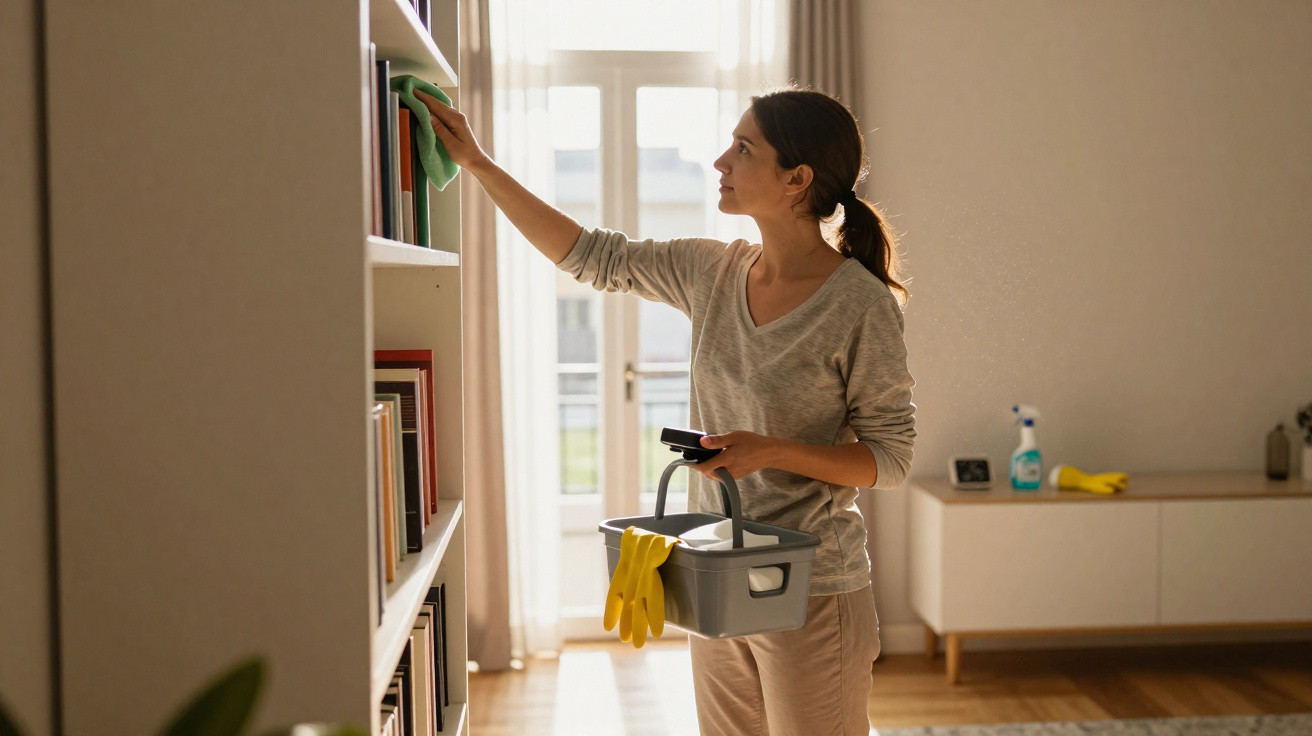
I had been cleaning for an hour, darting from crumbs to cobwebs, yet the room still had a weary look. My friend Ria, who makes her living cleaning holiday lets, arrived with a composure that almost seemed cheeky. She set down her caddy as carefully as a sommelier laying out a tray, took in the scene, and smiled at the disorder I had assembled: bottles of spray on the stairs, a partly hoovered rug and smears across the mirror. There was no judgement. She simply began at the ceiling. Ten minutes later, I understood that she was not cleaning more quickly than I was. She was making one deliberate journey through the room. That changes everything.
The morning I shadowed a professional cleaner
Ria wears black trainers with a navy sweatshirt bearing “Good Work” on one sleeve. It sums up her entire approach. She walks into a room silently and scans it as though it were a map: where the daylight falls, where dust collects and which way leads to the nearest exit. She does not begin with the thing that irritates her most. She starts with the task that will prevent the rest of the room becoming dirty again.
She explained the order to me with the patience of someone who has trained partners, teenagers and landlords. No hurrying. No fussing. She swept once along the top of the curtain pole, and the first faint cloud of grit floated down through a shaft of grey light. The room revealed what should happen next, and Ria paid attention. That was unfamiliar to me.
The cleaning sequence in one sentence
I asked whether she followed any rules. She laughed. “Rules, no. A few little promises.” Work from top to bottom, dry to wet and clean to dirty. Keep travelling in one direction, so you do not tread your own footprints back over the floor. Do not use a flamethrower when a cup of water will solve the problem. Ria gave a shrug, as if it were self-evident, and continued.
Begin high, end low, and travel forwards only once. That is the whole outline. Dust before spraying; spray before wiping; wipe before hoovering; hoover before mopping; then mop as you head out. When you interrupt the order to tackle something prematurely, the room charges you interest. Dust lands again on newly cleaned surfaces, or your socks stick to tiled floors. The sequence is a modest form of respect that stops you battling your own efforts.
Why the doorway is the wrong place to begin
Most of us pause in the doorway, take in the mess and start exactly there. It seems sensible: tidy the part in view, then work towards the middle. The professional method reverses that. Start at the spot furthest from the exit, then work your way towards it. Your future self will not need to cross the areas they have already cleaned.
I tested it in my bedroom, and for the first minute it felt unnatural, rather like writing with my non-dominant hand. Then it made sense. When I reached the door, the floor was the only remaining untouched surface and I already had the mop in hand. No footprints caught in the room. No faint wet outline surrounding the rug. Just cleanliness, followed by the pleasing click of the door closing behind me.
Dust drifts and time costs money
Touch a high surface and it releases dust into the air, like a deflating balloon. Those particles can take several minutes to settle. Wipe the coffee table first and you will need to wipe it again. Professionals cannot afford to do a job twice. They clean in a way that turns gravity into an assistant rather than an enemy, building in a brief settling period without truly pausing.
Ria calls this her “drift window”. After dusting tops and frames, she spends 30 seconds replacing bin liners and arranging soft furnishings while the airborne particles fall. That small interval means that, when she returns to wipe the surfaces, it is not a practice run. It is the real thing. You can sense it in the room’s rhythm: the air clears, surfaces are prepared and the cloth glides rather than catches.
The cleaning trolley is a route map, not a cupboard
Here is a trick worth borrowing, even in a studio flat: the way you carry your supplies is part of the routine. Ria arranges her caddy from left to right according to when she will need each item. Her duster and dry cloths sit on the left, sprays are placed in the middle, and wet cloths are kept in a small lidded tub on the right. Bags and gloves clip onto the outside like a belt. There is no searching and no unexplained stickiness.
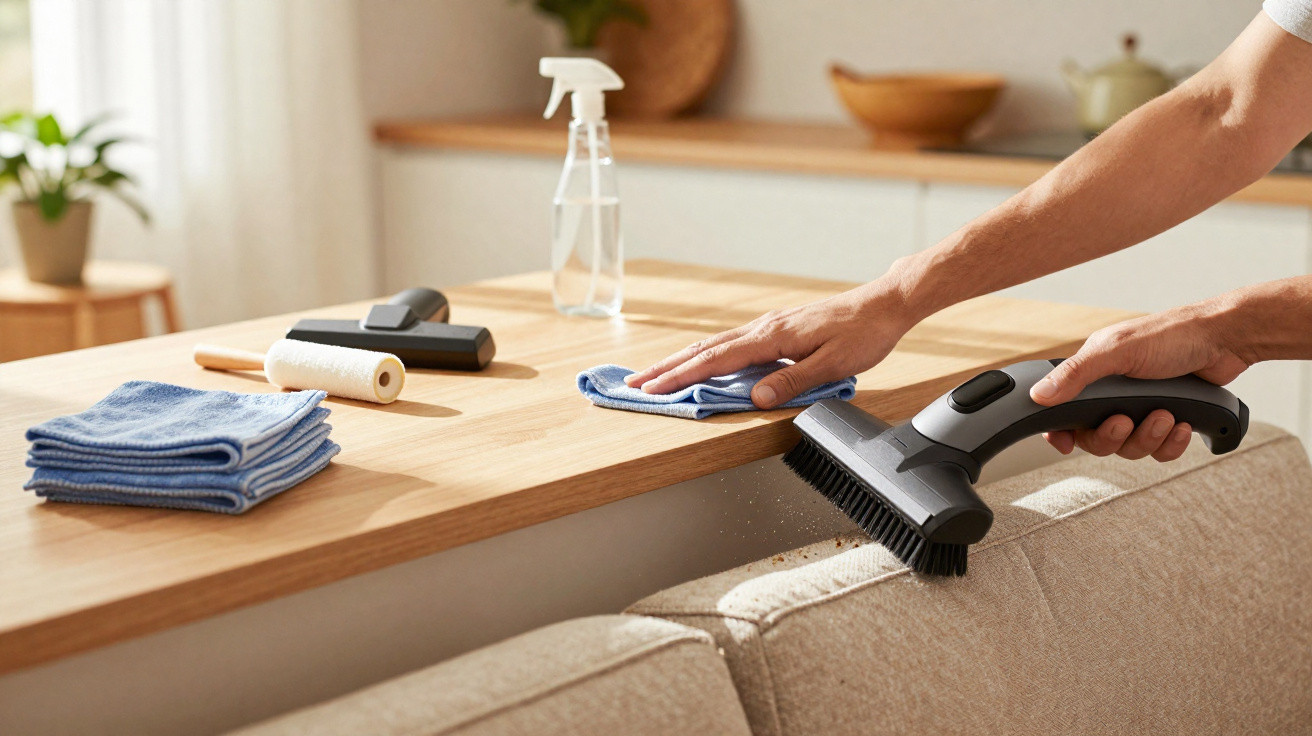
Colour-coded cloths are not pretension; they act as safeguards. Blue is for glass and mirrors, green for kitchen surfaces, red for toilets and yellow for general tasks. This prevents cross-contamination, but it also removes uncertainty. You do not pause to ask yourself, “Is this the cloth for everything?” Your hand already knows. The caddy works as a quiet checklist, carrying you onwards without any fuss.
Bathrooms last, kitchens nearly last
If there is one place where this order protects your sanity, it is here. Kitchens create grease and crumbs, while bathrooms create bacteria. You cannot treat them as the same thing. Begin with rooms carrying the lowest risk of cross-contamination. Leave spaces that splash and splatter until the cloths and mop are ready for their final task.
Bathrooms are always last. Ria said it with the warmth of someone who had repeated the instruction thousands of times through a mask. Kitchen surfaces can be tackled earlier if that gives a degreaser time to work, but you never clean the loo and then return to folding laundry. That is not efficient; it is roulette. Once you have used the red cloth, you do not go back.
Five passes that stop you backtracking
Spend a few minutes watching any professional and the pattern becomes clear. The first pass is for resetting and rubbish. Remove anything that does not belong, empty and reline the bins, and strip or straighten beds. This makes the room manageable and removes the small obstacles that would delay you later.
The second pass deals with high dust and vents. The third covers surfaces, details, handles, edges and switches. The fourth is for hoovering edges and floors: start with skirting boards and radiators, then tackle the rug and finally the centre. The fifth pass is mopping out of the room, leaving a tidy route to the exit. Dry work first, wet work last. The reasoning is obvious when you hear it, and you feel it beneath your feet when you do not squeak back over what you have just finished perfectly.
Small rituals that protect your back
There is plenty of muscle memory behind this approach. Ria folds a microfibre cloth into quarters, giving herself eight clean surfaces from one cloth. She sprays the cloth rather than the mirror, avoiding mist that settles where it should not. She moves furniture by its base, never its top. And she puts every bottle down with its label facing the same direction. It sounds fussy until you notice how much faster it is to reach for the right product.
On glass, she uses S-shaped strokes to avoid the rainbow smears that only appear once sunlight shifts. She works with both hands easily: one hand pulls objects forwards while the other wipes behind them. The hoover cable is draped over her shoulder, so it cannot catch on chair legs. These small habits save minutes and prevent aches. They are not elaborate; they are kindness presented as technique.
The sound of a properly cleaned home
A good clean has its own soundtrack: the muted whirr of the hoover, shoes softly crossing dry floors and a cloth gently squeaking through the final trace of suds. Every so often there is the click of a spray trigger, hot water glugging into a bucket or bottles clinking back into the caddy. The home starts to smell less of “products” and more of fresh air; lemon initially, then nothing at all.
A window opens a fraction, and the room seems to breathe. A chair moves an inch to centre a rug again. A duvet is fluffed, settling in a little fall of feathers. None of these are dramatic actions. They are the punctuation in a sentence your home already understood.
What amateurs get wrong and how to put it right
We have all experienced cleaning the kitchen, turning round and finding that it somehow looks worse. That is what happens when the sequence is ignored. We begin with the shiny area because it offers instant satisfaction, only to find that the corners have been working against us all along. We apply too much product, so the cloth pushes a thick slippery layer around the room. We wring it out once and decide that is sufficient.
Honestly, nobody does every part of this daily. You do not need to. Pick a route through your home and make it your standard routine. Dry-dust before reaching for anything wet. Let spray cleaners soften grime for a minute while you empty bins or arrange cushions. Rinse the mop head more often than seems necessary. “Clean water cleans,” Ria said, and I could feel the truth of it in my bones.
The 20-minute room routine worth borrowing
This single-room version transformed my Tuesdays. Minutes 1–3: open the window slightly, remove the bin bag, collect cups and reset soft furnishings. Minutes 4–6: dust high surfaces, including frame tops, blinds, lampshades and skirting-board ledges. Minutes 7–10: lightly spray surfaces and handles, then leave the cleaner to sit while you return objects to their proper places. The product is loosening invisible dirt, meaning you do not have to scrub like a cartoon character.
Minutes 11–14: wipe surfaces in a purposeful pattern, travelling from the furthest corner towards the door and turning the cloth as it becomes loaded. Finish cupboards and handles for that satisfyingly quick shine. Minutes 15–18: hoover the edges first and then the middle, winding the cable neatly as you go. Minutes 19–20: mop your way out in small figure-of-eight movements, rinsing once if the water turns grey. Close the door. Pause there and hear the quiet you have created.
Small changes that make cleaning faster
Choose a flat mop rather than a string mop for anything other than a spill. Keep a kneeling pad or folded towel for skirting boards, so you genuinely clean them. Carry a razor scraper for paint splashes on glass and a toothbrush for taps; store both in a zip bag so they do not mix with tea towels. Decant heavy products into smaller bottles. Your wrists will appreciate it, as will your patience.
When the cleaning sequence should be broken
Some days call for a different order. If a pet has had an accident on the hallway rug, contain it immediately. If there is a sticky spill beneath the table that will attach your shoes to the floor, remove it before dusting so you are not walking through it. When something is spreading, stop it from spreading first. Then return to the rhythm you know.
Ria told me that she only changes the order for dwell time or emergencies. Ovens and showers may need to soak while she cleans a bedroom. A time-sensitive stain gets first aid straight away. But as soon as possible, she returns to the main line of the sequence, because that is what prevents the morning descending into chaos. Consistency is the unglamorous magic.
The truth inside a tidy home
I expected efficiency to feel rushed and impersonal. Instead, it felt generous towards my future self. The work stopped pushing back. Surfaces no longer returned dirt like a boomerang. The house appeared to notice and relax, and there was a short moment when even the cat chose not to climb onto the freshly revived duvet.
My hands became slower, and then the room seemed to slow with them. That is the odd reward of following the right order: you find a pocket of quiet at the end. It is not perfection. It is a small, kind truce with the place where you live. Once you have experienced it, you will want it again-not by trying harder, but by timing things better.
The sentence to put on a Post-it note
I asked Ria what she would write above a sink if she could leave one line in every home. She answered immediately. “One pass, no backtracking.” That is all. It addresses the urge to spot-clean in the wrong order, the habit of walking back through wet floors and the temptation to polish a mirror before the dust has settled.
There is nothing smug about that sentence. It is simply a promise. You do not need to be a professional to borrow a professional route. You can still be a person with a busy life and a pile of laundry. Yet if you allow the sequence to do some of the thinking, cleaning stops sprawling and begins to reach an end. That may be the most grown-up feeling of all.

Comments
No comments yet. Be the first to comment!
Leave a Comment