
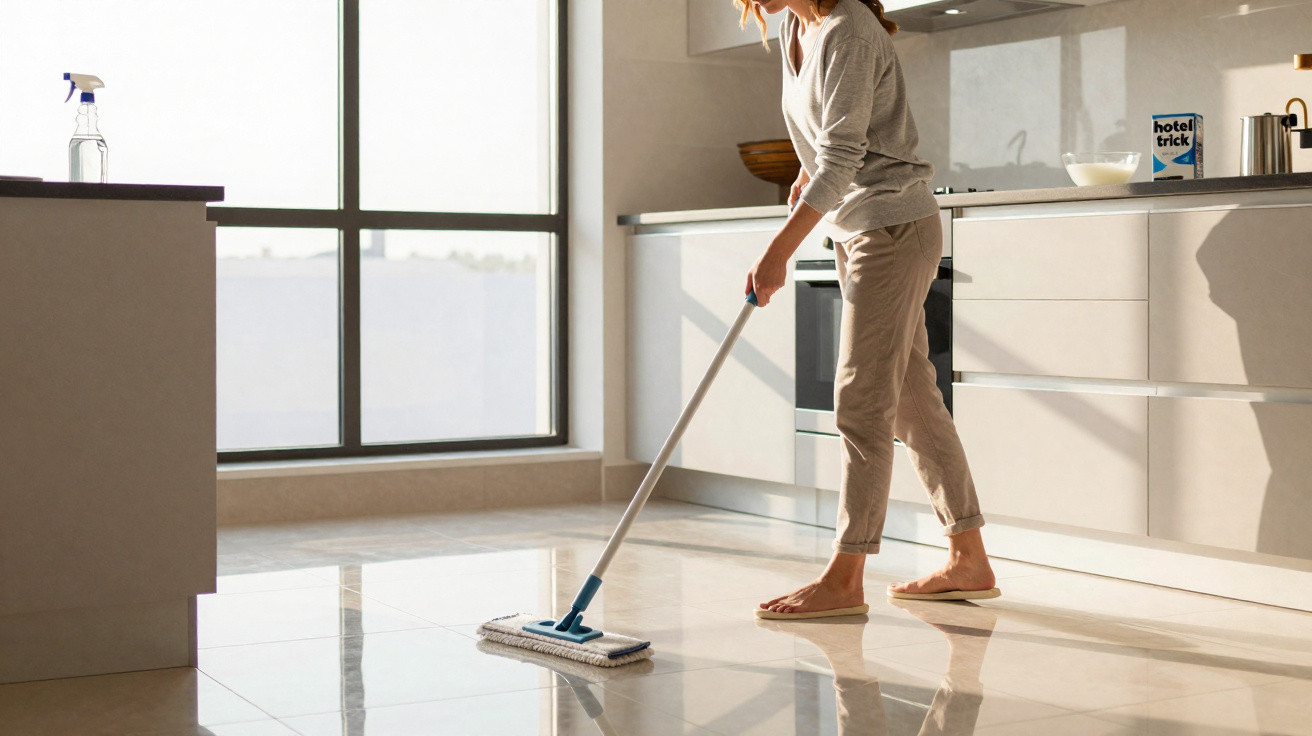
When guests leave a hotel, they rarely remember the cleaning products – but they do remember that reflective floor in the lobby.
It is precisely this understated detail that creates the memorable “wow” moment. Yet it often comes not from costly professional-grade containers, but from a surprisingly simple routine that works in an ordinary kitchen too.
Why hotel floors always look newly laid
The moment you check into a good hotel, you notice it: the floor shines without looking greasy. There are no streaks and no dull patches. Most guests assume this is down to specialist polishes, secret brands or expensive machinery. Hotel-industry professionals paint a different picture: the shine is primarily the result of a system, rather than luxury chemicals.
The crucial difference comes down to three factors: preparation, correct product dosage and consistent maintenance. These same principles are remarkably easy to recreate at home, even on a heavily used kitchen floor.
Hotel cleaning relies on mild products, a clear sequence and consistent repetition rather than “miracle products” from advertising.
The professional principle: deep-clean first, then maintain
Before a floor can shine, it needs to be genuinely clean. Not merely “looks clean”, but free from greasy residue, old cleaning-product deposits and fine dust. Over time, many homes accumulate layers from harsh all-purpose cleaners, fabric-softener splashes and kitchen grease. This coating absorbs light, no matter how much shine-enhancing product is poured over it.
Step 1: Remove invisible residue
Professionals begin in a surprisingly matter-of-fact way: with hot water, a neutral cleaner and patience. In many hotels, the rule is to use less chemistry but mop more often.
- Fill a bucket with very hot water.
- Add a splash of mild, pH-neutral cleaner, without any promise of shine.
- Work section by section with a thoroughly wrung-out mop.
- Change the water as soon as it becomes visibly cloudy.
When starting at home, allow for at least two to three passes. The first pass loosens the old film, while the second and third gradually remove it. Only when the floor looks even while wet is it worth focusing on shine.
Step 2: The hotel trick using household ingredients
Many establishments use a mixture for hard-wearing floors that is made from items most people already have in the cupboard: warm water, a little vinegar, and a hint of oil or alcohol. The proportions matter more than the ingredients themselves.
Shine develops when the floor can breathe freely – a thin, barely visible care film is entirely sufficient.
| Ingredient | Purpose | Note |
|---|---|---|
| Warm water | Loosens dirt and distributes the mixture | As warm as remains comfortable for your hand |
| Vinegar or citric acid (very little!) | Removes limescale and old residue | Not suitable for natural stone or delicate marble |
| A splash of alcohol, such as clear household alcohol | Degreases and helps the floor dry without streaks | Ventilate well and keep away from flames |
| A hint of neutral oil, such as a few drops of vegetable oil | Creates a light care film that reflects light | Use extremely sparingly, otherwise the floor will feel greasy |
For many kitchens, a bucket containing warm water, a dash of vinegar cleaner and one tablespoon of alcohol is enough. If you have hard-wearing tile or vinyl flooring, you can also add two to three drops of oil to the mop rather than to the whole bucket. This gives you better control over the amount used.
The right technique: how a floor really starts to reflect
Professionals do not simply give the floor a quick wipe. Their technique determines whether light reflects evenly or catches in streaks.
Mop rather than cloth, zigzags rather than circles
In hotels, you will mostly see flat mops with wide pads. They cover a large area and spread liquid evenly. The same approach works at home. An old cloth is more likely to push dirt around.
- Wring the mop out thoroughly – the floor should be dampened, not flooded.
- Mop in long strokes from the far end of the room towards the door.
- Overlap each stroke slightly to prevent streaks.
- Never scrub in small circles, as this creates dull patches.
The floor will not look particularly impressive while wet. The key moment comes as it dries: when light falls in from the side, you can see whether the layer has become even. In hotels, staff often check this shortly before their shift ends; at home, a glance while having a coffee is enough.
Why my kitchen suddenly looked like a hotel corridor
A trial of this method revealed a striking effect. After two thorough cleaning rounds and one pass with the mild “hotel mixture”, the kitchen light was clearly reflected in the floor. It was not a plastic-looking gloss, but the clear, calm sheen familiar to many people from hotel corridors.
The visible shine did not come from “more product”, but from less residue and precisely measured care.
The comparison was revealing: on one side of the room, an area had been mopped only with a standard all-purpose cleaner. It looked clean, but dull. On the other side, chair legs and window frames were visibly reflected in the flooring.
Which floors benefit – and where caution matters
Not every floor can tolerate every method. Professionals adapt their approach to the material and surface finish. Anyone experimenting at home should know their flooring type, or at least test the method in an inconspicuous area.
Tiles, vinyl, laminate: major results with minor adjustments
Ceramic tiles and modern vinyl floors respond particularly well to the routine described above. They are relatively robust and tolerate mildly acidic cleaners in low concentrations. Laminate needs a little more care: too much water can seep into the joins, so a very thoroughly wrung-out mop is essential.
- Tiles: a slightly higher vinegar proportion is possible, but keep the oil content low.
- Vinyl: use a mild mixture with a reduced alcohol proportion.
- Laminate: use barely any vinegar, mop almost dry and do not use an oil film.
Wood, parquet and natural stone: where a professional is genuinely needed
Sensitive floors, including oiled parquet and limestone, can react quickly to unsuitable products. Hotels use specialist care oils or stone soaps for these surfaces, often in precisely calculated doses. If you have such flooring at home, follow the manufacturer’s recommendations. Vinegar, citric acid and alcohol can leave permanent marks here.
However, the same core principle still applies: gentle, well-matched care in the right order is preferable to aggressively going over the surface with strong cleaners.
How often does a floor really need this treatment?
In hotels, the schedule depends on footfall. Lobby floors are mopped every day, sometimes several times a day. Corridors often follow a planned cycle of deep cleaning, light maintenance and targeted touch-ups. At home, kitchen flooring rarely needs this frequency.
If you cook, bake and have children bringing muddy shoes into the house, this simple rule of thumb works well:
- Sweep or vacuum daily or every other day.
- Mop once or twice a week with a mild cleaner.
- Every two to four weeks, carry out a “hotel pass” with thorough preparation and light care.
This keeps the shine in place without having to start from scratch every time. The floor does not build up a fresh dirt film that then needs laborious removal.
Risks, myths and what hotel professionals clearly avoid
Many households reach for strongly scented products in the hope that they will deliver greater cleanliness. Hotel professionals often say the opposite: an intense fragrance does not automatically mean better cleaning, but often means more residue left on the surface.
Too much cleaner in the water causes streaks, sticky surfaces and a greasy shine that magically attracts every speck of dust.
Another risk is online trends promoting pure cooking oil or fabric softener as a “miracle shine” solution. The floor may indeed look reflective in the short term, but over the medium and long term, a slippery coating forms. This can increase the risk of falls and is difficult to remove.
This is why hotel cleaning staff pay close attention to concentrations. Many cleaning trolleys display small mixing instructions: one capful, two capfuls, no more than one splash. You can apply this approach at home by writing down your own exact bucket mixture once.
What really lies behind the “hotel shine”
The effect seen in a lobby or along a glossy hotel corridor is based less on secret chemistry than on a straightforward logic: a clean base, gentle care, controlled moisture and even distribution. Anyone applying this logic in their kitchen can achieve a floor that visibly reflects light.
It becomes interesting in day-to-day life because a reflective floor makes crumbs and marks easier to spot. At first glance, that may seem like a disadvantage. In practice, it means dirt does not remain unnoticed for days. The home genuinely stays cleaner because small interruptions in the shine are immediately visible.
Once you have followed the method through, you quickly notice a psychological effect. The room appears tidier, even though only the floor has been treated differently. Kitchen units, chairs and even old tiles stand out more attractively when the surface beneath them reflects light rather than absorbing it.
That is exactly what makes the “hotel trick” so appealing in everyday life: no new cleaner and no polishing machine, just a different approach to the order of each step. Anyone prepared to do two or three thorough rounds can create at home an effect once largely reserved for hotel corridors.

Comments
No comments yet. Be the first to comment!
Leave a Comment