
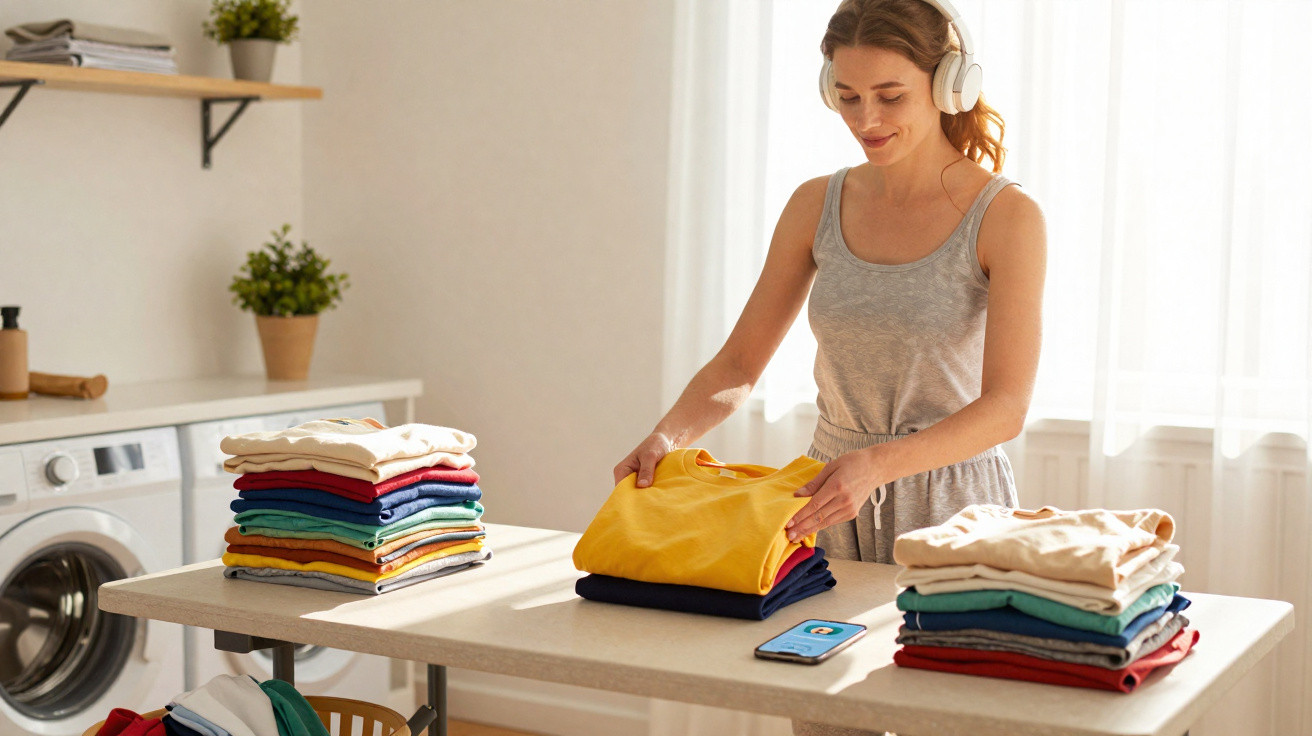
There is a peculiar sort of magic in the laundry room. At first, you are faced with a heap of T-shirts and odd socks; moments later, you are wearing headphones, following a crime thriller at double speed, while your hands work almost on their own. The basket gets lighter, the chapters race ahead, and a job you would normally avoid no longer seems like a job at all.
The mound of clothes gradually disappears. The audiobook's time stamp leaps ahead in satisfyingly large increments.
Somewhere in your mind, something quietly clicks: “Wait, that felt… good.”
Why double-speed stories turn boring laundry into a mini dopamine rush
Laundry normally belongs in life's “low brain, low joy” category. Your hands have something to do, your mind is under-stimulated, and time stretches out like an endless fitted sheet you are attempting to fold by yourself. Playing an audiobook at normal speed makes things slightly better, but it can still drag. The story unfolds slowly, your thoughts drift, and you keep looking to see how long remains in the chapter.
Switch to 1.5x or 2x, however, and the experience changes. All at once, the pace of the story seems to line up with the pace of your hands.
Imagine a Sunday evening, with a laundry basket crammed full of a week's worth of everyday life: gym tops, school uniforms, and that one shirt you are certain you have never seen before. You start your audiobook, set it to double speed, and begin separating everything: whites, colours and towels; shirts, socks and underwear.
When you fold the final towel, your player says you have listened to 45 minutes of a book… in just over 20. You have not scrolled on your phone. You have not fixated on how dull the laundry is. Instead, you look at the tidy stacks and feel unexpectedly accomplished. It is not an illusion: your brain is rewarding you for converting dead time into progress on two fronts at once.
The process happening in the background is remarkably straightforward. Folding clothes occupies your hands and requires enough attention to avoid mistakes, but it does not demand deep concentration. Audiobooks, particularly at standard speed, may feel slow beside the rate at which your eyes and mind prefer to take in information. Double speed creates a cognitive zone that feels “just right”.
Your body takes care of the repetitive work while your brain remains involved, following a quick plot or a dense concept. The chore is no longer empty waiting time; it becomes the setting for a brief mental sprint. That dual progress is what makes the whole thing feel faster and more rewarding than it actually is.
How to turn your laundry sessions into surprisingly satisfying listening rituals
Begin by selecting a book that suits your energy on laundry day. When you are tired, choose something easy-going, such as memoirs, humour or cosy mysteries. If you feel full of energy, a twisty thriller or incisive non-fiction can be a good fit. Then test different playback speeds. You can go straight to 2x if that appeals, although 1.5x initially feels more natural for many people.
Try that speed for one complete load of laundry before deciding whether it works. Your brain adjusts quickly, and by the fifth T-shirt you fold, the accelerated voices can start sounding entirely normal.
One understated pitfall is turning the whole thing into the “productivity Olympics”. You put in one earbud, queue three podcasts, tackle the laundry, washing-up and emails, all at 2x, and end up feeling more drained than pleased. You are not doing it wrong on days when you fold in silence or listen at standard speed.
Let’s be honest: nobody really does this every single day.
The key is to regard double-speed audiobooks as a tool rather than a rule. Use them when restless boredom starts creeping in, rather than when your mind is already asking for a rest.
Sometimes, speeding up the audio isn’t about cramming more into your day. It’s about giving your mind something genuinely engaging to chew on, so your hands can glide through the dull stuff without complaint.
- Choose a genre that suits your mood: Quick fiction or conversational non-fiction generally works best at double speed while doing chores.
- Find your ideal speed: Increase gradually, moving from 1.25x to 1.5x and then 1.75x or 2x, rather than immediately choosing the highest setting.
- Reserve a particular book for laundry time: This modest ritual gives your brain a prompt: basket out, story on, hands moving.
- Keep your phone beyond reach: This limits the temptation to pause, scroll or wander away from both the story and the laundry.
- Stop when your mind feels overloaded: Audio should not feel pressurised; it should feel like a pleasant soundtrack to an otherwise uninteresting task.
Why this tiny habit quietly changes how you feel about your whole day
This pairing works for so many people for more than the fact that the washing gets finished sooner. It creates the quiet sense that you have “won” a part of the day that would normally seem wasted. Time previously dismissed as dull can suddenly count as reading time. That can matter when you already feel as though you are pursuing everything yet completing nothing.
You may begin to notice other opportunities too: waiting in the car, wiping down the kitchen worktop or matching socks. These are small pockets of time in which a double-speed story can change restless fidgeting into a minor reward.
| Key point | Detail | Value for the reader |
|---|---|---|
| Combining tasks alters your sense of time | Fast audio alongside uncomplicated manual work makes the chore seem shorter | Less reluctance before beginning the laundry and a greater feeling of flow |
| Double speed strengthens the sense of progress | You move through chapters and shirts simultaneously | A more powerful feeling of achievement from everyday routines |
| A ritual makes chores feel like “me-time” | Linking particular audiobooks with folding forms a mini-ritual | Changes an obligation into a small personal reward |
FAQ:
- Question 1 Is listening at double speed bad for comprehension?
- Answer 1 Most people adjust rapidly and can still follow the story perfectly well, particularly with conversational narrators or fiction. If you repeatedly find yourself rewinding, reduce it to 1.5x-there’s no prize for suffering through 2x if your brain can’t keep up.
- Question 2 What if I find the voices at 2x distracting or annoying?
- Answer 2 Certain narrators become chipmunky at faster speeds, while others remain remarkably clear. Experiment with different books and speeds, or raise the speed in small increments. If your app offers it, you can also adjust settings such as “pitch correction” to make voices sound more natural.
- Question 3 Can I use this trick with podcasts, not just audiobooks?
- Answer 3 Absolutely. Short, chatty podcasts can work even more effectively at 1.5–2x while doing chores. Take care with episodes that are packed with information, though: when you are stopping to make notes, it is no longer a background companion and becomes proper study time.
- Question 4 Is multitasking like this mentally draining in the long run?
- Answer 4 For most people, light multitasking-simple hands, engaged ears-is generally sustainable. If you finish the laundry feeling wired or tense rather than relaxed and satisfied, that is your signal to slow the audio down or do some loads with no sound at all.
- Question 5 What if I actually enjoy silence while doing chores?
- Answer 5 In that case, keep the silence. This is not a rule you “should” follow, only a tool for times when laundry feels like dead time. On some days your brain may want a fast-moving story; on others, it may prefer the gentle thump of folded towels and nothing more.






Comments
No comments yet. Be the first to comment!
Leave a Comment