

Cheap and easy to find, white vinegar is giving blue window-cleaning sprays serious competition.
As household costs rise, a cupboard staple is making a comeback. Families say it leaves windows clear quickly, without harsh smells or unnecessary packaging.
A tip passed down through generations
The revival of straightforward recipes is far more than a passing trend. Many households say they have retained a habit learned from parents or grandparents: cleaning windows with white vinegar. The practice has been passed on, adapted to modern surfaces, and spread through social media and home-help groups. Its appeal lies in combining effective cleaning, a low cost and a limited impact on indoor air.
“A bottle for less than one euro, water and a cloth: the promise of transparent windows without scented residue or propellant gas.”
From a chemistry perspective, diluted acetic acid breaks down limescale, lifts greasy film and evaporates rapidly, helping to minimise smears. As there is no polishing agent, it does not leave behind a coating that attracts dust and fingerprints. On lightly soiled glass, this mechanical and chemical action is enough, particularly when used with the right cloth.
Precise method for cleaning windows with white vinegar
Ratios and equipment
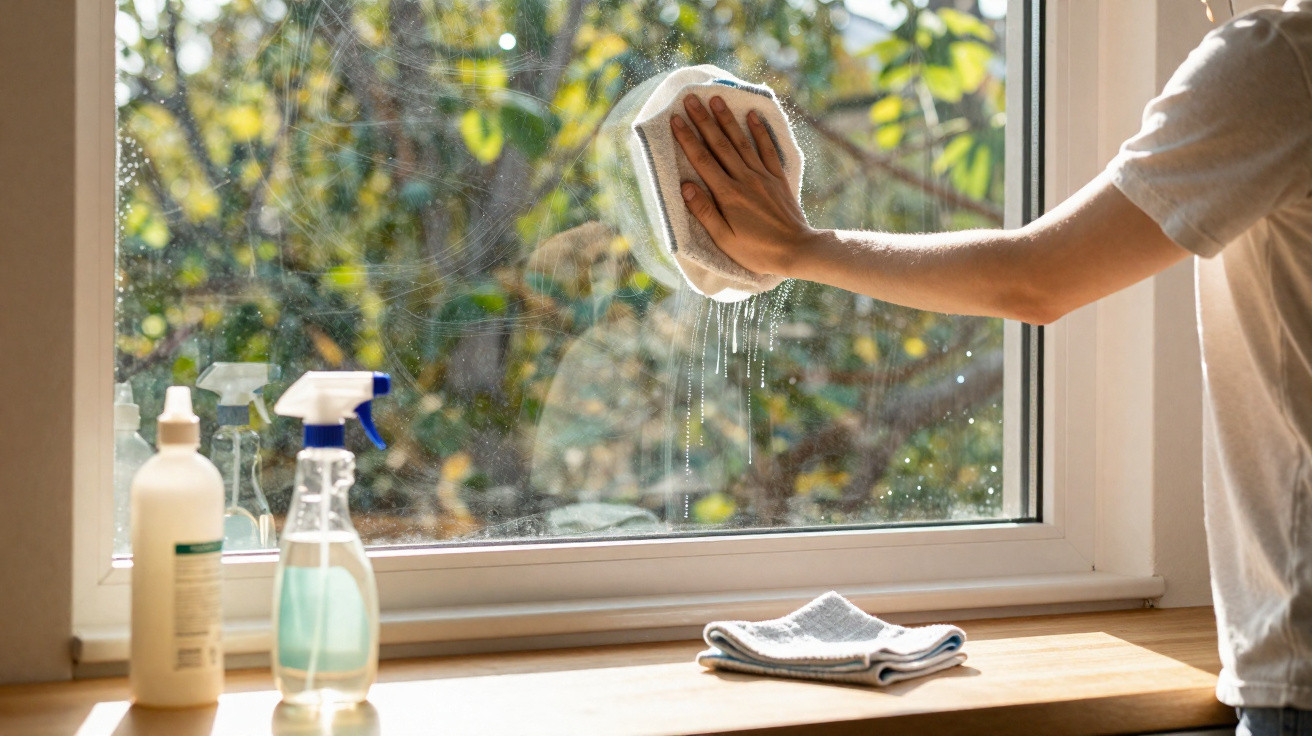
Start with an equal-parts mixture: 1 part white vinegar (8% acetic acid) to 1 part water. In hard-water areas, using 2 parts demineralised water to 1 part vinegar produces a better finish. Pour the mixture into a clean spray bottle.
- A graduated spray bottle, rinsed with hot water before use
- Demineralised water if your tap water leaves deposits
- A tightly woven microfibre cloth or newspaper without greasy inks
- A window squeegee for large glazed areas
“Anti-streak tip: indoors, finish with vertical strokes; outdoors, use horizontal strokes. Crossing the directions exposes even the smallest flaw.”
Technique and conditions
Clean from top to bottom. Apply a fine mist, leave it for 30 seconds where mineral deposits are present, then wipe in broad Z-shaped movements without going back over dry areas. For very greasy surfaces, such as kitchen windows, add a tiny drop of neutral washing-up liquid. Wipe it off, then finish with a light mist of the vinegar solution.
Do not clean in full sun, as overly fast evaporation sets the marks in place. In cold weather, use less solution to prevent drips. Pay particular attention to the edges and lower rail, where water tends to collect and leave marks.
Cost comparison and what you avoid
The price difference is substantial. One litre of white vinegar costs between €0.40 and €0.90. A shop-bought window cleaner ranges from €2.50 to €4.50 for 500 ml. For the same area, annual savings can exceed 70%, while reducing the number of bottles thrown away.
| Product | Price per litre | Amount per session (10 m²) | Estimated cost per session | Notes |
|---|---|---|---|---|
| White vinegar + water | €0.40 to €0.90 | 150 ml of solution (75 ml of vinegar) | €0.03 to €0.07 | No fragrance, low VOCs |
| Standard window spray | €5.00 to €9.00 | 120 to 180 ml | €0.60 to €1.60 | Shining agents, fragrance, alcohol |
| Cleaning wipes | €12 to €20 (equivalent) | 6 to 10 wipes | €0.90 to €2.00 | Non-recyclable waste |
Where white vinegar works, and where not to use it
- Ideal for: windows, mirrors, glossy tiles, chrome door handles and tempered-glass shower screens.
- Avoid on: marble, limestone, travertine, unprotected polished concrete and polished calcareous surfaces.
- Use caution with: varnished wood, anodised aluminium and natural-rubber seals; test first on an inconspicuous area.
- Do not use on screens, including TVs and smartphones, or on windscreens with a recently applied water-repellent treatment.
“Never mix vinegar and bleach: contact between them releases irritating chlorine.”
Variations and additions for different situations
Kitchen marks and greasy film
For windows near a hob, add one drop of low-foaming washing-up liquid. Degrease using circular motions, then apply a light vinegar-and-water mist to remove remaining residue and restore shine.
Heavily scaled glass
Increase the vinegar concentration to a 2:1 water-to-vinegar ratio. Leave it on for 2 minutes, draw the squeegee across slowly, then dry the edges with a dry microfibre cloth. If deposits return quickly, switch to demineralised water for the dilution.
Anti-fog finish in the bathroom
For a mirror, work a drop of vegetable glycerine into a slightly damp microfibre cloth and buff the surface. The hydrophilic film delays misting. Do not use this method on glass exposed to rain.
Urban settings and fine dust
In towns and cities, soot and particles create a surface film. Dry-brush the frame and vacuum the tracks before spraying anything. This prevents a difficult-to-remove black sludge from forming and limits micro-scratches.
Safety and professional habits
- Ventilate the room during and after cleaning to clear the light acidic vapours.
- Wear gloves if your skin reacts to acidic products.
- Shield stone window ledges with a folded cloth.
- At height, use a telescopic pole and keep the step ladder stable; do not lean beyond the railing.
Common mistakes to avoid
- Cleaning in direct sunlight: instant evaporation and streaks are inevitable.
- Using too much product: excess solution leaves a film that streaks as it dries.
- Choosing fluffy cloths: fibres cling to corners and seals.
- Neglecting the edges: even a tiny remaining droplet shows up in raking light.
Checking the result and adjusting the method
Inspect the glass in angled light. Stand at a 45-degree angle to the window and scan from left to right. If you spot hazy patches, go over them with a dry cloth without adding more product. Persistent circular marks indicate too much solution, so reduce the amount sprayed. Straight lines point to a technique issue: reverse direction for the final pass.
“On lightly soiled windows, 2 parts water to 1 part vinegar are enough to restore crisp transparency.”
Beyond windows: several uses from the same bottle
White vinegar can descale a kettle and coffee machine (run a cycle with 50% water, then rinse twice), revive chrome taps, remove limescale from shower heads (tie a vinegar-filled bag around them for 1 hour), freshen the vegetable drawer, and soften laundry as a replacement for fabric conditioner (50 ml in the rinse compartment). Avoid it on technical textiles, which may lose their water-repellent finish.
Schedule, budget and impact: practical benchmarks
For a flat with 10 standard windows, two light cleans each month and one more thorough clean every quarter are sufficient in an urban environment. At 75 ml of vinegar per session, yearly use comes to around 2 litres, costing €1 to €2 depending on prices. Commercial sprays can easily exceed €20 to €35 at the same frequency, excluding refills.
This approach reduces fragrant compounds in indoor air, which is valued by sensitive people. In waste terms, one bottle reused throughout the year replaces several trigger-spray bottles. Bulk options cut plastic further while retaining consistent effectiveness over time: acetic acid does not degrade quickly when kept away from heat.
Going further: adapting the technique to your home
Living in a coastal area? Salt leaves a film, so give the glass a quick rinse with clean water before applying the vinegar mixture. Have a wood-burning stove? Soot can become embedded: pre-cleaning marked areas with methylated spirit may help, followed by the vinegar solution to polish the surface. Large south-facing glazed areas? Schedule cleaning early in the morning or late in the day, when side light reveals flaws more clearly and the solution dries less quickly.
One final useful point: the microfibre cloth matters as much as the formula. A dense 300 g/m² weave and a thoroughly rinsed cloth without fabric conditioner provide a clean wipe. Keep one cloth for applying the solution and another, completely dry one, for finishing the edges and handles. With this arrangement, results become more consistent, even when demanding raking light falls across the glass.



Comments
No comments yet. Be the first to comment!
Leave a Comment